
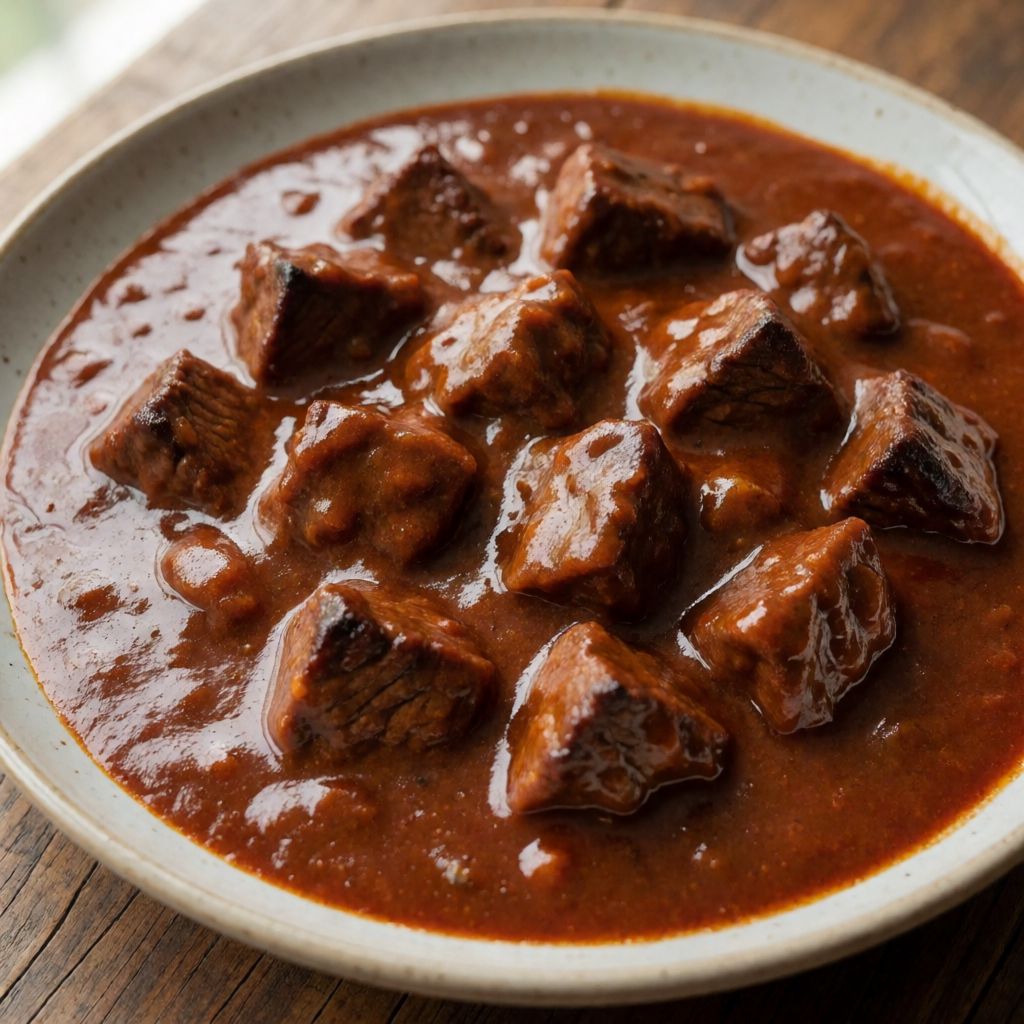
 AI photo
Dark Beer Beef Goulash
A hearty beef goulash slow-braised with dark beer, shallots and tomato, finished with a bouquet of sage and rosemary.
Labels are worked out automatically from the ingredients and can be wrong. Check the packaging if it matters to you.
Ingredients
- 800 g Beef
- 300 ml Dark beer
- Olive oil to taste
- Potato starch to taste
- 150 g Tomato passata
- 40 g Butter
- Paprika to taste
- Salt to taste
- Mixed dried herbs to taste
- Datterini tomatoes to taste
- 200 g Shallot
- 1 bunch Sage
- 1 bunch Rosemary








Steps
Pour a little olive oil into two frying pans.
Peel and chop the shallot, add it to one pan and fry with the butter.
Trim the beef of any sinew, cut into cubes, season with salt, coat in potato starch and fry in the second pan, generously sprinkled with paprika.
Prepare a bouquet of sage and rosemary (or use whichever dried herbs you prefer).
Once the meat is well browned, pour in the dark beer and let it evaporate.
Transfer the meat to a pot together with the herb bouquet.
Add the shallot and the tomato passata.
Stir all the ingredients together and braise the goulash for about two hours.
120 minWhile cooking, top up with hot water if needed and check the goulash for salt.
To serve: use a serving ring to plate the meat in the centre, garnish with a datterini tomato and a sprig of rosemary, and dust with paprika.
Goulash is a word that's been stretched to cover too much. The Hungarians who gave it to us meant a thin, paprika-red soup eaten by herdsmen off a fire. What you're making here is closer to what the word became once it crossed into Austrian and German kitchens: a thick, dark, almost stew-like braise, built on beer instead of water, with butter-softened shallots standing in for the onion mountain that real gulyás demands. That's not a corruption — it's just a different economy. Beer was what was on hand; wine was for feasts, water made it thin. This version leans into that logic hard, using a dark beer's bitterness and caramel notes to do what hours of onion-sweating usually does.
What decides whether it works is browning, twice over. First the shallots, slowly, in butter, until they go from white to a deep ginger-brown — not translucent, not "softened," properly coloured, because that colour is sugar and it's what gives the sauce its backbone later. Butter rather than oil here isn't fashion: butter's milk solids brown and add a nutty depth that neutral oil can't, and since you're not pushing it past a gentle sizzle, there's no danger of it burning before the shallot does its work.
Two hours of braising is the real author of this dish, not the frying. Searing builds flavour at the surface; the long, low simmer is what turns a tough cut tender by breaking down collagen into gelatine, which is also what gives the sauce its cling rather than leaving it thin and soupy. There's no clock-watching shortcut here — "about two hours" is a floor, not a target. The real test is mechanical: a cube of beef should yield to the side of a fork without you sawing at it, the way an onion should turn from pale gold to deep amber, not stay waxy. If it's still resisting at two hours, it needs more time, not more heat. Turning the heat up to rush collagen breakdown just toughens the proteins faster than it melts the connective tissue — you'll get meat that's both overcooked and chewy, which feels like a contradiction until you've done it once.
On a British hob without a kazan, do this in your heaviest pot with a lid, and treat "braise" as meaning the gentlest bubble you can manage, no more than the occasional lazy blip breaking the surface. If your pot's lid doesn't seal well, a plate on top does the same job of trapping steam that would otherwise carry the beer's alcohol and the stew's moisture straight out of your kitchen before they've had time to do their work.
Beef: this cut matters more than the recipe lets on by not naming one. You want something with real connective tissue — shin, chuck, blade — not sirloin or anything you'd put on the Sunday roast. The tough cuts are tough because of collagen, and collagen is exactly what you're paying two hours to turn into the thing that makes this sauce silky rather than watery. A lean, "good" cut here is wasted money; it'll just dry out with nothing to melt.
Dark beer: stout or a dark lager, something with roasted, caramel notes rather than a hoppy pale ale, which would just taste bitter and thin by comparison. No dark beer in the cupboard — use a splash of strong black tea with a spoon of dark brown sugar, which gives you the same bitter-sweet backbone without the carbonation.
Shallot over onion: shallots are milder and sweeter, which matters because there's less here to build sweetness than in a classic gulyás that's half onion by weight. If you only have onion, use it — just expect a slightly sharper finish.
Potato starch: this is doing a textural job — a light, crisp seal — different from flour's heavier, more flour-tasting crust. Cornflour works the same way if that's what's in the cupboard; plain flour will do in a pinch but browns faster and can catch, so watch the pan more closely.
Tomato passata and the datterini garnish are two different jobs, not duplication: the passata melts into the braise and adds acidity that cuts through the beer's bitterness and the beef's richness; the cherry tomato on top at serving is there for a fresh, uncooked bite and colour, a contrast rather than an echo.
The sage-and-rosemary bouquet is there to perfume the braise without littering the sauce with bits of leaf you then have to fish out — tie it, or wrap it in muslin, and lift it out before serving. Patience with the herbs matters too: they're released slowly over the full two hours, not stirred in at the end for a quick hit.