
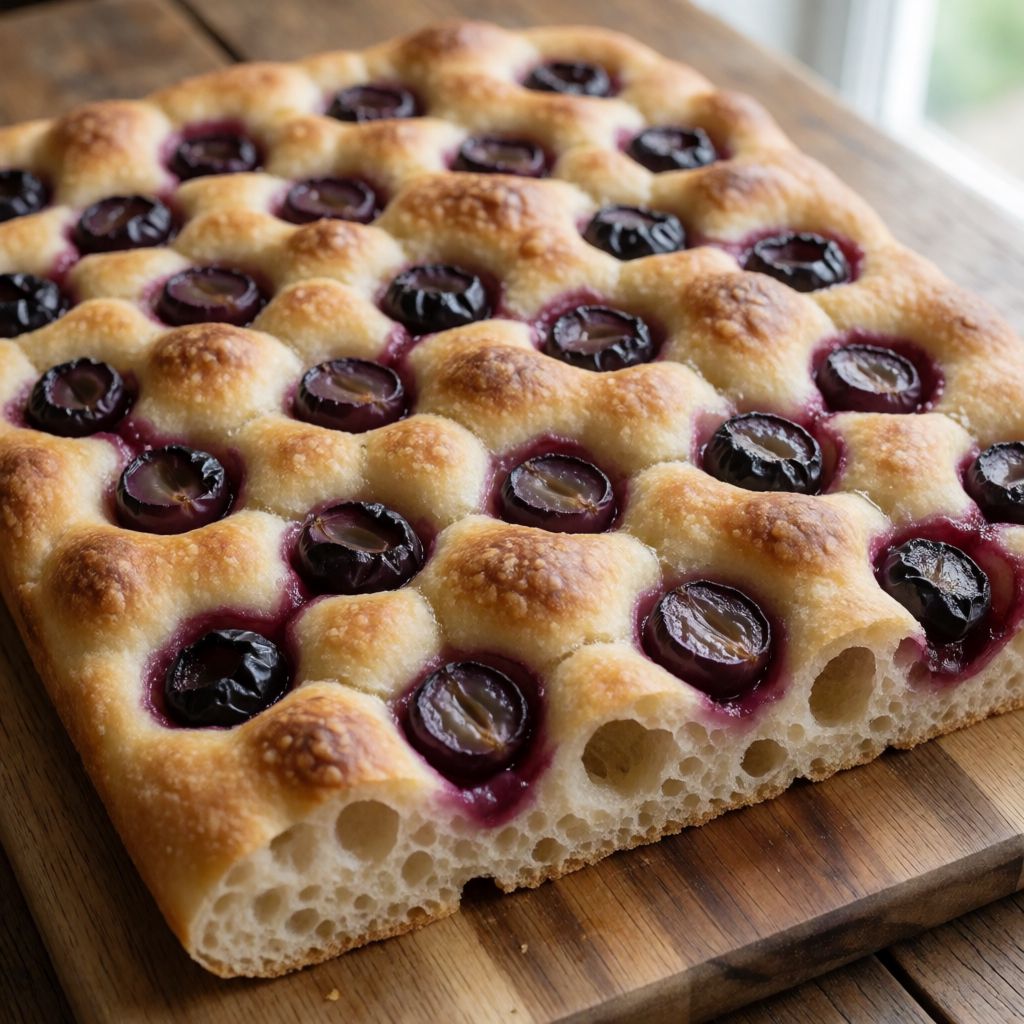
 AI photo
Focaccia with Black Grapes
A sweet, yeasted focaccia layered with juicy black grapes and a sprinkle of sugar.
Labels are worked out automatically from the ingredients and can be wrong. Check the packaging if it matters to you.
Ingredients
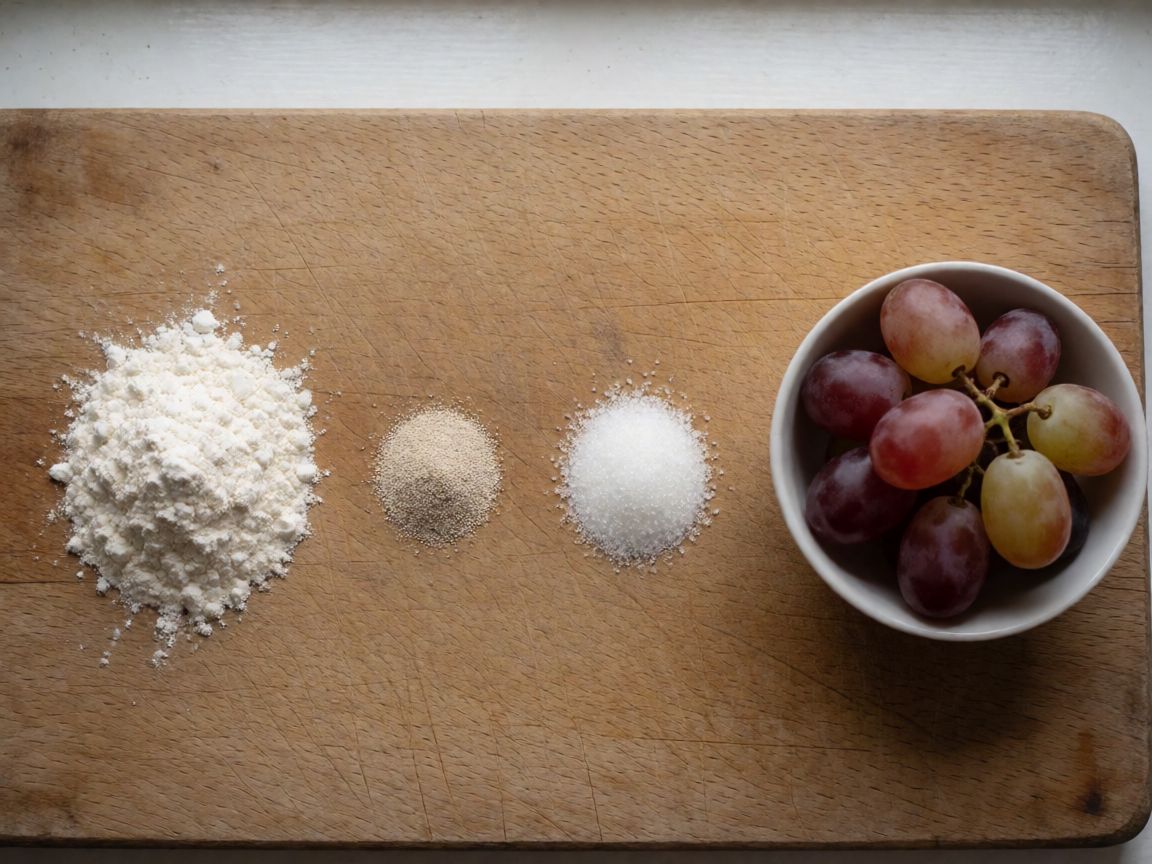
- 350 g Plain flour
- 20 g Yeast Fresh yeast; if using fast-action dried yeast, use about 7 g instead
- 180-200 ml Water lukewarm
- 2 tbsp Olive oil
- 120 g Caster sugar
- 250 g Black grapes




Steps
Tip the flour into a large bowl, make a well in the centre, pour in the yeast dissolved in warm water, mix with a fork, then add the olive oil and stir well.
Knead the dough by hand on a work surface until soft and no longer sticky.
10 minShape into a smooth ball, place in an oiled bowl, cover with cling film and leave to rise.
60 minDivide the dough into two equal pieces, roll out the first and line a 20x30 cm baking tin.
Wash the grapes, pat them dry, scatter half over the dough and sprinkle with half of the sugar.
Roll out the second piece of dough, cover the first layer, pinch the edges together, then scatter over the remaining grapes.
Sprinkle with sugar, drizzle with olive oil and leave to rise again.
60 minBake at 190°C until golden and crisp on top.
45 minRemove from the oven and let cool before serving.
This is a close cousin of Tuscan schiacciata all'uva — not really a bread you eat with dinner, more a slab of sweet dough with a layer of fruit trapped inside it, cut into squares once it's cool. Grape harvest food, originally: whatever bunches were too small or too bruised to send to the winepress got pressed into dough instead, so nothing went to waste. That's the whole economics of it — flour and yeast were always in the house, grapes were only free for a few weeks a year, so the dish exists at the overlap.
What decides whether it works isn't the grapes themselves, it's whether the juice stays where you put it. You're building a sealed parcel — dough, fruit, dough — and if the seam round the edge isn't pinched shut properly, the juice that cooks out of the grapes runs to the lowest point of the tin and you get a soggy, pale patch that never crisps, no matter how long you leave it in. Seal the edge well and the juice has nowhere to go but up through the top layer, which is exactly what you want: that's what turns the surface from bread-pale to the deep amber-gold with blistered, jammy bits where a grape has pushed through.
Flour: plain, not strong bread flour, and that's not an oversight. Some say a yeasted dough always wants the strongest flour you own, for more gluten, more chew — no, because here you don't want chew. You want something tender enough to fold round fruit and tear softly, closer to a sweet bun than a pizza base. Strong flour will give you an elastic, tight crumb that fights the grapes instead of yielding to them.
Yeast: 20 g fresh is a lot by weight, but fresh yeast is mostly water and has a shorter, less concentrated life than the dried kind, so the conversion to about 7 g fast-action dried isn't a rough guess, it's a real ratio — roughly a third the weight. Dried yeast also usually carries a little ascorbic acid or similar to help it along, so if you only have that, don't be surprised if the first rise goes slightly faster than the recipe's hour; go by the dough visibly doubling and holding a dent when you press a finger in, not by the clock.
Water, lukewarm: this isn't a vague comfort word, it's a working range. Above about 60°C you start killing the yeast outright; too cold and it just sits there sulking for an extra hour. Blood-warm is the honest test — dip a finger in, it should feel like nothing, neither warm nor cool against your skin.
Olive oil does two separate jobs here, not one. In the dough it keeps the gluten strands from binding too tightly, which is part of why the crumb stays soft rather than bready. Brushed over the top before the second rise, it stops the surface skinning over and drying out before the oven ever gets to it — skip that and the top can crack rather than blister. Any oil with no smell of its own will do the job in the dough; for the top, though, you want something that can take a bit of colour and flavour from caramelising sugar without fighting it, which is where olive oil earns its place over something neutral like sunflower.
Sugar on the grapes isn't just sweetening them — it's pulling water out of them by osmosis before the oven even starts, which is why the fruit collapses into something closer to jam rather than staying grape-shaped. More sugar doesn't mean more sweetness so much as more liquid drawn out faster, and too much tips you back into the soggy-seam problem from the short version. If your grapes are already very ripe and sweet, you can afford to ease back slightly rather than add more.
Grapes: black or dark red for the acidity as much as the colour — a very sweet, pale grape gives you sugar without anything to balance it, and the filling turns one-note. If black grapes aren't to hand, the honest substitute isn't another grape at all but a firm-skinned, not-too-juicy stone fruit cut small — a slightly underripe plum does the job on the same logic, holding shape rather than collapsing to liquid in the first ten minutes of heat. As for servings — a 20x30 tin cut into squares will quietly feed more than four at a tea table, this is a slice-with-your-tea thing, not a plate-on-its-own thing, so don't be shy about cutting it small. And give it the two risings in full before you think about the oven — an hour each is the floor, not a target; a cold kitchen will want longer, and rushing it just means a denser, less generous crumb to carry the fruit.