
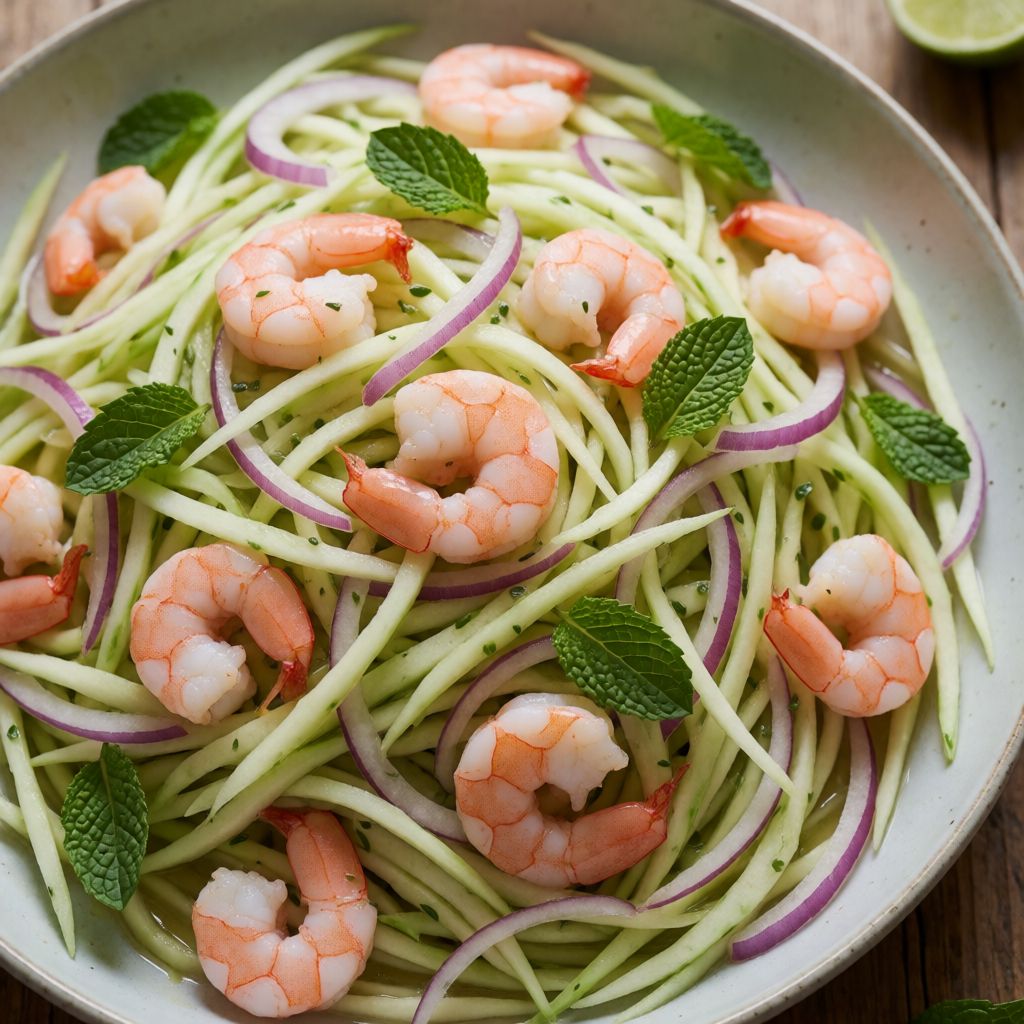
 AI photo
Green Mango Salad with Prawns
A refreshing salad of shredded green mango and prawns tossed in a sweet-sour lime dressing.
Labels are worked out automatically from the ingredients and can be wrong. Check the packaging if it matters to you.
Ingredients









Steps
Mix the dressing (lime juice, sugar, fish sauce, garlic and chilli) and let it stand while you prepare the salad.
2 minPeel the mango with a vegetable peeler, then cut it into very thin strips — use an unripe mango, as it is easier to work with and slice into thin strips.
5 minCombine the shredded mango with the finely chopped mint, onion and prawns.
2 minTaste and adjust the dressing, then toss it through the salad.
1 min
This is a raw, acid-built salad — nothing here gets properly cooked except the prawns, and even they stay modest, a handful of protein scattered through a dish that's really about mango. The whole idea belongs to the hot-climate logic of Southeast Asia: when the air is thick, you don't want weight on the plate, you want sour, salty, sweet and hot hitting you all at once so your appetite wakes up. Green mango plays the role papaya plays in Thailand — the sharp, crunchy vegetable-fruit that carries a dressing without falling apart.
What decides whether this works is not a step, it's a choice you make at the greengrocer: the mango has to be unripe. Not "green-ish", properly unripe — flesh pale, almost white-green, firm enough that your peeler meets real resistance. Some people think unripe fruit is just fruit that hasn't finished yet, a shame to use. No — because a ripe mango is soft and sweet and turns to wet rags the moment you shred it and hit it with lime juice. The whole mechanism of this dish depends on cell walls that haven't softened yet: they hold the julienne, they hold the crunch, and they hold their own sourness, which is doing half the dressing's job before the dressing even arrives.
Start with the mango itself, because the ingredient list says "2 pcs" and that's the easy part — the hard part is choosing them in a British supermarket where most mangoes on the shelf are there specifically because they're ripening. Look for ones still hard as a green apple, no give under your thumb, skin green rather than blushed. If you genuinely cannot find one, the honest substitute isn't another mango — it's any firm, low-sugar, acid-leaning fruit or vegetable that holds a julienne: green papaya is the classic swap the whole dish descends from, a very firm unripe pear works at a pinch, even a crisp, under-ripe apple with a squeeze of extra lime will get you the texture, if not quite the same perfume.
Shallot and onion are doing two different jobs, not the same job twice. Shallot is softer and sweeter, breaks down fast in the acid and almost dissolves into the dressing by the time you eat — it's there for roundness. Onion is sharper and holds its bite longer, giving you a crunch and a kick that shallot alone won't. If you only have one of them, onion on its own will read harsher, shallot on its own gentler and a touch flat — either is fine, just know which direction you're nudging the dish.
Mint goes in raw and at the end, chopped fine but not to a paste — bruised herb turns bitter and dark, so a sharp knife and a light hand matter more here than the recipe lets on. There's no substitute that does the same job: coriander will give you a different, more savoury salad, which isn't wrong, just a different dish wearing this one's name.
Prawns: 100 grams for four people tells you they're a garnish, not the meal, so don't feel obliged to pile more in. What matters with prawns is the moment you stop cooking them — they go from translucent grey to opaque pink-white and curl gently into a loose C. Some people wait for a tight, closed circle because that looks more "done" — no, because by the time a prawn curls that tight, the protein has squeezed out its own moisture and you're eating rubber. Buy them ready-cooked if that's easier on a weeknight; this dish doesn't care how the prawn got cooked, only that it wasn't cooked twice.
The dressing runs on four things balancing each other, and each one has a job a substitute has to actually do, not just resemble. Lime gives sharp, clean acid with no bitterness — lemon will do if that's what's in the fruit bowl, but it sits heavier and loses lime's top note, so taste and maybe add a touch more sugar to compensate. Fish sauce is there for salt plus a deep, fermented savouriness that plain salt can't fake — if you won't keep a bottle of it, the honest nearest thing is a few drops of Worcestershire sauce mixed into light soy, which gets you closer than salt alone ever will, though it's not the same animal. Sugar isn't sweetening the salad, it's blunting the harsh edges of the fish sauce and the acid — leave it out and the dressing tastes aggressive rather than lively. Garlic and chilli are the heat and the backbone; use less chilli, not none, if you're cooking for people who flinch, because a salad with zero heat against all that sour and salty reads unfinished.
Last thing: taste the dressing again once it's actually on the mango, not before. Mango brings its own sourness to the table, different from batch to batch depending on how unripe it was, so the balance you built in the small bowl two minutes earlier might need another pinch of sugar or another squeeze of lime once it meets the salad. That's not the recipe failing you — that's just what raw, acid-built food asks of a cook: taste at the end, not just at the start.