
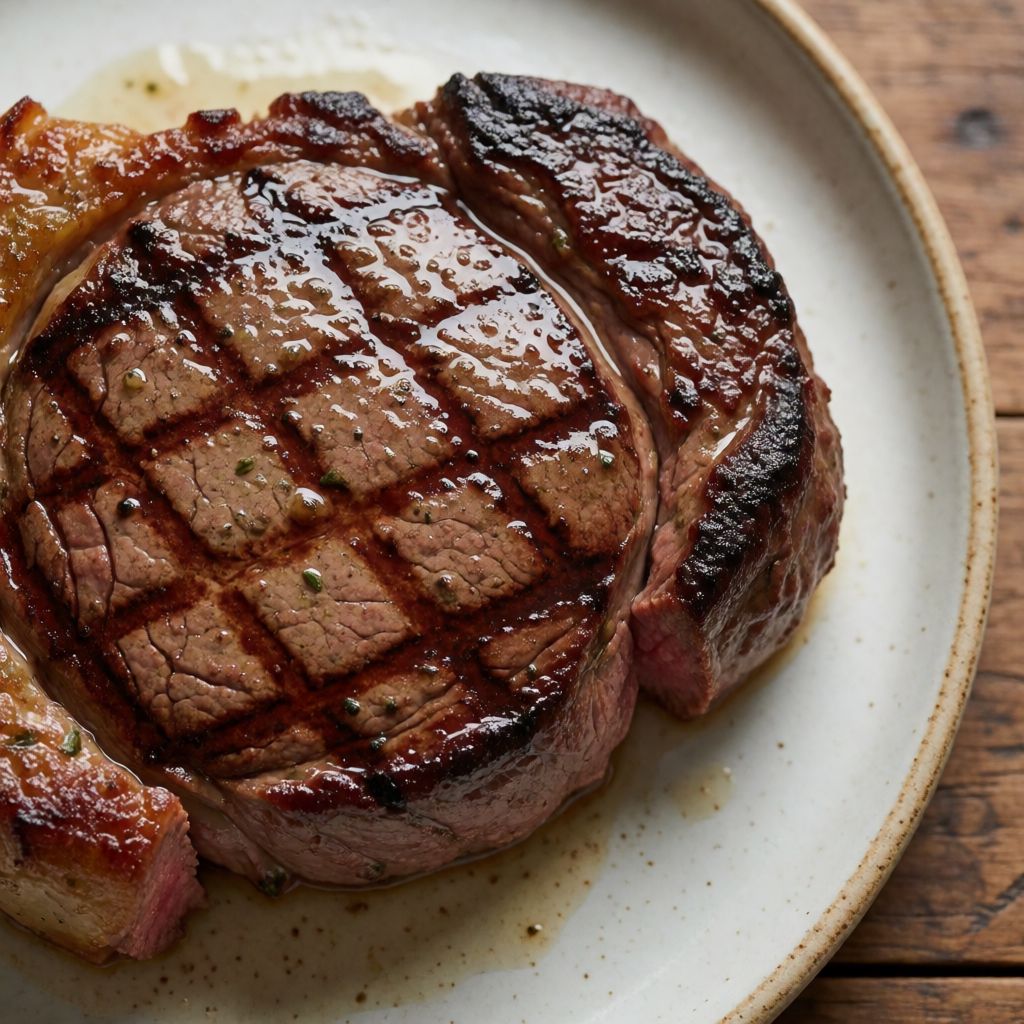
 AI photo
Grilled Entrecôte Steaks with Tarragon Butter
A simple entrecôte steak dish, grilled and served with fresh tarragon butter.
Labels are worked out automatically from the ingredients and can be wrong. Check the packaging if it matters to you.
Ingredients
- 4 pcs entrecôte steaks
- 3 tbsp Olive oil for the steaks and potatoes
- Salt
- Black pepper freshly ground
- 100 g Butter at room temperature
- 1 bunch Tarragon fresh
- 1 clove Garlic
- ½ pcs Lemon juice and grated zest
- 1 kg Potatoes
- 100 g lettuce hearts
- 250 g Asparagus
- 50 g Pitted black olives
- 50 g Parmesan coarsely grated
- 20 g Butter for frying the asparagus












Steps
Finely chop the tarragon and mix with the butter, lemon juice and garlic, add the lemon zest to taste, salt and pepper
5 minTransfer the tarragon butter to a bowl and chill in the fridge for 1 hour before serving
60 minTake the steaks out of the fridge 45 minutes before grilling so they come to room temperature
45 minBrush the steaks with olive oil and place on a hot grill over direct heat for about 2 minutes on each side
4 minIf the steaks are very thick or you want them more than medium, leave them for an extra 1–2 minutes on each side over indirect heat
2 minSeason the steaks with flaky salt and freshly ground black pepper before serving — for example, with a spoonful of whipped tarragon butter
Scrub the potatoes well, dry them, and toss with oil and salt
5 minRoast the potatoes in a preheated oven at 200°C for about 25–35 minutes until tender
30 minSnap off the asparagus tips and quickly fry in a hot pan with butter for half a minute
Mix the asparagus with the lettuce, black olives, salt and pepper and sprinkle with Parmesan — serve immediately
2 min
Entrecôte is the rib steak off the bone, the muscle that does almost nothing in the animal's life — which is exactly why it's soft and marbled with fat. That fat is the whole plan here. It melts under heat and bastes the meat from inside, which is why you need direct, fierce heat for a short time, not a gentle one for a long time. A domestic hob can't do what a kazan-level grill does, but a griddle pan or the grill element on full can get close enough if you let it actually heat up before the steak goes anywhere near it.
What decides this dish is not the steak, though people think it is. It's the butter. Cold, hard tarragon butter laid on a hot steak doesn't baste it — it sits there sulking while you plate up. That's why it has to chill into a firm block first, so a spoonful holds its shape, and then melt slowly in front of the diner, not in the pan where it would just burn.
Some say resting the steak before cooking is a chef's affectation. No — it's temperature physics. A steak straight from the fridge is cold in the middle and hot grill means the outside sears while the centre is still fighting its way up from 5°C. Forty-five minutes on the counter evens that gradient out, so the steak cooks through roughly at the same rate everywhere instead of giving you a grey band under a burnt crust.
Start with the steak itself. Entrecôte — rib steak, sometimes sold boneless as a "ribeye" cut here — carries a seam of fat through the middle and a fat cap at the edge. You want that fat, don't trim it off before cooking; it's the self-basting system, and cutting it away is like turning off the oven halfway through. If your butcher only has sirloin or rump, fine — just know they're leaner, so they go dry faster and need slightly less time, not more.
The oil on the steak isn't for flavour, it's for contact. A dry steak on a hot grill sticks and tears instead of marking; a thin film of oil — any neutral oil with no smell of its own, so a light olive oil, or sunflower if that's what's in the cupboard — lets the surface sear cleanly and come away in one piece. Olive oil for the potatoes does a different job: it coats so the skins crisp and separate on the tray instead of steaming each other soft. Scrubbing and drying the potatoes first matters for the same reason — wet skin on an oiled tray is just more steam, which is the enemy of crisping.
Butter at room temperature is the operative phrase in step one. Cold butter won't take up the chopped tarragon, garlic and lemon evenly — you'll get streaks of green in a sea of plain fat. Soft butter folds the lot through uniformly, then the hour in the fridge is what gives it structure again: this is the only way you get a butter that holds a spoon-shape on a hot plate for a few seconds before it starts to run, which is the entire point of serving it this way rather than melting it into a sauce. Fresh tarragon has a faint aniseed note that dried tarragon loses almost completely in storage — if you truly can't get fresh, a little fresh chervil or even parsley with a drop of pastis gets you nearer than dried tarragon would.
The lettuce-and-asparagus plate wants its asparagus hot off the pan and onto cold leaves immediately — that contrast of warm, buttered, slightly charred tip against cool crisp lettuce is the dish; let the asparagus sit and cool first and you've just made a boring warm salad. The olives and Parmesan aren't dressing ingredients, they're seasoning by other means — salt and savoury hit without reaching for the salt cellar again, since the steak and potatoes are already seasoned separately.
On the potatoes at 200°C: that's hot enough to crisp the skin before the inside turns to mush, and the 25–35 minute range is honestly a lower bound, not a clock to watch — a knife should go in with no resistance, a fork should let the inside give. Thick, old potatoes (good baking varieties, Maris Piper is the obvious British choice) hold their shape better in this oven window than waxy new potatoes, which will cook faster and can turn mealy if you leave them the full time by habit rather than by checking.
Last thing — patience really is an ingredient twice over here: once in the hour the butter needs to firm up, once in the forty-five minutes the steak needs to come up to room temperature. Skip either and you're not doing this recipe faster, you're doing a different, worse one.