
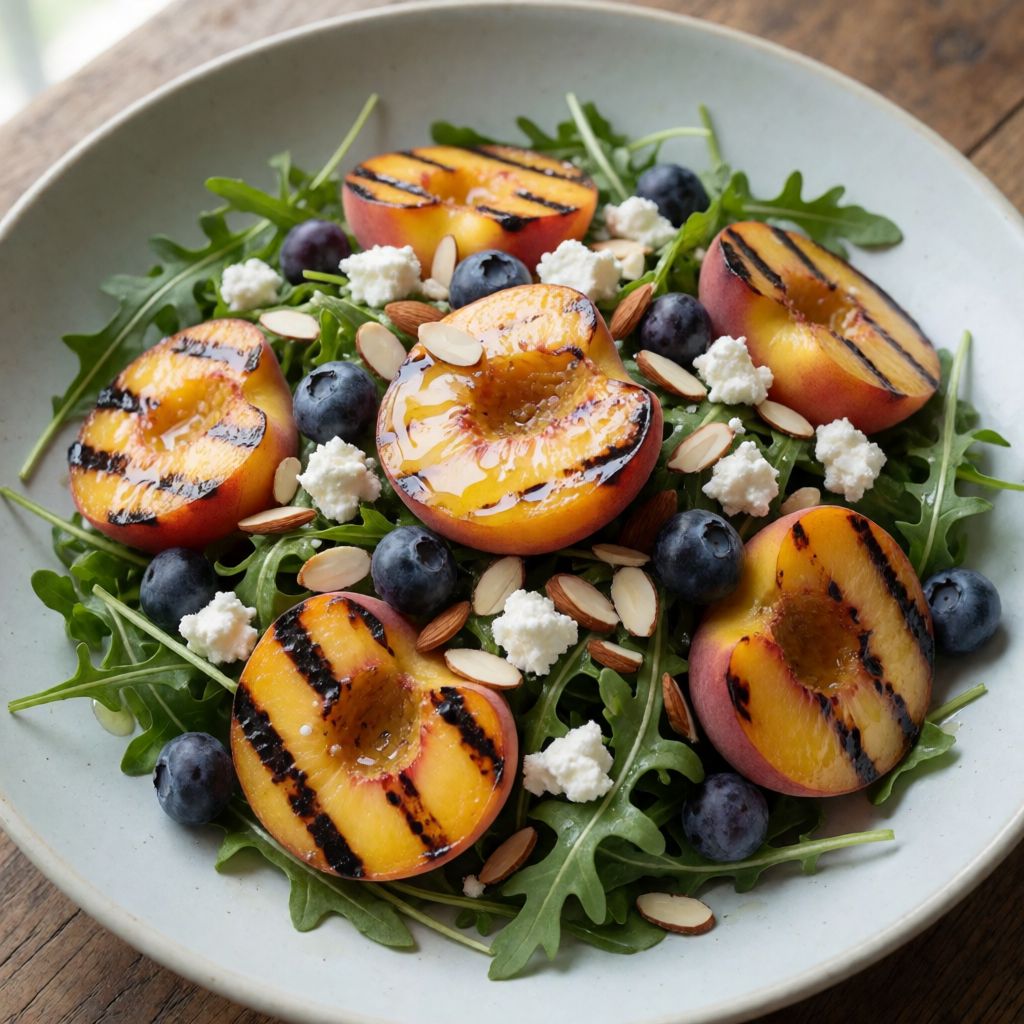
 AI photo
Grilled Peach Salad
A summery salad of smoky grilled peaches, peppery rocket, crumbled feta and blueberries, finished with a honey-mustard dressing.
Labels are worked out automatically from the ingredients and can be wrong. Check the packaging if it matters to you.
Ingredients
- 4 pcs Peach halved and pitted
- 50 g Almonds
- 125 g Rocket
- 50 g Feta crumbled
- 75 g Blueberries
- 3 tbsp Olive oil
- 2 tbsp Apple cider vinegar
- 1 tbsp Honey
- 1 tsp Dijon mustard
- Salt to taste
- Black pepper freshly ground, to taste








Steps
Grill the peach halves over direct heat for about 2-3 minutes, until nice char marks appear.
3 minToast the almonds in a hot, dry pan, stirring, for a few minutes until crisp but not coloured. Chop roughly.
3 minFor the dressing: put all the dressing ingredients in a bowl and whisk well until smooth and even.
2 minToss the dressing with the rocket and arrange on a serving plate.
2 minCut the warm grilled peaches into wedges and arrange on the plate with the rocket.
3 minScatter the salad with the roughly chopped almonds, blueberries and crumbled feta.
2 min
This is a salad built on contrast — hot and cold, sweet and sharp, soft and crunchy — and the whole thing stands or falls on one five-minute operation: getting real char on the peach without turning it to mush. A peach is mostly water and sugar held together by not very much. Push it too far on the heat and the structure collapses before the sugar has a chance to caramelise. That's the mechanism you're managing, not "grilling a peach for 2-3 minutes" — the time is just where that mechanism usually lands.
What actually happens on the heat: sugar on the cut surface meets a hot, dry surface and caramelises — turns from pale flesh to those dark stripes, bitter-sweet, almost smoky. You want that bitterness, because everything else in this bowl is soft and sweet or salty, and without it the salad reads as one-note. On a British hob that means a ridged grill pan or a cast-iron frying pan, taken properly hot, dry, with the peach cut side down and left alone. Resist moving it. Contact is what makes the stripe; fidgeting breaks it.
The second thing deciding whether it works is the dressing, and specifically whether it holds together or splits into oily puddles and sharp puddles. Mustard and honey aren't just flavour here — they're what keeps the oil and vinegar from separating, each molecule gripping both the fat and the water side. Whisk properly, not a token stir, and it'll stay creamy on the leaf rather than sliding off.
Peaches: you want them ripe enough to smell sweet at the stem end but firm enough to hold a cut edge on the grill pan — a peach soft enough to eat straight away will fall apart into string before it chars. If your peaches are rock-hard and flavourless, which happens often enough in a British supermarket in a cold month, a ripe nectarine works the same way, or even a firm plum halved the same manner — same sugar-and-heat mechanism, slightly different flavour. Some say only a proper barbecue gives real char. No — char is sugar meeting a very hot dry surface for long enough, and a ridged cast-iron pan on your hob does that fine; what you lose is smoke, not caramelisation.
Almonds: toasting in a dry pan isn't about making them crunchy — they're already crunchy — it's about waking up the oil inside the nut, which is where almost all the flavour lives. Raw almonds taste of almost nothing by comparison. Watch colour, not the clock: you want pale gold moving toward light ginger, stirred so they don't scorch on one side while the other stays raw. Any nut with a similar oil content works the same way — hazelnuts, pecans, walnuts — toast them the same way and swap freely.
Rocket: its job is bitterness and bite against the sweetness of peach and honey. If you only have spinach or a milder salad leaf, it'll work, but you lose that peppery edge, so add a few extra turns of black pepper to compensate — pepper and rocket's bitterness are doing similar work on the palate.
Feta: salt against sweet, and crumbly texture against soft peach. Choose a block, not pre-crumbled feta in a tub, which is often drier and chalkier because it's been sitting exposed to air. Any firm, salty, crumbly cheese does the same job — a mild goat's cheese, or even a hard ricotta salata if you can find one.
Olive oil, vinegar, honey, mustard: the oil should be one with no strong flavour of its own fighting the peach and honey — a light olive oil, not an aggressive extra virgin, though extra virgin at this quantity won't ruin anything. The vinegar needs to be mild and fruity rather than sharp — apple cider vinegar is exactly that; balsamic would be too heavy and sweet on top of the honey and peach, doubling up where you want contrast. Honey and mustard aren't seasoning here so much as glue, holding the emulsion — leave either out and the dressing will separate on the plate within a few minutes, oil pooling on top, vinegar sinking. Blueberries just add a cold, tart burst and need nothing done to them at all — that's their whole contribution, so don't warm them or cook them into anything.
And the one ingredient not listed: patience, in the small sense of leaving the peach alone on the heat and the rocket alone until the last moment. Rush either and you get a salad that looks the same on the plate but tastes flat — all the mechanisms above only pay off if you let them finish on their own terms.