
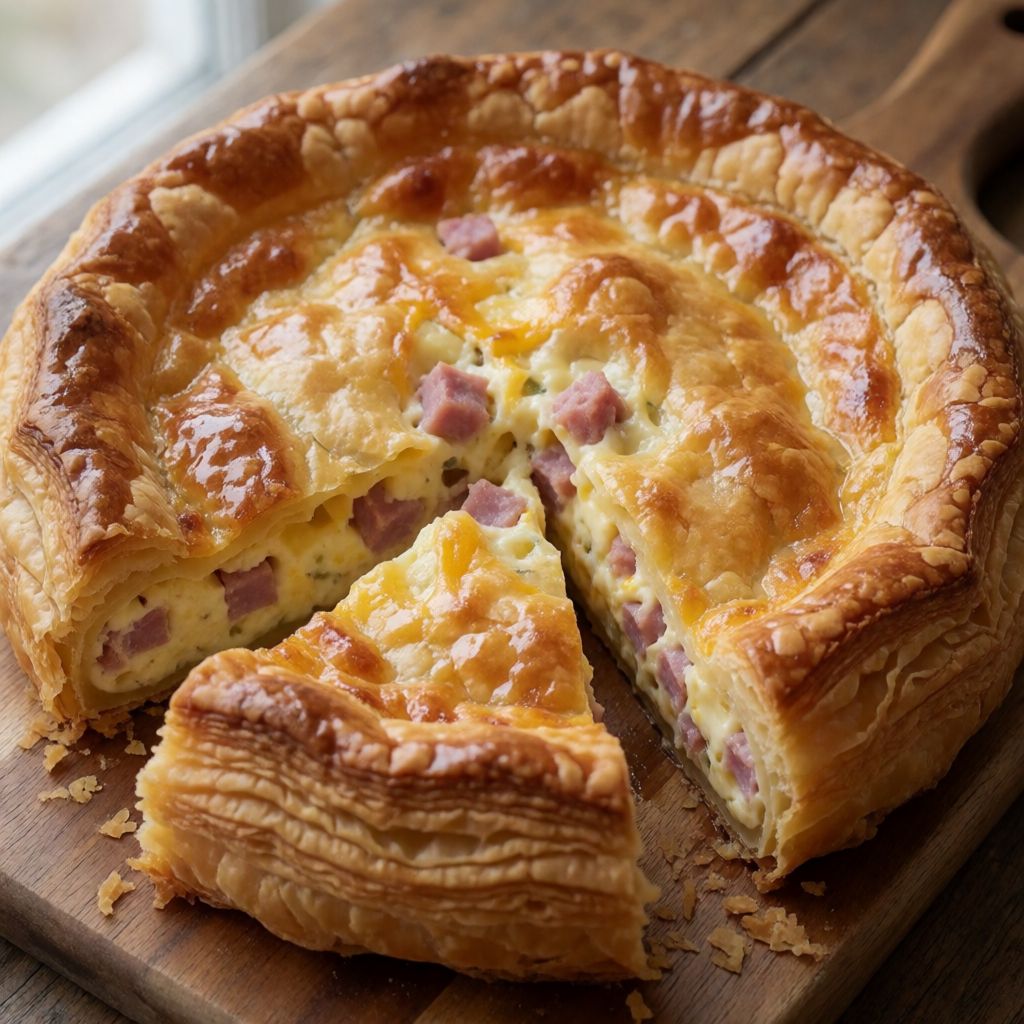
 AI photo
Ham and Cheese Puff Pastry Pie
A savoury pie filled with ham, melted cheese and eggs, baked in puff pastry until golden.
Labels are worked out automatically from the ingredients and can be wrong. Check the packaging if it matters to you.
Ingredients
- 2 pcs Puff pastry
- 3 pcs Eggs
- 100 g Parmesan grated
- 200 g Mature cheddar diced
- 300 g Ham diced
- Salt to taste
- Black pepper to taste






Steps
For the filling, whisk 2 eggs in a bowl with salt and black pepper.
Add the grated Parmesan and mix well, then stir in the diced ham.
Cut the mature cheddar into small pieces and add it to the mixture.
Roll out the first sheet of puff pastry and use it to line a 24 cm tin; shape the edges and prick the base with a fork.
Spoon the filling into the tin and smooth the surface.
Roll out the second sheet of puff pastry and cut a disc; cover the pie and pinch the edges to seal.
Carefully prick the top with a fork and brush with beaten egg.
Bake in a preheated fan oven at 180°C for 33 minutes.
33 min
What was changed
The smoked scamorza was replaced with Mature cheddar, a cheese that is easier to find in UK shops and melts well in savoury pies.
This is a sealed pastry box: two sheets of puff dough holding a dense, mostly-solid filling of ham, two cheeses and just enough egg to glue it all together. It's not a quiche, and that distinction matters more than it looks — a quiche is egg-and-cream custard that happens to have a crust, this is the opposite: solid stuff held together by a little egg, wrapped in pastry that has to survive the oven on its own strength. Get that ratio wrong — too much egg, not enough ham and cheese — and you've built a quiche in the wrong shell, and the base goes soft under the weight of liquid it was never built to hold.
What decides whether it works is steam management, twice over. First at the base: you prick it so steam escapes downward and doesn't lift the pastry off the tin and leave an air gap under the filling — that gap is where a soggy, pale, separated base comes from, not from some failure of the dough itself. Second at the top: prick it again, same reason, so the lid puffs evenly instead of ballooning in one spot and splitting. Some say pricking kills the rise — no, because what you're killing is the random, uneven rise, not the rise itself. The layers still lift from trapped steam between the butter sheets; you're just giving that steam a controlled way out instead of letting it blow a hole wherever it likes.
Let the pie sit five, ten minutes once it's out — patience here isn't optional decoration, it's the last bit of cooking. The egg inside is still setting from carry-over heat, and the cheese is still liquid in places; cut too early and you get a wound, not a slice, with filling running out onto the plate. Let it rest and it holds its shape when you cut it.
Eggs here are structural, not a feature. Two eggs whisked with salt and pepper are doing a binder's job — holding diced ham and chunked cheese in a matrix firm enough to slice, the way a small amount of beaten egg holds a meatball together rather than making a soup. The third egg, brushed on top, is pure cosmetics and crust — it's what gives you that blistered gold rather than a pale, steamed-looking lid; a milk wash does something similar but softer, water alone does almost nothing.
Two cheeses, two different jobs, and that's deliberate, not decoration. Parmesan is grated fine and mixed right through — it's dry, hard, intensely salted, and its job is seasoning and tightening the whole mixture, the way you'd use a hard aged cheese as a flavour base rather than a melting cheese. Mature cheddar is diced, not grated, and stays in distinct pieces — its job is pockets of pull and stretch when you bite into it. Grate the cheddar too and you lose that; everything melts into one uniform, slightly greasy mass instead of ham and molten cheese as separate textures doing separate things. If you don't have cheddar, any firm cheese that holds its shape in the heat and melts without weeping much fat works — Gruyère, Comté, even a mature Gouda. For the Parmesan, any hard, aged grating cheese that's salty and relatively dry does the same job — Grana Padano, an aged pecorino.
Ham, diced small, is already cooked and cured — all it needs from the oven is to warm through and pick up a little colour at the edges, not to cook from raw. This is a good home for Sunday's leftover gammon, in fact, which is the economic logic behind the whole dish: ham-and-cheese pies and sandwiches are what you make when you've got cooked meat sitting around and a shop full of ready puff pastry, not a dish with some deep ceremonial history. If you've no ham, bacon lardons fried off first, or diced cooked turkey, do the same job — cured or pre-cooked, cut small, holding its shape.
On the pastry itself: proper puff is butter laminated into dozens of thin layers by repeated folding and resting, which is exactly why almost nobody makes it at home for a weeknight pie — it's hours of patience for a result the supermarkets now produce reliably by machine. Buy an all-butter block if you can; it browns better and tastes of something, where a vegetable-fat version tends to puff pale and a little flat-tasting. Roll it cold, work quickly, and don't overwork the edges when you line the tin — warm hands melt the butter layers and you lose the lift you're relying on for that top crust. A 24cm tin isn't arbitrary either: go much wider and the filling layer thins out, the egg sets before the middle's had any chance to heat through evenly; go much smaller and you're fighting the opposite problem, a raw centre under a cooked top. Feeds four as a proper lunch with something green on the side, or more as part of a spread — and it travels cold just as happily as it comes out of the oven hot, which is no small thing on a weekday.