
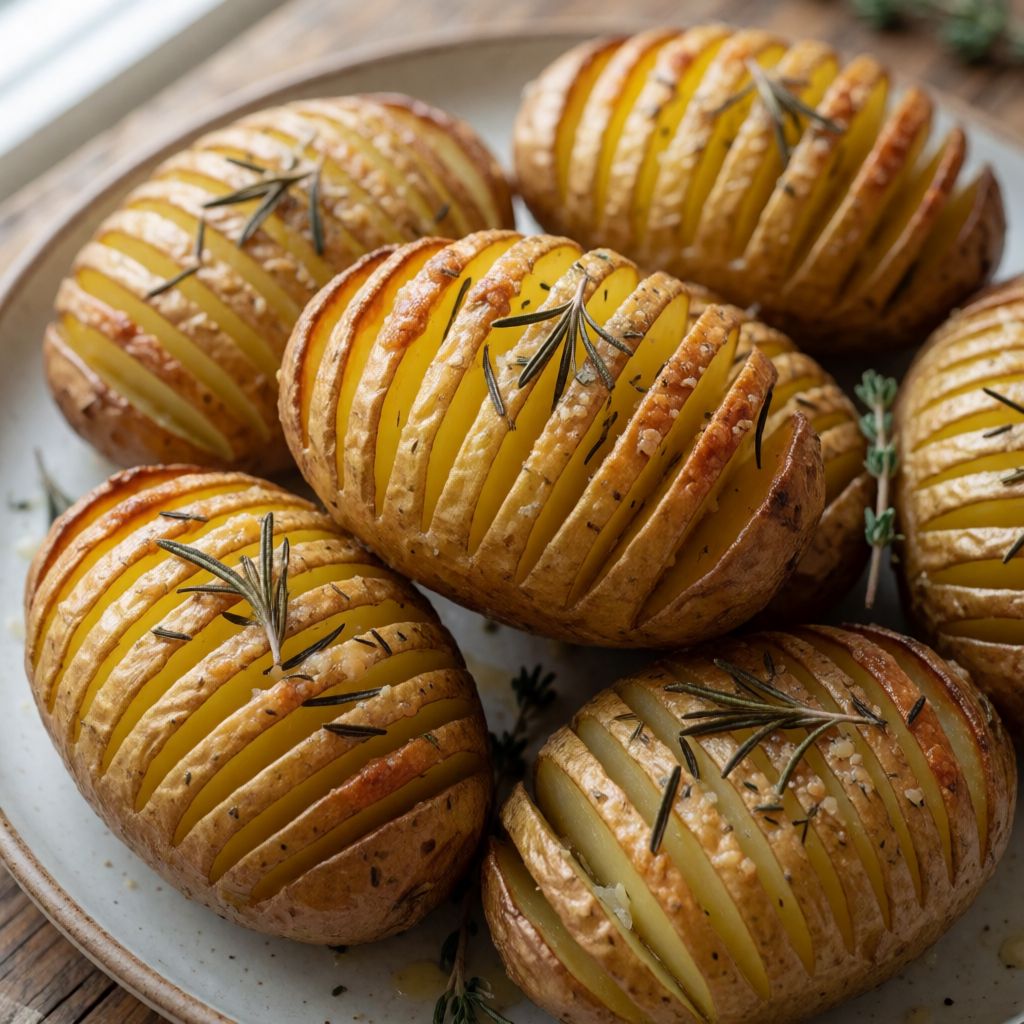
 AI photo
Hasselback Potatoes
Crispy hasselback potatoes baked with garlic, herbs and parmesan.
Labels are worked out automatically from the ingredients and can be wrong. Check the packaging if it matters to you.
Ingredients






Steps
Wash the potatoes thoroughly on the outside. Near the base, pierce each potato all the way through with a wooden skewer.
Using a sharp knife, make cuts every 2-3 mm, stopping just before the skewer at the base.
Finely chop the rosemary, thyme and garlic with a knife. Mix them in a bowl with the salt, pepper and parmesan.
Distribute the fragrant mixture between the slices of each potato.
Place the hasselback potatoes in a buttered baking dish and sprinkle with the remaining mixture.
Drizzle with olive oil, add a pinch of salt and bake.
70 minRemove the hasselback potatoes from the oven and serve hot.
Hasselback is a potato that wants to be a fan, not a wedge and not a mash. The cuts are the whole idea: you are turning one lump into forty thin leaves without letting them fall apart, so every leaf gets its own crust and its own little pocket of garlic and cheese. What decides whether it works is the skewer at the base — it stops the knife a few millimetres short of the bottom, so the potato stays one piece and opens like a book when it bakes, instead of collapsing into a pile of chips.
Some say you need a mandoline or a special comb for this. No — a steady hand and a knife you trust is enough, because the skewer is doing the precision work for you. All you have to do is keep the knife moving at the same thin width, cut after cut. Uneven slices are the real cause of the two defects people blame on the oven: thick slices that stay raw and pale in the middle, thin ones at the end that burn to a crisp before the fat one next to it has even softened.
The second thing that decides the result is heat that comes from below and around, not from above only — this is a bake, not a grill. Give it enough time for the heat to walk all the way into the centre of the potato before the cheese on top turns from melted to blackened. That is why this is a long, slow sit in the oven rather than a quick blast: patience is what turns starch into something creamy without losing the top to charcoal.
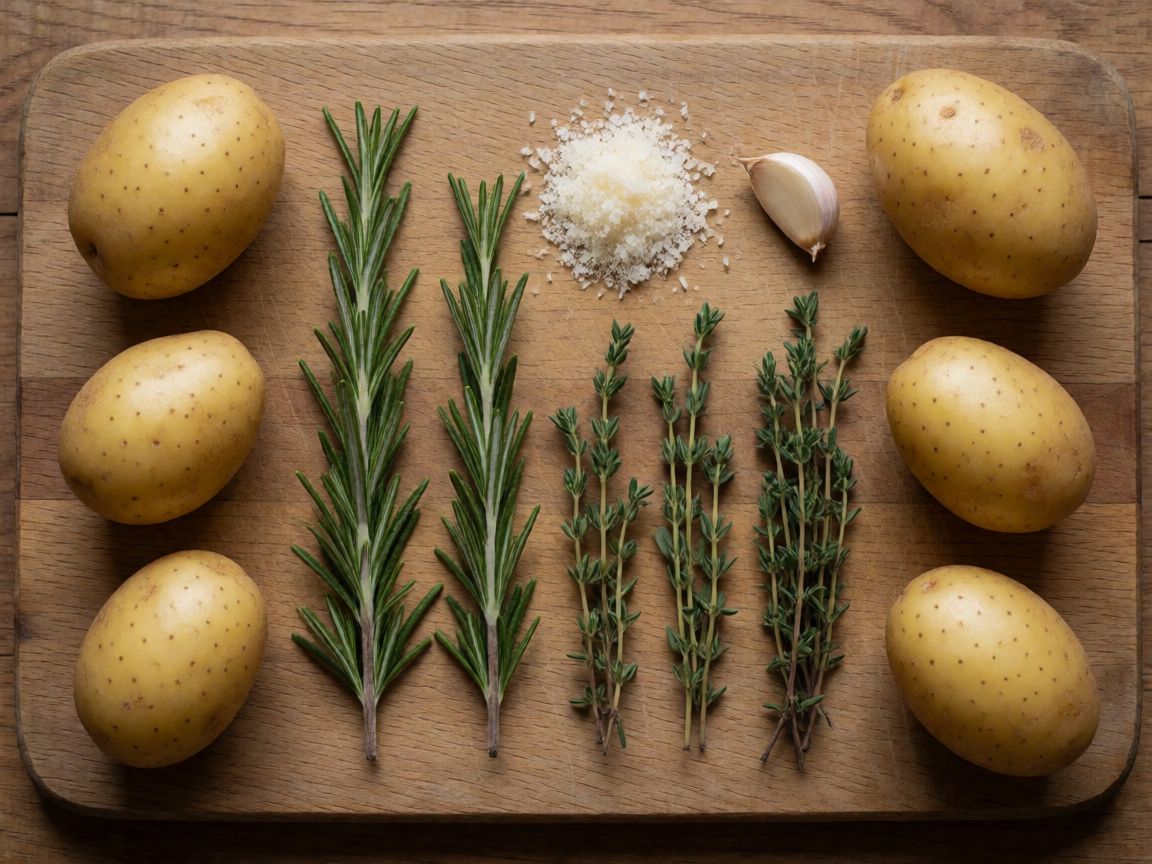
Potatoes: pick ones that hold their shape under heat rather than dissolving into mush — waxy to medium varieties, something like Maris Piper or King Edward if you're in a British shop, roughly palm-sized so the fan has something to open into. Too small and there's no structure to score; too big and the centre never catches up with the edges in the same bake.
Rosemary and thyme: these are here for aromatic oil, which releases slowly in heat and seeps down into the cuts rather than sitting on top like a garnish. Fresh is worth it because the needles hold their oil until you bruise them with the knife; dried herbs have already lost most of that oil to the air, so if that's what you've got, use less water and double the quantity to compensate, and expect a flatter smell.
Parmesan: its job is to melt, then keep melting past the point where it goes crisp and savoury rather than just stringy — that's what a long-aged hard cheese does and a young, moist one doesn't. Any hard cheese that behaves the same way under heat will do: pecorino, an aged gouda, even a strong cheddar in a pinch, though cheddar will run softer and greasier rather than forming those little golden shards.
Garlic: one clove, finely chopped, is there to perfume the fat and the cheese, not to dominate — in a cut this thin it has nowhere to hide if you overdo it, so go easy rather than generous.
Olive oil: here it's not a neutral medium, it's a flavour you actually want sitting next to the rosemary and garlic, so don't swap it for something odourless unless you have no choice. If you must substitute, pick another oil that can sit in a hot oven without turning bitter — a light vegetable oil will do the job of crisping but will leave the potato tasting of less.
A word on the dish itself, since the name makes people think there's something exotic about it: Hasselback potatoes are named after a restaurant in Stockholm, not after a technique with ancient roots — someone there worked out that slicing a potato this way gets more surface in contact with fat and seasoning for the same lump of starch, which is just good economics dressed up as a party trick. It sits comfortably next to a Sunday roast for exactly that reason: the oven's already on, the potatoes can go in alongside the meat, and you get a potato that looks like it took more effort than it did. A wide ovenproof dish and a square of foil instead of a proper lid is all a normal flat needs — there's nothing here that asks for a kazan or anything you don't already own.