
 AI photo
Hazelnut Baskets
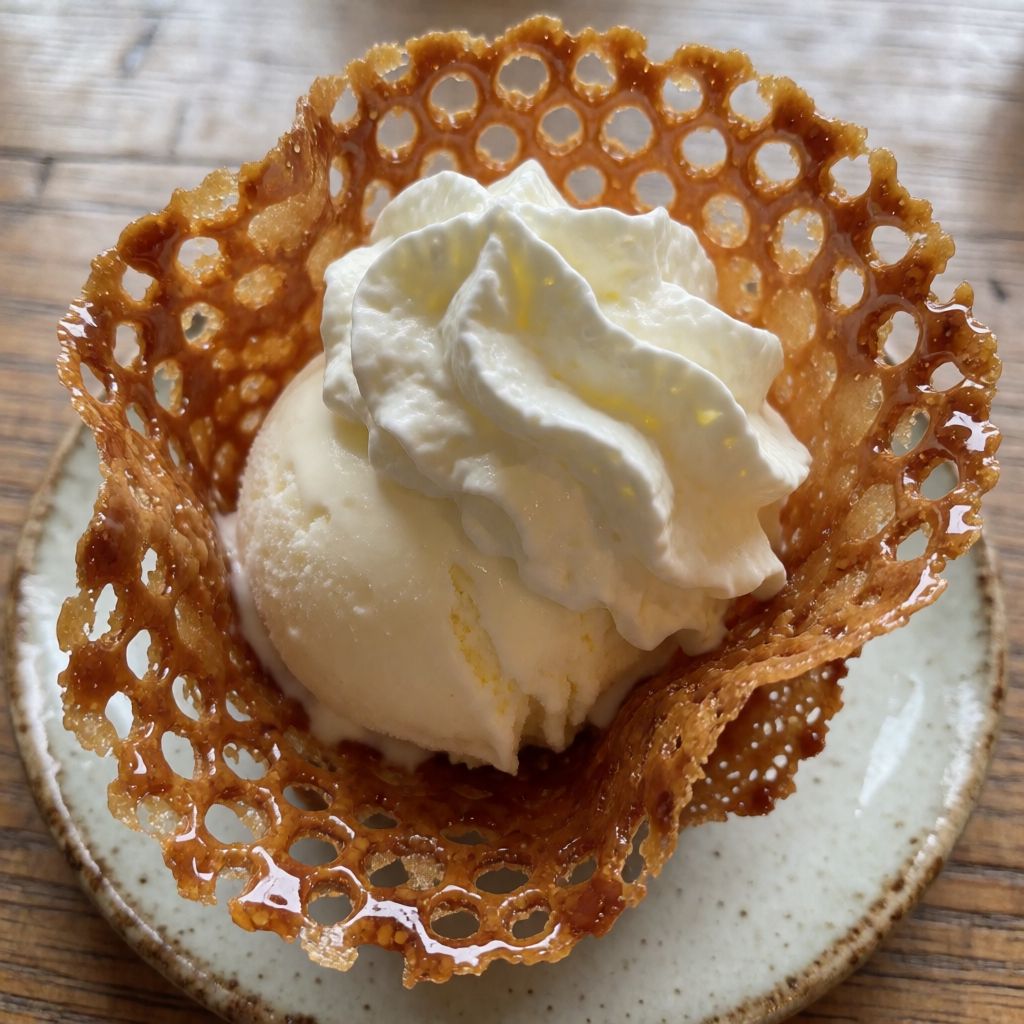
Crisp hazelnut tuile baskets filled with vanilla ice cream, double cream, chocolate, raspberries and mint.
Labels are worked out automatically from the ingredients and can be wrong. Check the packaging if it matters to you.
Ingredients
- 40 g Hazelnuts
- 25 g Butter
- 50 g Caster sugar
- 2 tbsp Glucose syrup
- 0.4 l Vanilla ice cream
- 100 ml Double cream for the cream filling
- 25 g Dark chocolate roughly chopped
- 25 g Hazelnuts roughly chopped
- 50 g Raspberries
- 1 tbsp Mint fresh, chopped







Steps
Grind the hazelnuts in a food processor to a fine nutty flour. Add the butter, caster sugar and glucose syrup, and mix until smooth.
5 minShape into balls and flatten them slightly into rounds on a baking tray lined with parchment, leaving plenty of space between them as they spread a lot while baking.
5 minOne tray holds 4 rounds of dough, so if you're making a double batch or more, you'll need several trays.
Bake in a preheated fan oven at 180°C for about 10 minutes, until golden. Watch closely, as baking time may vary depending on your oven.
10 minRemove from the oven, let cool for a minute — no longer — then turn out onto a small bowl or an upturned glass to shape into little baskets. Reshape gently if needed and leave to cool completely on the glass.
Serve the hazelnut baskets with vanilla ice cream, whipped double cream, chopped dark chocolate, hazelnuts, raspberries and mint.
What was changed
Swapped in Double cream for the whipping cream and rounded the oven temperature to .
This is not a biscuit you bake and eat as a biscuit. It's candy that you catch at exactly the right moment of being solid. Butter, sugar and glucose syrup melt together in the oven into a thin molten lace held up by ground hazelnuts — and for about sixty seconds after it comes out, that lace is neither liquid nor set. That minute is the whole trick. Too early and it's still too hot and runny to lift without tearing; too late and the sugar has gone glassy and will crack the second you try to bend it over a glass. Everything else in this recipe — the spacing on the tray, the quick toss onto an upturned glass, the ten careful minutes in the oven — exists to get you cleanly into that window and out the other side with a basket instead of a puddle or a shard.
Some people see "dough" in step one and treat it like shortbread — rest it, chill it, handle it like pastry. Don't. There's no flour here to give it structure at room temperature; the only thing holding it together before baking is cold butter, and the only thing holding it together after baking is caramelised sugar. It behaves like a florentine, not a cookie, because that's what it is under a kinder name.
Hazelnuts: grind them fine, almost to a flour, in the processor — not chopped, not coarse. Coarse pieces leave gaps in the lace that the melted sugar has to bridge on its own, and that's where it tears when you try to shape it. A fine grind spreads the fat evenly through every bit of the mixture, which is what gives you an even, lace-thin disc instead of a patchy one. If you've got no hazelnuts, almonds will do the same structural job — you lose the particular roasted-nut flavour hazelnuts carry, which is really the point of the dish, but the mechanism doesn't care which nut, only that it's ground fine and has enough oil in it to help the thing melt.
Butter brings two things: fat to carry flavour, and water, which flashes off in the oven and helps the mixture spread before the sugar sets it. Use a proper butter, not a low-fat spread — spreads carry extra water and emulsifiers that behave unpredictably under heat, and this recipe has no margin for unpredictable.
Caster sugar is specified because it's fine enough to dissolve fully into the butter at room temperature in step one; granulated will leave gritty undissolved crystals that can seed early crystallisation and turn your lace grainy instead of glassy. The glucose syrup is doing a specific job alongside it: pure sugar left to cool wants to recrystallise into something brittle and opaque, and glucose gets in between those sugar molecules and stops them lining up neatly, which is why your basket bends slightly instead of shattering at the first touch. Golden syrup or honey will do roughly the same anti-crystallising work if that's what's in your cupboard — honey will bring its own flavour along for the ride, which isn't a flaw, just a different dessert.
Fan oven at 180°C: the moving air is there to colour and spread the discs evenly across the whole tray, not just near the element. But a dial setting and the air actually hitting your biscuit can disagree by ten or fifteen degrees in an ordinary home oven, so the ten minutes in the recipe is a floor, not a verdict — go by colour. You want an even amber-gold, the colour of strong tea with milk, not the pale blonde of underdone dough and not the deep mahogany of burnt sugar. Some say a darker biscuit means more flavour — no, past a certain point you're tasting burnt sugar, and burnt sugar is bitter, not flavourful.
For the filling: double cream whips best cold, in a cold bowl, to soft peaks — stop before it looks matte and grainy, because that's the first sign of butter starting to separate out. Dark chocolate wants to be a bar you'd actually eat on its own, not baking chocolate full of wax to keep it from blooming — you're using it raw here, chopped, so there's nowhere for a poor one to hide. The raspberries and mint want to go on last, cold and just-picked-looking, because their whole job is freshness against a basket that's been sitting in a warm kitchen since it came out of the oven.
Shaping over an upturned glass or small bowl is just borrowing the technique French pastry kitchens use for tuiles shaped over a rolling pin — the same molten-sugar-lace trick, dressed for a different occasion. No special mould required; any smooth curved thing that'll hold the disc's shape while it finishes setting will do. Work quickly, don't fuss over perfect symmetry, and if one basket cracks, that's not failure — eat that one in the kitchen while the others cool. Patience here isn't waiting around; it's resisting the urge to touch the disc again once you've draped it, while the sugar finds its own shape and sets.