
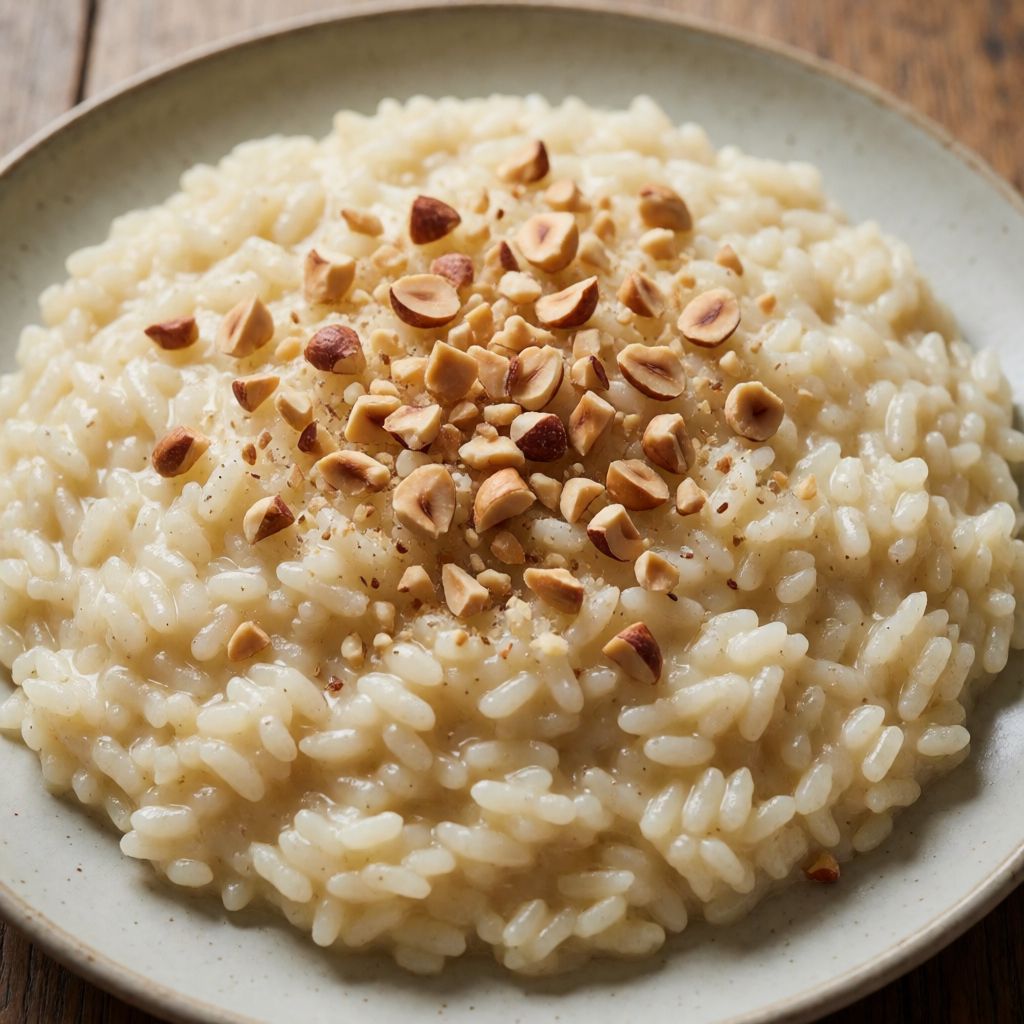
 AI photo
Hazelnut and Fontina Risotto
A creamy risotto with toasted hazelnuts and melted cheese.
Labels are worked out automatically from the ingredients and can be wrong. Check the packaging if it matters to you.
Ingredients
- 320 g Carnaroli rice
- 1/2 pcs Shallot
- 60 g Hazelnuts
- 250 g Fontina cheese
- 125 ml White wine
- Olive oil to taste
- Salt to taste
- Black pepper to taste
- Vegetable stock to taste
- 40 g Butter









Steps
Make the vegetable stock, strain it and keep it hot.
In a pan, over a very low heat, sauté the finely chopped shallot in olive oil.
Add the rice and toast it over a high heat, stirring constantly.
Pour in the white wine and let it evaporate.
Lower the heat and add the stock a little at a time, stirring until the rice is cooked.
Roughly chop the hazelnuts and add them to the rice.
Add salt and black pepper to taste.
Add the diced fontina cheese and stir until it melts.
Remove from the heat and stir in the butter, mixing everything together well.
Plate up and serve.
What was changed
Replaced with Fontina cheese, a cheese more easily found in UK shops.
Risotto is not a rice dish — it's a starch-release process you control with liquid and heat. You're deliberately damaging the rice grain, bit by bit, so it bleeds amylopectin into the pan and turns the whole thing creamy without a drop of cream. This version does it with fontina for richness and toasted hazelnuts for the crunch that says "someone bothered."
What decides whether it works is the toasting at step 3 and the rhythm of liquid after that. High heat on dry rice before any liquid touches it seals the outer layer of each grain just enough that it won't blow out into mush later — skip that and you get risotto that goes from al dente to porridge in the time it takes to answer the phone. Some say you need a kazan-wide pan and a wooden spoon blessed by nonna. No — you need a wide pan because a narrow one steams the rice instead of letting it fry and then simmer in contact with air, and any spoon that doesn't scratch your pan will do.
The second thing that decides it is patience with the stock. "Add it a little at a time" isn't ritual, it's physics: a flood of liquid cools the pan, drops you out of the simmer that's coaxing starch loose, and the rice cooks unevenly — soft outside, chalky core. Small additions, letting each one almost disappear before the next, keep the temperature and the starch exchange steady. There's no clock that replaces this. Time here is a floor, not a target — somewhere past twenty minutes the grain should bend to a bite with the faintest resistance left in the centre, and that's your actual finish line, not a timer going off.
Carnaroli is the right rice because of starch, not status. It carries more amylose than everyday rice, which means it holds its shape right up to the point it releases, instead of collapsing into gum. Arborio is the usual stand-in and will behave, just slightly more forgiving of your mistakes and slightly less silky at the end — fine for a Tuesday, not a scandal either way. What you must not reach for is anything labelled "easy cook" or long-grain rice from your rice-and-peas shelf — that rice is processed precisely so it won't release starch, which is the one thing this dish needs it to do.
The shallot is there for a background sweetness that won't fight the cheese and nuts later; it's milder than onion and cooks gently without throwing off sharp edges. If you've only got a brown onion, use half of it, finely chopped, over the same very low heat, and give it a touch longer so it goes translucent rather than coloured — browning here means burnt sugar flavour creeping into a dish that's meant to taste of nuts and cheese, not caramel.
Hazelnuts give you the one textural contrast in an otherwise smooth dish — stirred in near the end so they stay toasty rather than turning soft and lost in the creaminess. Buy them already roasted if you can, or toast raw ones dry in a pan for a few minutes until the skin smells faintly of chocolate and cracks when you press one — that smell is the sign, not a clock. No hazelnuts in the cupboard, walnuts or toasted almonds will do the same job: crunch and a slight bitterness against the fat of the cheese.
Fontina is a washed-rind Alpine cheese that melts without splitting or going grainy, which matters because you're adding it off direct contact with the base of the pan and relying on residual heat to do the melting. If fontina isn't on your supermarket shelf, go for any cheese that melts smoothly under gentle heat and isn't aggressively salty — a young Gruyère or even a mild Taleggio will behave; a hard, dry cheese like mature cheddar will seize into oily lumps instead of folding in.
The white wine isn't for flavour alone — its acid cuts through the fat of butter and cheese that's coming later, and letting it evaporate properly before the stock starts means you're cooking off the raw alcohol smell, not leaving a boozy edge in the final dish. Any dry white you'd actually drink works; skip anything sweet, it'll unbalance the fontina.
Butter stirred in at the very end, off the heat, is the last mechanical trick: adding it cold-ish into a hot but not boiling risotto lets it emulsify into the starch and stock rather than simply melting and pooling as grease on top — that pooling is usually what people mean when they complain a risotto tastes "heavy." Use a butter with no strong salted-cultured tang if you want the fontina and hazelnuts to lead; if you're out of butter, a knob of a neutral oil will finish the dish, just without quite the same silk.