
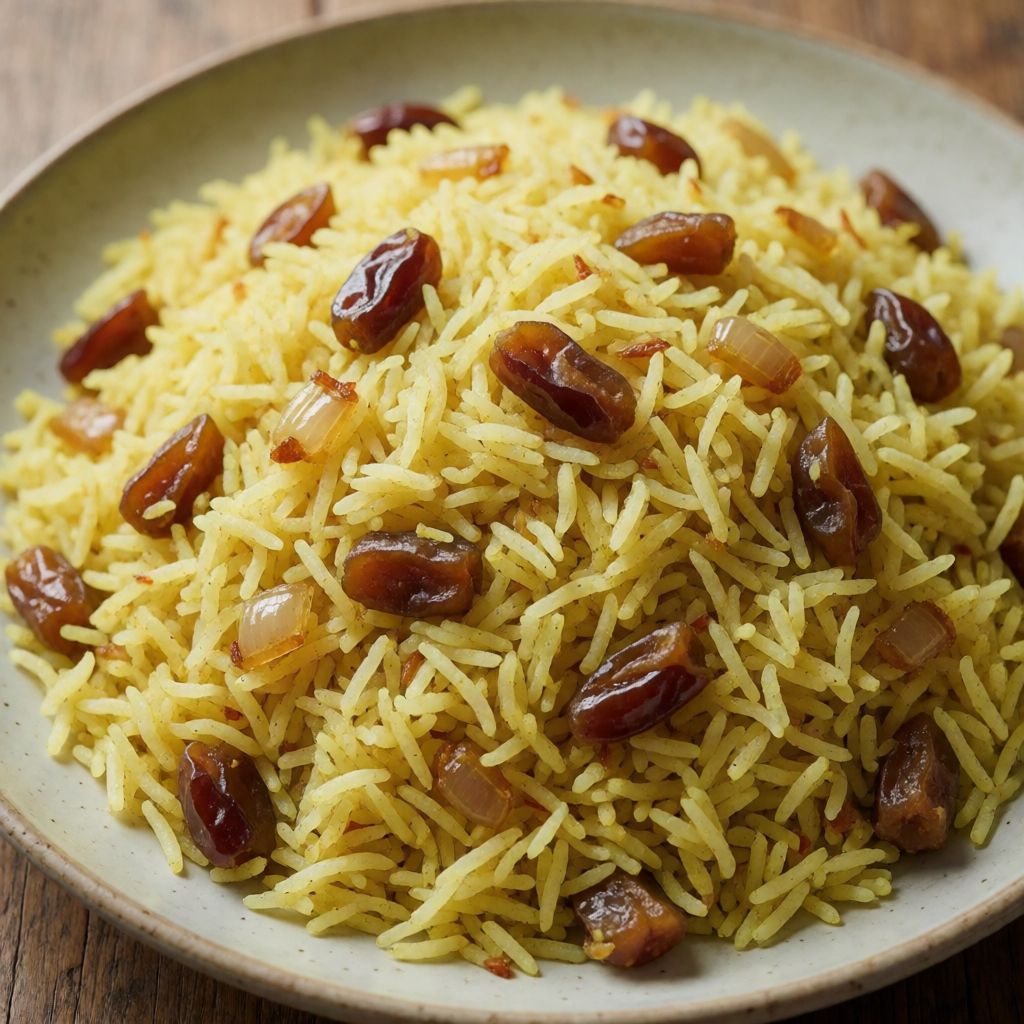
 AI photo
Indian-spiced Rice
A fragrant spiced rice with dates, cashews and warm spices, finished with fresh coriander.
Labels are worked out automatically from the ingredients and can be wrong. Check the packaging if it matters to you.
Ingredients
- 300 ml Basmati rice
- 50 ml Black rice
- 1 pcs Onion finely chopped
- 2 clove Garlic finely chopped
- 2 pcs Dates finely chopped
- 1 tsp Turmeric ground
- 1 pinch Cayenne pepper
- 1 tsp Cardamom ground
- 1 tsp Cinnamon ground
- 0.5 tsp Cloves ground
- 1 tsp Cumin ground
- 30 g Cashew nuts
- 1 bunch Coriander fresh
- 1 tbsp Olive oil for frying
- Salt
- Black pepper freshly ground















Steps
Cook the rice according to the packet instructions.
Heat a little oil in a frying pan and fry the onion and garlic until the onion is soft, then add the chopped dates and spices and mix well.
Add the cooked basmati rice, black rice and cashew nuts and heat through, stirring, for 5 minutes.
5 minSeason with salt and pepper and sprinkle with fresh coriander.
This is pilaf stripped of its throne and put to work as a side dish — two rices, a fistful of spices, a few dates for sweetness, and a job to do: sit next to a curry and not get boring. What decides whether it works isn't the spice list, it's whether you cook the rice separately and correctly before it ever meets the pan, and whether the onion gets properly soft before the spices go in.
The black rice is the tell. It's not basmati's relative, it's a different grain family entirely, with a bran layer that stays chewy no matter how long you boil it. That's the point — against fluffy white basmati it gives you a contrast of textures in the same spoonful, little dark beads that resist while everything else gives. If you cook them together in one pot you lose that contrast; the basmati overcooks waiting for the black rice, or the black rice stays hard waiting for the basmati. Cook them separately, to their own instructions, then marry them in the pan at the end. That's not fussiness, that's the only way the dish has a reason to use two rices at all.
Onion first. "Fry until soft" is doing real work here, not padding out the method — a raw or half-cooked onion stays sharp and bitter under spice, and no amount of simmering afterwards fixes that, because by then it's drowned in rice and starch instead of sitting in open fat where it can actually cook. Give it the time in the pan before anything else goes in. You'll see it: translucent, slumped, losing its structure — not colour, you're not caramelising it here, just softening it. On a domestic hob without a wok's fierce, even heat, that means a slightly lower flame and a bit more patience than you'd think, or the edges catch before the middle softens. Patience here is the ingredient that saves you from a dish that tastes of raw onion wrapped in cinnamon.
Basmati rice: choose it for the long, slender grain and the fact that it's aged — proper basmati is rested for months after harvest, which dries it slightly and is exactly why it separates into distinct grains instead of clumping into porridge. Any long-grain white rice will stand in if that's what's in the cupboard, but you lose the particular dry, fluffy bite that makes this a good carrier for spice rather than a competitor to it. Black rice (sometimes sold as "forbidden rice") brings the bran layer I mentioned — if you can't find it, a short-grain brown rice gets you some chew back, though you lose the colour, which is half the point of putting it in a white rice dish in the first place: dark flecks through pale grains, visible contrast before you even taste it.
Turmeric, cumin, cardamom, cinnamon, cloves, cayenne — this is a home cook's approximation of garam masala, and there's no myth to break here except the idea that you need a named, bought blend to get the effect. Some say you must have an "authentic" masala tin — no, because garam masala itself is a household mix, different in every Indian kitchen, built from what's in the cupboard and toasted to taste. What matters is balance: warm-sweet (cinnamon, cardamom, clove) against earthy-bitter (turmeric, cumin) against one small lick of heat (cayenne). If you're missing one, lean harder on the others rather than leaving a gap — the mix should still smell rounded, not like a single spice shouting over the rest.
Dates, chopped fine: their job is to melt a little in the heat of the pan and leave sweetness in the fat, not to survive as chewy lumps in the finished rice. If you don't have dates, a teaspoon of honey or a few raisins softened in the pan juices does a similar job — something that brings sugar without bringing acidity, because acidity would fight the spices instead of rounding them.
Cashews: raw, unsalted, added at the stirring-through stage so they warm and soften slightly but keep their bite — this isn't a dish where you toast them separately for crunch, it's one where they go soft-crisp, a texture note alongside the rice-against-rice contrast already happening. Any mild nut works if cashews aren't to hand — almonds, even peanuts in a pinch — the criterion is "mild and a bit buttery," not "exactly this nut."
Coriander at the end, uncooked, is for smell as much as flavour — heat kills its particular green sharpness fast, which is why it goes on last, not into the pan. If you genuinely can't stand coriander — and some people's dislike of it is a real taste-receptor thing, not fussiness — parsley gives you green freshness without the specific flavour, though you'll lose the dish's most obviously "Indian" note.
Last thing: oil with no smell of its own — a neutral vegetable oil, or a light olive oil as written — because the dish's aroma is meant to come from spices blooming in fat, not from the fat itself. A strong, grassy extra-virgin olive oil would compete with six spices for attention and lose, taking some of your dinner's clarity down with it.