
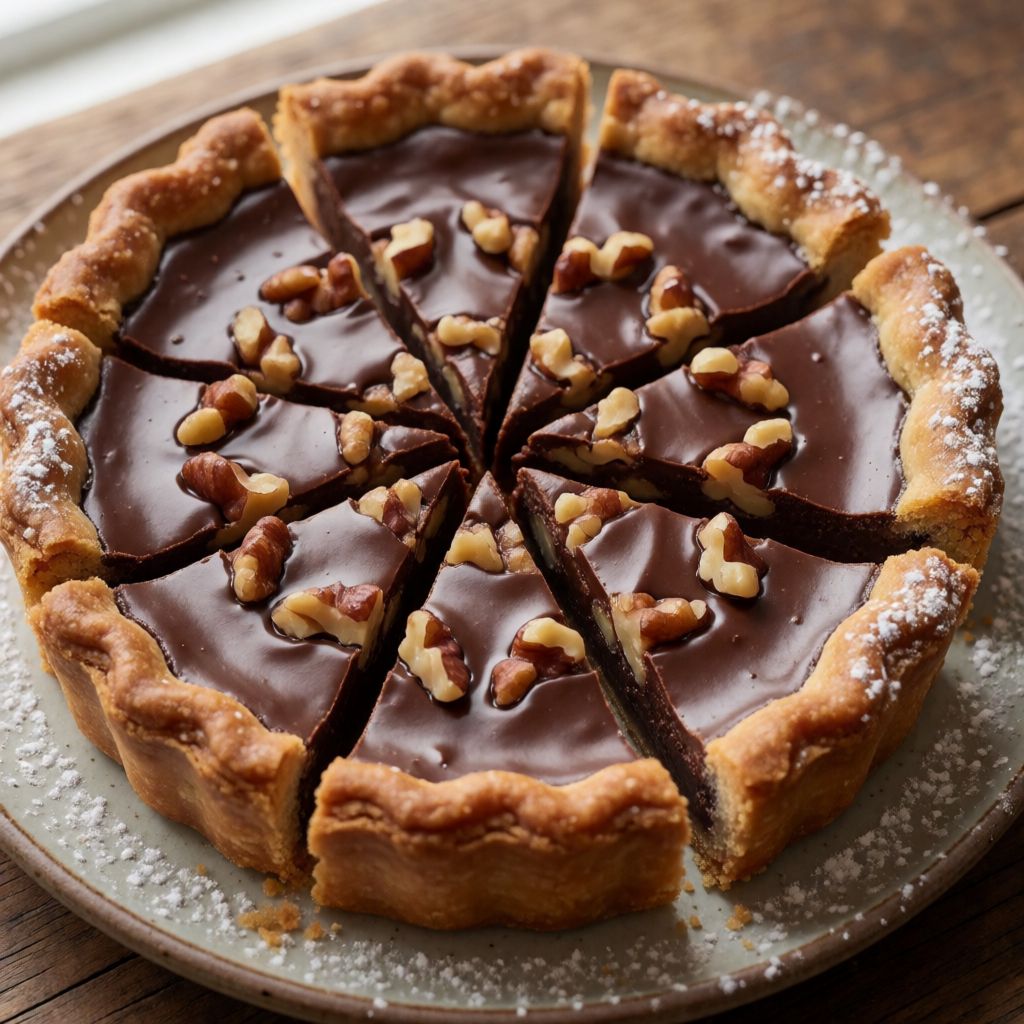
 AI photo
Chocolate and Walnut Crostata
A sweet shortcrust tart filled with ricotta, dark chocolate and walnuts.
Labels are worked out automatically from the ingredients and can be wrong. Check the packaging if it matters to you.
Ingredients
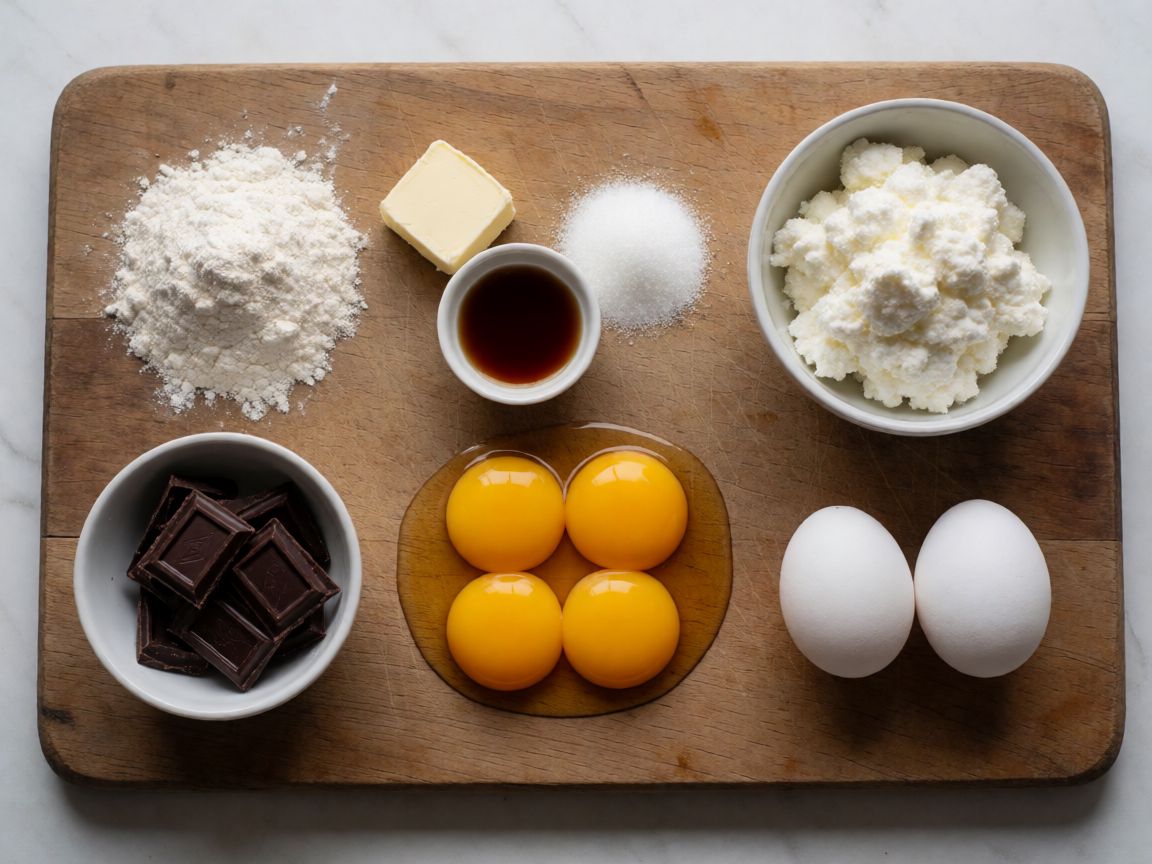
- 340 g Plain flour
- 180 g Butter
- 210 g Caster sugar
- 1 tsp Vanilla extract
- 4 pcs Egg yolks
- 200 g Ricotta
- 200 g Dark chocolate
- 2 pcs Eggs
- 130 ml Milk
- 150 g Walnuts
- Icing sugar to taste










Steps
Make the shortcrust pastry: pile the flour on a surface, make a well and add the diced butter, sugar and egg yolks. Add the vanilla and mix.
Knead energetically until the dough is smooth and soft. Form a ball, wrap in cling film.
Chill the dough in the fridge.
30 minBreak the dark chocolate into pieces and melt over a bain-marie or in the microwave.
Let the chocolate cool slightly. Roughly chop the walnuts.
In a bowl, mix the ricotta with the sugar and whisk.
Add the eggs and melted chocolate, then gradually pour in the milk.
Add the chopped walnuts, then finally the flour.
Roll out the chilled dough with a rolling pin to a thickness of 7–8 mm.
Line a tart tin greased with butter and dusted with flour. Trim off excess dough and prick the surface with a fork.
Spread the filling and level it with a spatula.
Gather the leftover dough, roll it out and cover the filling, pinching the edges. Prick the top layer with a fork.
Bake in a preheated fan oven at 160°C until the pastry is golden.
Alternatively, bake in a conventional (non-fan) oven at 170°C until the pastry is golden.
Leave the crostata to cool, remove from the tin and dust with icing sugar if desired.
This is a closed tart — pastry underneath and pastry on top, not the open-faced kind you're used to seeing on a cake stand. Inside: a dark filling that's half chocolate custard, half cheesecake, with walnuts for crunch. The flavour is not the risk here — chocolate and ricotta get along fine without help. The risk is structural: does the base survive a wet filling without going soft, does the filling set into something you can slice rather than something that oozes, and does the lid let its steam out instead of blistering.
That's why the pastry is rolled thick — 7–8mm, thicker than you'd ever roll for an open tart. A thin wall under a loose, egg-and-milk filling is how you end up with a soggy, see-through patch in the middle by the time the top is cooked. The extra millimetres buy the base time to firm up before the filling's moisture can get through it. The fork pricks on the lid aren't decoration either — the filling has eggs and milk in it, which means steam, and steam trapped under a sealed pastry roof either cracks it or puffs it into a dome that collapses later. Give the steam a door and it behaves.
On the flour: plain, soft flour, which is exactly what UK 'plain flour' is — low in the protein that makes gluten. Don't reach for strong or bread flour here even though the method involves firm kneading; strong flour would develop toughness regardless of the fat-coating trick, because there'd be more gluten-forming protein to develop in the first place.
Butter goes in diced, not melted and not fridge-hard — pliable enough to mash into the sugar and yolks with your hands, firm enough that it doesn't just turn to grease. Any butter will do, salted won't hurt a sweet pastry in the quantities here. Sugar does double duty across the recipe: in the pastry it tenderises as much as it sweetens, getting between flour particles and limiting gluten the same way the fat does; in the filling it's just sweetness against bitter chocolate, so taste your chocolate before deciding whether 210g is even the right split between the two uses — a very dark chocolate wants more sugar nearby, a milkier one less.
Four yolks in the pastry, two whole eggs in the filling — that's not an oversight, it's two different jobs. Yolks bring fat and richness without much water, which again keeps the pastry short. Whole eggs in the filling bring the white's protein, which is what actually sets a custard as it heats — without it you'd have sweetened melted chocolate and cheese that never firms up, however long you bake it.
Ricotta is the filling's backbone: a fresh, mild, slightly grainy cheese with some whey still in it, not a dense block cheese. If you can't get ricotta, a well-drained curd cheese or sieved cottage cheese gets you close — the criterion is low density and a bit of moisture, not richness. Cream cheese is the wrong substitute; it's too fatty and too smooth, and the filling comes out heavy instead of light. Milk, poured in gradually after the eggs and chocolate, is there to loosen that density back down — and the small last addition of flour in the filling is what claims that moisture back, so the whole thing bakes into a sliceable custard instead of weeping liquid into your pastry case. There's only one flour measurement on the list because most of it goes into the pastry at the start and a spoonful or two is held back for exactly this job — a gap in the written quantities, not in the logic.
Melt the chocolate over a bain-marie or in short microwave bursts, not in a pan over direct flame — chocolate scorches before it looks scorched, and once the sugar in it catches, it turns grainy and bitter rather than smooth, no matter how much you stir. Any dark chocolate with a cocoa percentage you actually enjoy eating works; avoid chocolate chips sold for baking, which are formulated with stabilisers to hold their shape in cookies, which is precisely the opposite of melting smoothly here. Walnuts just need to stay walnuts under heat — pecans are the closest swap, hazelnuts work but bring their own toastier flavour that competes a little with the chocolate.
On the oven: the recipe gives you two numbers because UK kitchens split between fan and conventional ovens, and that's not fussiness — a fan moves hot air around the cavity fast and evenly, so it reaches the pastry's surface quicker at a lower set temperature; a conventional oven relies more on radiant heat and natural convection, slower and patchier, so it needs a higher dial setting to get the same colour in the same rough window. Use whichever number matches what your oven actually has — don't average them. And once it's out, resist cutting it warm out of eagerness; the filling is still finishing its set as it cools, and the icing sugar at the end only sits as a visible dusting on a cooled, dry surface — dust it over anything still warm and it just melts into a shine. Patience, here, is the last ingredient on the list, even though nobody writes it down. Six slices, with tea, once it's properly cool, is the whole point of making one.