
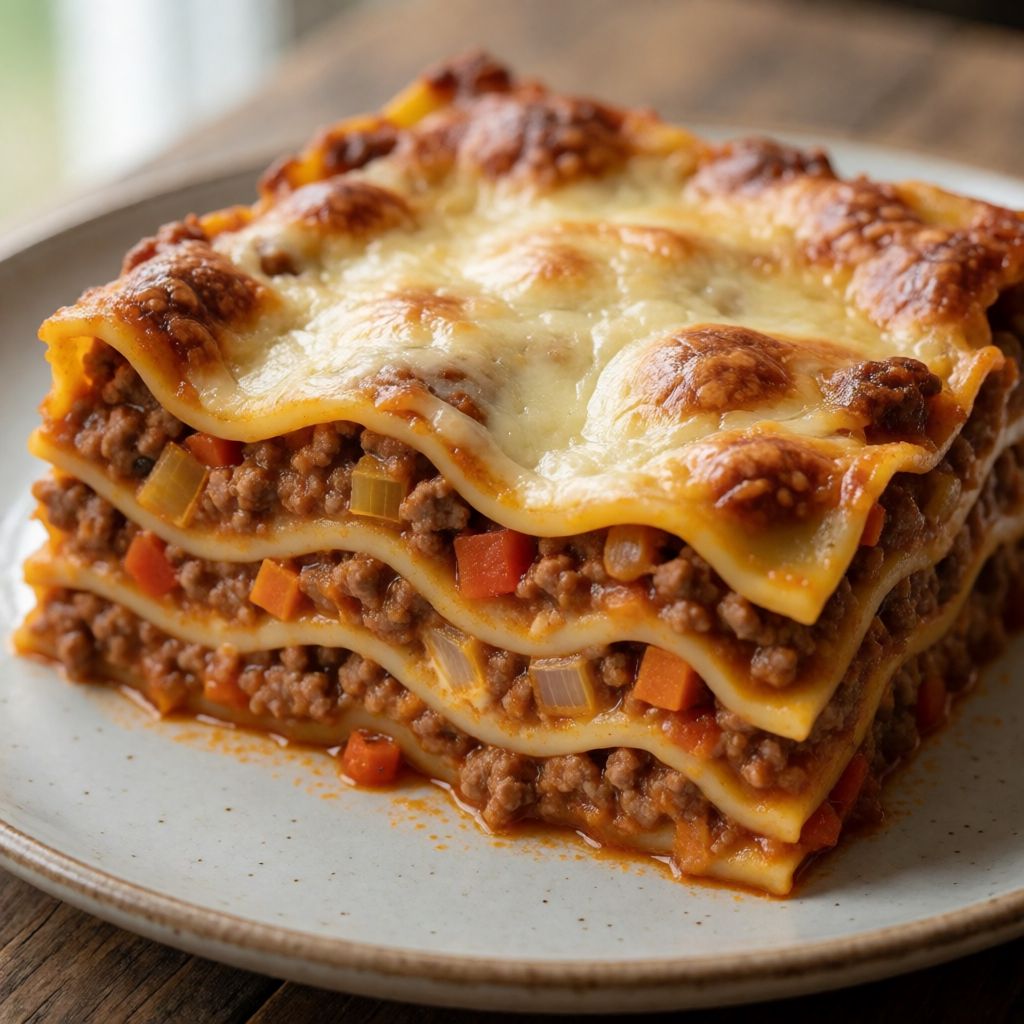
 AI photo
Lasagne
A hearty beef lasagne layered with slow-cooked ragù and a creamy béchamel sauce.
Labels are worked out automatically from the ingredients and can be wrong. Check the packaging if it matters to you.
Ingredients
- 2 pcs Onion finely chopped
- 4 clove Garlic finely chopped
- 400 g Beef mince
- 2 tsp Oregano dried
- 1 tsp Dried thyme
- 4 pcs Carrot coarsely grated
- 5 pcs Celery sticks coarsely grated
- 1 pcs Courgette coarsely grated
- 50 g Tomato purée
- 800 g Tinned chopped tomatoes
- 100 ml Wine
- 2 tbsp Olive oil
- Salt
- Black pepper freshly ground
- 2 tbsp Butter
- 2 tbsp Plain flour
- 300 ml Milk
- 1 pinch Nutmeg finely grated
- 125 g Mozzarella fresh
- Salt
- Black pepper freshly ground
- 200 g Lasagne sheets
- 125 g Mozzarella for the top layer, fresh




















Steps
Fry the onion and garlic in olive oil until the onion softens.
Add the mince and fry on high heat until browned.
Reduce the heat and add the remaining ingredients.
Let the sauce simmer gently, covered, for 2–6 hours, the longer the better.
240 minTaste the sauce occasionally and add more spices, tomato purée, chopped tomatoes, salt and pepper to taste as needed.
If the sauce seems too dry, add a little vegetable stock, but it's best to do this after it has simmered for about 1 hour.
60 minMelt the butter in a saucepan, add the flour and whisk until it forms a smooth paste.
Gradually pour in the milk in small amounts, whisking until it reaches a sauce-like consistency.
Add the cheese and whisk until fully melted.
Season with grated nutmeg, salt and pepper.
Spread a layer of béchamel sauce in a greased ovenproof dish.
Alternate layers of ragù and lasagne sheets, finishing with a layer of sauce.
Top with a layer of béchamel sauce and thinly sliced mozzarella.
Bake the lasagne in a fan oven preheated to 175°C for about 20–25 minutes, until the lasagne sheets are soft but still slightly firm.
22 min
Lasagne isn't really a pasta dish wearing a sauce — it's two sauces, a ragù and a béchamel, stacked with dried pasta sheets acting as blotting paper that steals just enough moisture from both to cook itself through. Get the sauces right and the sheets are almost incidental. Get them wrong — too wet, too dry — and no amount of time in the oven saves it.
What decides whether this works is patience in the ragù, not skill in the layering. Four hours on a bare simmer turns a pot of mince and tinned tomatoes into something with actual depth, because that's how long it takes collagen in the meat to break down and the vegetables to give up their water and sugar slowly enough to concentrate rather than scorch. Twenty minutes of enthusiastic boiling gives you tomato soup with mince in it. Some say a lasagne ragù is just bolognese with extra vegetables — no, because bolognese is often eaten within the hour it's made, while a proper lasagne ragù wants to sit, even overnight, so the sauce thickens and the flavours settle into each other rather than sitting side by side.
The béchamel is the quieter half of the job but it's doing real structural work: it's the glue and the moisture reservoir that keeps the top layer of pasta from drying into cardboard in the oven, and it's what stops the whole dish collapsing into a wet, sliding mess when you cut it. A béchamel that's too thin runs straight through the layers and pools at the bottom of the dish; too thick and it won't spread, it just sits in clumps and leaves the pasta starved of liquid.
Onion and garlic go in first and only until the onion softens — not browns. Brown it here and you've built a bitter edge into four hours of sauce you can't fix later; soft and translucent means the raw sulphur compounds have cooked off without the sugars caramelising yet. The mince then wants proper heat, high enough to brown rather than stew in its own juice. That browning — the Maillard reaction, the same thing that happens on a Sunday roast joint — is where the savoury depth comes from; mince added to a timid pan just greys and weeps water, and that water is exactly what waters down your sauce before it's even started.
Carrot, celery and courgette are grated coarsely rather than diced for a practical reason: they dissolve into the sauce over the long simmer instead of sitting there as stubborn chunks, and they're doing a job your nose will recognise as sweetness and body, not as "vegetables in a meat sauce." Courgette particularly is mostly water — it's there to soften and vanish, not for flavour, so don't mourn it if you leave it out; use any soft, watery vegetable you have, or skip it and reduce the sauce a touch longer to compensate.
The wine isn't for flavour as itself — by the time it's simmered for hours you won't taste "wine," you'll taste the acidity it leaves behind, which is what cuts through the richness of the mince and butter later. Any dry wine does this; if you've none open, a splash of vinegar diluted in stock does the same acidic job, just less generously.
For the oil, "olive oil" here is doing nothing an oil with no smell of its own couldn't do just as well, since its character gets cooked out over four hours anyway — sunflower or a light vegetable oil works fine; save a good extra virgin for drizzling raw over something that stays cold.
Butter and flour cooked together before the milk goes in is simply making sure the flour's raw starch grains are coated in fat and cooked through, so the sauce thickens smoothly instead of leaving you with a lumpy, chalky paste — pour cold milk straight onto raw flour and you get exactly that, lumps that whisking alone won't fully rescue. Nutmeg is traditional in béchamel for a reason rooted in cost and history, not magic: it was one of the few warm spices that didn't fight with dairy, and a pinch still lifts milk-based sauces without announcing itself — leave it out and nobody at the table will accuse the dish of anything, but it'll taste a touch flatter.
Mozzarella melted into the béchamel itself, rather than only on top, means the middle layers have some stretch and richness too, not just the top crust everyone fights over. Fresh mozzarella rather than the dry block sold for pizza toppings matters here because fresh mozzarella carries water that helps it melt smoothly into the sauce; the drier block tends to go stringy and separate rather than blend.
At 175°C fan the job left to the oven is modest: finish softening the dried pasta sheets using the moisture trapped between the layers, and colour the top. Twenty minutes is the lower bound, not a deadline — judge it by whether a knife slides into the centre with no resistance from a stiff, uncooked sheet, and by a top that's gone from pale to properly golden, blistered in places. Some say you must pre-cook lasagne sheets first — no, because if your sauces carry enough moisture, dried sheets cook perfectly well in situ, and pre-boiling them just adds washing-up and a risk of tearing fragile sheets before they've even gone in the dish. Let the finished dish sit ten minutes out of the oven before cutting — it's not optional, it's the béchamel setting enough to hold a slice together instead of sliding apart on the plate.