
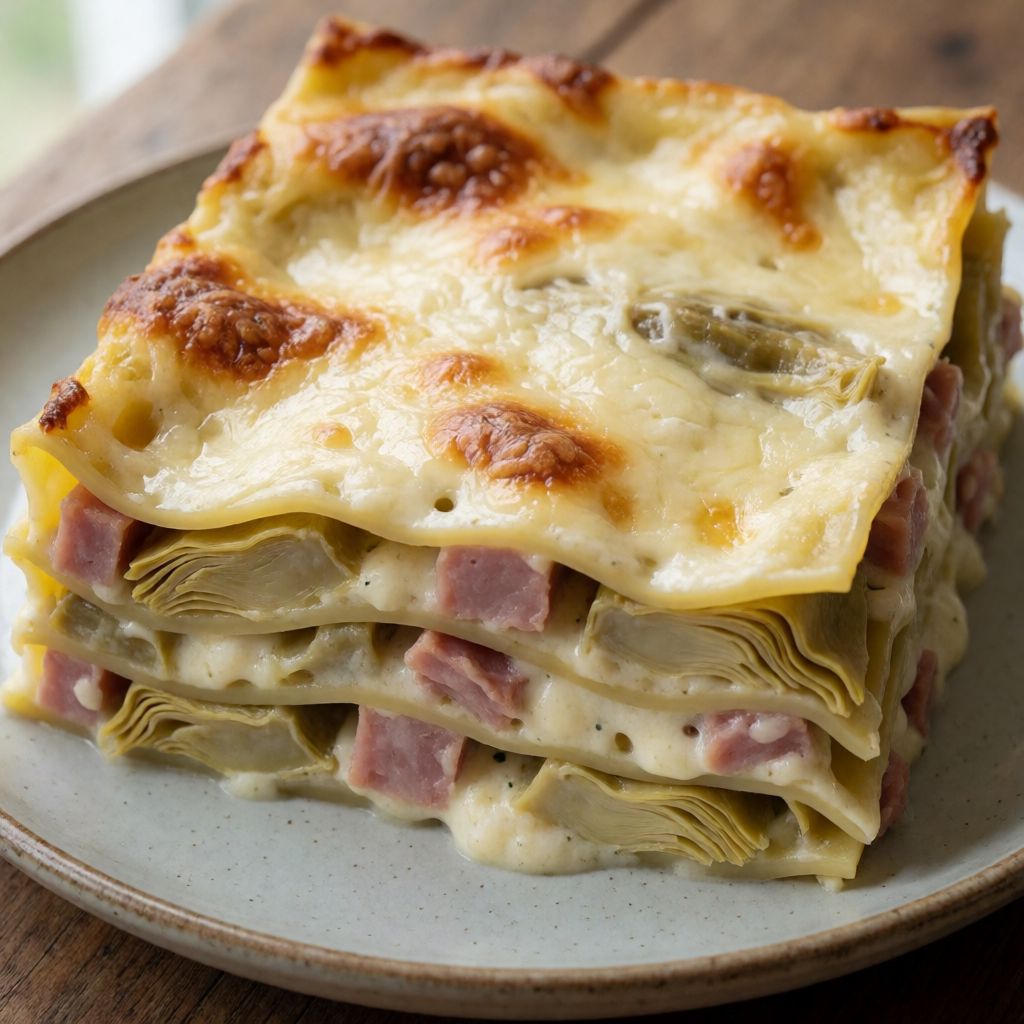
 AI photo
Lasagne with Artichokes and Ham
A rectangular bake of layered lasagne sheets, artichokes, ham and béchamel, finished with a crumb of hard cheese.
Labels are worked out automatically from the ingredients and can be wrong. Check the packaging if it matters to you.
Ingredients
- Lasagne sheets
- 1 clove Garlic
- 300 g Artichoke
- 500 g Béchamel sauce
- Parmesan to taste
- 150 g Ham
- Salt to taste
- Black pepper to taste
- Olive oil to taste
- Butter to taste
- Parsley to taste











Steps
Cut the cleaned artichokes into wedges and fry in olive oil together with finely chopped garlic and parsley.
Cover with a lid and simmer gently for 10 minutes, until the artichokes have softened.
10 minLet the artichokes cool.
Butter a rectangular baking dish and spread a spoonful of béchamel over the base.
Arrange the lasagne sheets and build up to 5 layers, alternating artichokes, ham, béchamel and Parmesan.
Spread the top layer with béchamel, sprinkle with Parmesan and dot with small pieces of butter.
Bake at 180°C for 25 minutes.
25 minServe, sprinkling with extra Parmesan.
What was changed
The hard cheese was changed to Parmesan, as this is the hard cheese sold in local shops.
This is lasagne built around a vegetable that most people only meet pickled in a jar or hidden in a dip — the globe artichoke, cut into wedges and fried until it gives up its raw, slightly bitter edge. Everything else in the dish — ham, béchamel, Parmesan — is there to support that one ingredient, not compete with it. Get the artichoke right and the rest looks after itself; get it wrong and you've just made a bland white lasagne with some green bits in it.
What decides whether this works is step two, the quiet ten minutes under a lid. Frying alone browns the outside of the wedges but leaves the core fibrous — artichoke hearts have a dense, almost woody structure, and raw heat only toughens the surface before the inside has softened. The lid traps steam, which cooks the artichoke through gently, the way braising does. You're looking for the wedge to go from snapping to bending, from grey-green to a softer olive colour. Ten minutes is where to start checking, not where to stop.
Some say artichokes need lemon water and endless trimming or they'll turn black and bitter in your hands. True, raw cut artichoke oxidises fast — but once it hits hot oil, that's over; the enzyme causing the browning is destroyed by heat in seconds. So don't fuss over it once it's in the pan. Fuss over it before, when you're cutting away the tough outer leaves and the choke.
The artichoke is doing the job a mushroom or a courgette does in other lasagnes — adding bulk and a savoury, slightly mineral note without being the point of the whole dish. Fresh globe artichokes in a British supermarket are not common and not cheap, and trimming them is fiddly work with a knife, leaving your fingers stained. If fresh ones aren't to hand, frozen artichoke hearts, already trimmed, do the job with far less effort — just fry them a little less long since they're already partly cooked. Tinned or jarred artichokes in oil or brine are the fallback: drain them well, pat dry, and fry briefly just to drive off the liquid clinging to them, otherwise that liquid waters down your béchamel from inside the lasagne.
The ham is there for salt and a meaty backbone, not for its own flavour to dominate — any sliced, cooked ham works, and this is exactly the kind of dish where leftover Sunday roast ham earns its place, since a lasagne doesn't care that the ham came from a joint rather than a packet. Cured Parma-style ham would be wasted here; its delicacy disappears under baking heat and béchamel. You want something with a bit of chew and savour that survives the oven.
Béchamel is butter, flour, milk — nothing more mysterious than that, and if yours splits or goes lumpy it's almost always because the milk went in too fast against flour that hadn't cooked long enough to lose its raw taste. Ready-made béchamel from a carton is a reasonable shortcut on a weeknight; just taste it before using, because shop versions are often under-salted for a dish like this one where the sauce has to carry seasoning through several layers of bland pasta.
Parmesan is for two things: salt and that long, nutty depth that plain milk and flour don't have on their own. A hard, aged cheese with no soft stretch to it is what you need — grana padano is the obvious substitute if parmesan isn't in the fridge, and in truth most British kitchens have one or the other rather than both.
Butter dotted on top before baking isn't decoration — it melts down through the Parmesan crust and keeps it from drying into a hard shell before the inside has had its 25 minutes to heat through properly. A UK domestic oven runs hotter at the top than the dial suggests, especially fan ovens, so check the top layer a little before the stated time if yours runs fierce — you want gold, not the brown edge of something starting to catch.
Garlic and parsley in the frying pan are there to season the oil the artichokes cook in, not to be tasted as themselves afterwards — chop them fine so they melt into the dish rather than turning up as a stray clove on someone's fork. And olive oil here wants to taste of something; a basic one is fine, since its character gets folded into béchamel and cheese anyway, so there's no need to reach for your best bottle for this.
Patience sits in two places in this recipe, and both get skipped by people in a hurry. Let the fried artichokes actually cool before layering — hot vegetable straight into raw pasta sheets starts cooking the béchamel's structure unevenly and you end up with a slick, separated sauce once baked. And once it's out of the oven, give it five or ten minutes before cutting — the layers are held together by béchamel that's still setting from liquid to something closer to a sauce with body, and a knife through it too soon just collapses the whole stack onto the plate.