
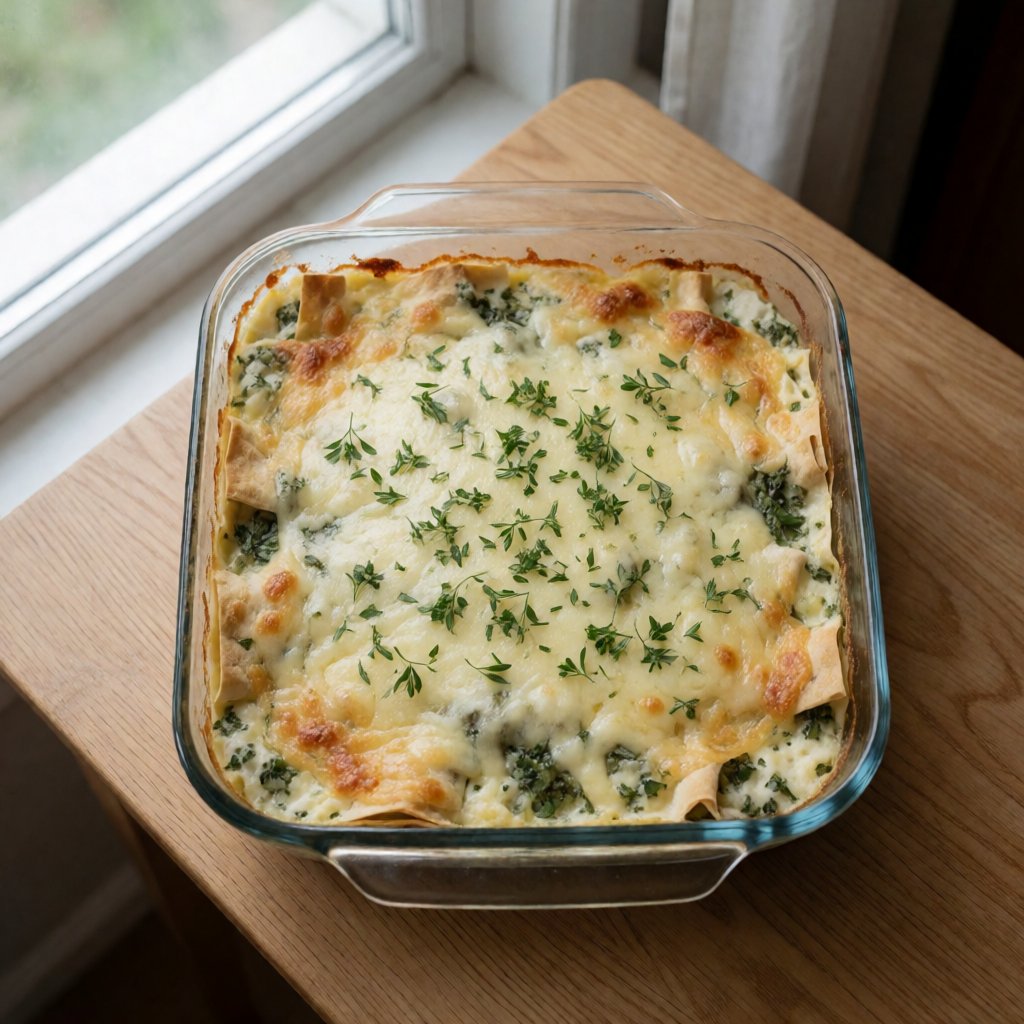
 AI photo
Lavash Casserole with Cheese and Greens
A quick savoury bake of layered lavash, cheese and herbs, baked until golden.
Labels are worked out automatically from the ingredients and can be wrong. Check the packaging if it matters to you.
Ingredients
- 120 g thin lavash 2 sheets
- 150 g feta cheese crumbled
- 20 g fresh herbs chopped
- 2 pcs eggs
- 100 ml kefir
- 1 pinch salt to taste



Steps
Beat the eggs with the kefir. Crumble the cheese and mix it with the chopped herbs.
Layer the dish: lavash, a little of the egg mixture, cheese, and continue layering until everything is used up.
Pour over the remaining egg mixture.
Place the dish in the oven for 25 minutes.
25 minRemove the dish from the oven.
What was changed
We used feta cheese, which is easy to find in UK supermarkets and was already suggested by the author as an alternative.
This is bread pudding, Caucasian style — except the bread is lavash and the custard is salted with feteta rather than sugar. Stale flatbread, a few eggs, kefir, cheese, a handful of greens: the kind of thing a Georgian or Azerbaijani cook makes on a Tuesday because there's half a loaf of lavash going dry and three eggs in the fridge, not because anyone wrote it down first. The dish came after the thrift, not the other way round.
What decides whether it works is absorption, not assembly. Thin sheets of dry lavash soak the egg-and-kefir mixture evenly only if you give the liquid somewhere to go — a little custard, a scatter of cheese, another sheet, repeat. Pour the whole mixture on top at the end and you get a soggy crust and a dry middle; the layering in step 2 is what prevents that, it's not decoration.
Forget minutes as your main clock. An egg-based filling sets by what it does, not by how long it's sat in the oven: the top turns from pale and wet-looking to matte gold, the sides pull a little away from the dish, and if you nudge the centre with a knife it holds its shape instead of sloshing. Twenty-five minutes is where to start checking, not where to stop thinking.
Some say you should soak or steam the lavash first, the way you'd soften pasta sheets for lasagne. No — because the whole point of using it dry is that it can still absorb liquid from the custard while baking and hold a shape. Pre-soak it and you've made wet paper; it collapses into one sticky mass with nothing left to layer.
Lavash itself is just flour, water, a pinch of salt, rolled thin and baked hot and fast — no fat in the dough, which is exactly why it drinks up the egg mixture instead of resisting it the way a buttery pastry would. In a British kitchen the honest substitute is a plain flour tortilla wrap, which is built the same way and behaves the same way in a custard. Filo won't do the job — it's layered with butter or oil between the sheets specifically to crisp and separate, which is the opposite of what you want here.
The egg and kefir together are doing two different jobs. Egg protein is what sets solid when it gets hot enough — that's the whole mechanism of the dish, the custard going from liquid to sliceable. Kefir's job is acidity: it loosens the egg's structure just enough to keep the set tender rather than rubbery, and its sourness cuts against the saltiness of the feta so the whole thing doesn't taste one-note. If you've no kefir, use plain yoghurt thinned with a splash of milk or water to the same pourable consistency — buttermilk works too. Plain milk alone will do in a pinch, but the dish will taste flatter and the texture firmer, more like a quiche filling than this.
Feta — proper feta in a block, kept in its own brine, crumbled by hand just before you use it. The pre-crumbled bags sold dry have usually lost moisture and picked up a chalky edge from the anti-caking powder dusted on them, and they won't release the same savoury juice into the custard. If feta's not to hand, any salted, crumbly curd cheese that doesn't melt to liquid will stand in — a young Lancashire, a salted ricotta, even paneer with extra salt worked through it. Taste the cheese before you add the separate pinch of salt; feta varies a lot in saltiness batch to batch, and it's easy to double up by habit.
The herbs aren't garnish, they're there to cut the richness of egg and cheese with something green and a little bitter — dill, parsley, coriander, whatever's growing or going soft in the fridge, finely chopped so it distributes rather than clumping in one layer.
You don't need a kazan or anything special for this — any oven dish sized for two will do, a small gratin dish or even a loaf tin, deep enough to hold three or four layers without the top scorching before the middle sets. And once it's out of the oven, leave it five minutes before you cut it. That's patience doing the cheese's work for it: the custard carries on firming as it cools, and a dish cut straight from the oven will run egg onto the plate instead of holding a clean edge.
·