
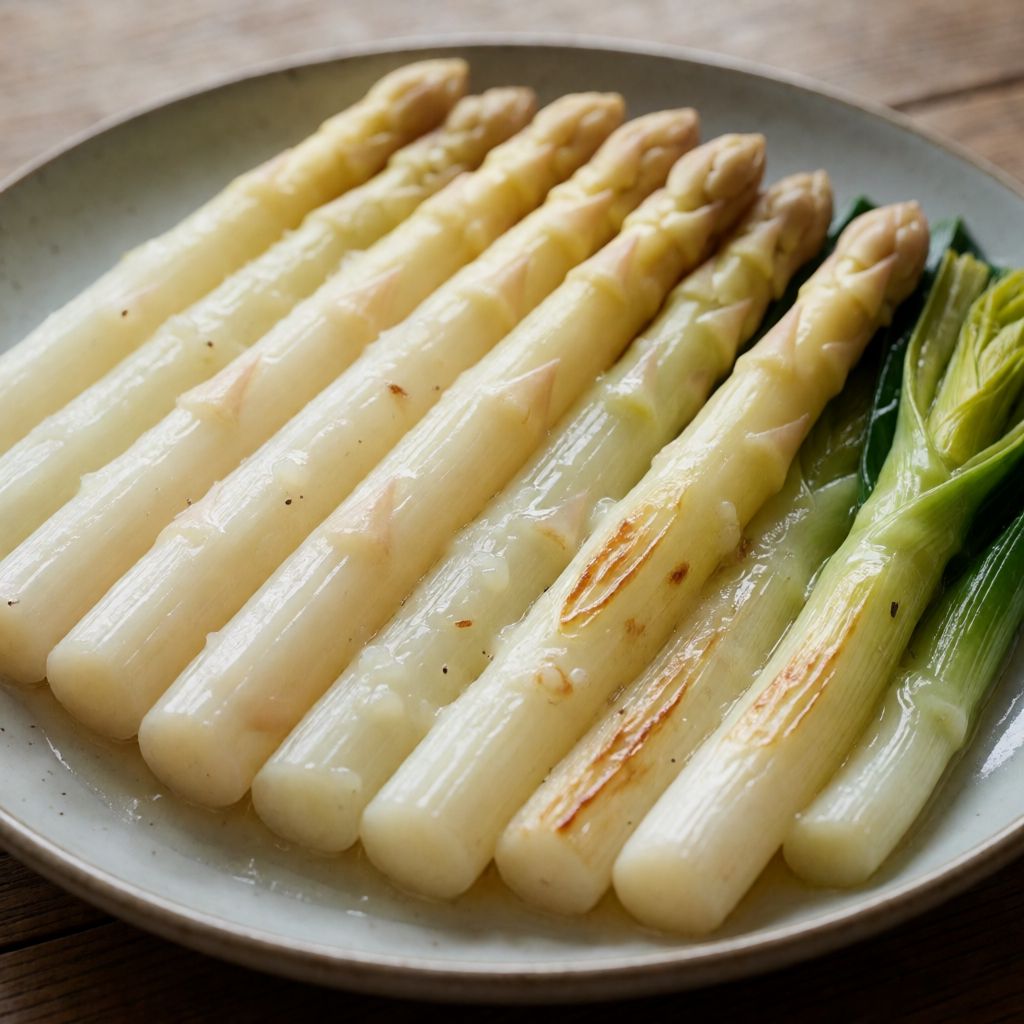
 AI photo
Young Leeks with White Asparagus
A simple side dish of tender young leeks and white asparagus with a honey-mustard butter dressing, parmesan and dill.
Labels are worked out automatically from the ingredients and can be wrong. Check the packaging if it matters to you.
Ingredients
- 1 package Asparagus
- 3 pcs Leeks
- 2 tbsp Butter
- 1 tsp Honey
- 1 tsp Dijon mustard
- 0.5 pcs Lemon juice and finely grated zest
- 30 g Parmesan freshly grated
- 1 bunch Dill
- Salt to taste
- Black pepper to taste, freshly ground







Steps
Peel the white asparagus and snap off the woody ends. Trim the green tops and ends from the leeks, then halve them lengthways.
Bring lightly salted water to the boil in a saucepan, add the asparagus and leeks, and cook for 2 minutes.
2 minDrain and arrange the vegetables on a serving plate.
Melt the butter in a small saucepan, pour into a bowl and whisk with the honey and Dijon mustard.
Season with lemon juice and zest. Spoon over the warm leeks and asparagus, then sprinkle with the parmesan, dill, salt and pepper.
This is not really a cooked dish — it is two minutes of blanching followed by dressing, and almost everything that matters happens before the water even boils. You peel the asparagus and halve the leeks, you make a small emulsified butter sauce, and then you commit for exactly as long as it takes the vegetables to turn from raw to barely done. There is no simmering, no reduction, nothing to rescue a mistake once it's made — so the two minutes carry more weight than two minutes usually do.
What decides whether this works is not the cooking at all. It's the thinness of what you buy. Young, pencil-slim white asparagus and slim spring leeks cook through in that short dunk; anything thicker or older will still be raw in the core at two minutes, or you'll have to push the time and lose the crispness that's the whole point. So buying right is most of the recipe.
The other hinge is the sauce. Melted butter, lemon juice, honey and mustard whisked together shouldn't really want to stay together — fat and water don't mix on their own. The mustard is doing a job here, not just adding flavour: it's an emulsifier, holding the butter and the acid in one sauce instead of letting them separate into a greasy pool with a sour puddle underneath. Get that whisk going properly and you have a thin warm vinaigrette that clings; skip it or rush it and you get melted butter with lemon juice floating in it, which is a different and worse thing.
White asparagus is white because it never sees daylight — the grower mounds soil over the row as the spears push up, so there's no chlorophyll, no green. That mounding is hand labour, done blind, spear by spear, which is exactly why it costs more than the green kind and why it has a season rather than being on the shelf all year. It isn't a superior vegetable, just a more expensive one to grow, and that expense is the whole story — no mystique required. Peeling it matters because that underground growth also builds a thicker, slightly bitter skin than green asparagus ever needs; green you just snap at the point where it naturally gives, white you peel first and then snap. If you can only get green asparagus, use it — skip the peeling, keep the snap, keep the two minutes.
Leeks: buy the slim, young ones meant for this, not the fat winter leeks sold for soup. A young leek halved lengthways cooks at the same rate as thin asparagus; a thick one won't, and you'll end up with raw layers hiding inside a softened outside. If slim leeks aren't to be found, baby leeks or even thick spring onions, trimmed the same way, will behave similarly in the water.
Butter carries the sauce, and here it's doing more work than usual, so use a butter you'd actually taste on its own — this dish has almost nothing else going on, fat-wise, to hide behind. If you need to avoid dairy, a mild olive oil will carry the lemon and mustard well enough, but you lose the particular roundness butter gives; choose something with no sharp flavour of its own to fight the citrus. The honey isn't for sweetness as such — it's there to take the edge off the lemon and the mustard so the sauce doesn't read as simply sour. Any mild syrup does the same job if you're out of honey. The mustard is the one ingredient you shouldn't substitute loosely: its job is binding fat to water, and Dijon has the smoothness and bite to do that cleanly. Wholegrain will work too, but you'll get flecks of seed through a sauce that's meant to be glossy.
Parmesan here is salt and savour in solid form, so the criterion is a hard cheese that grates to a fine, dry powder rather than clumping — Grana Padano does the same job, pecorino will do it saltier and sharper. Dill brings an aniseed note that's the traditional partner to asparagus right across northern and eastern Europe; parsley or chervil will stand in if you have neither dill nor the inclination, but you're changing the character of the dish a little, not just substituting a herb.
Two last mechanical points worth knowing. Dress the vegetables while they're still warm, not once they've cooled on the plate — butter sauce set against cold vegetables starts to firm up and separate again, and you'll be eating little solid flecks of butter instead of a sauce. And don't let the asparagus sit in the hot water a moment past that bend-not-snap point: the stem is thin enough that overcooking turns pectin to mush fast, and there's no browning or reduction step later to disguise it. As a side next to a roast, this is a small, quick dish — the patience it asks for is all spent at the peeler and the chopping board, not at the hob.