
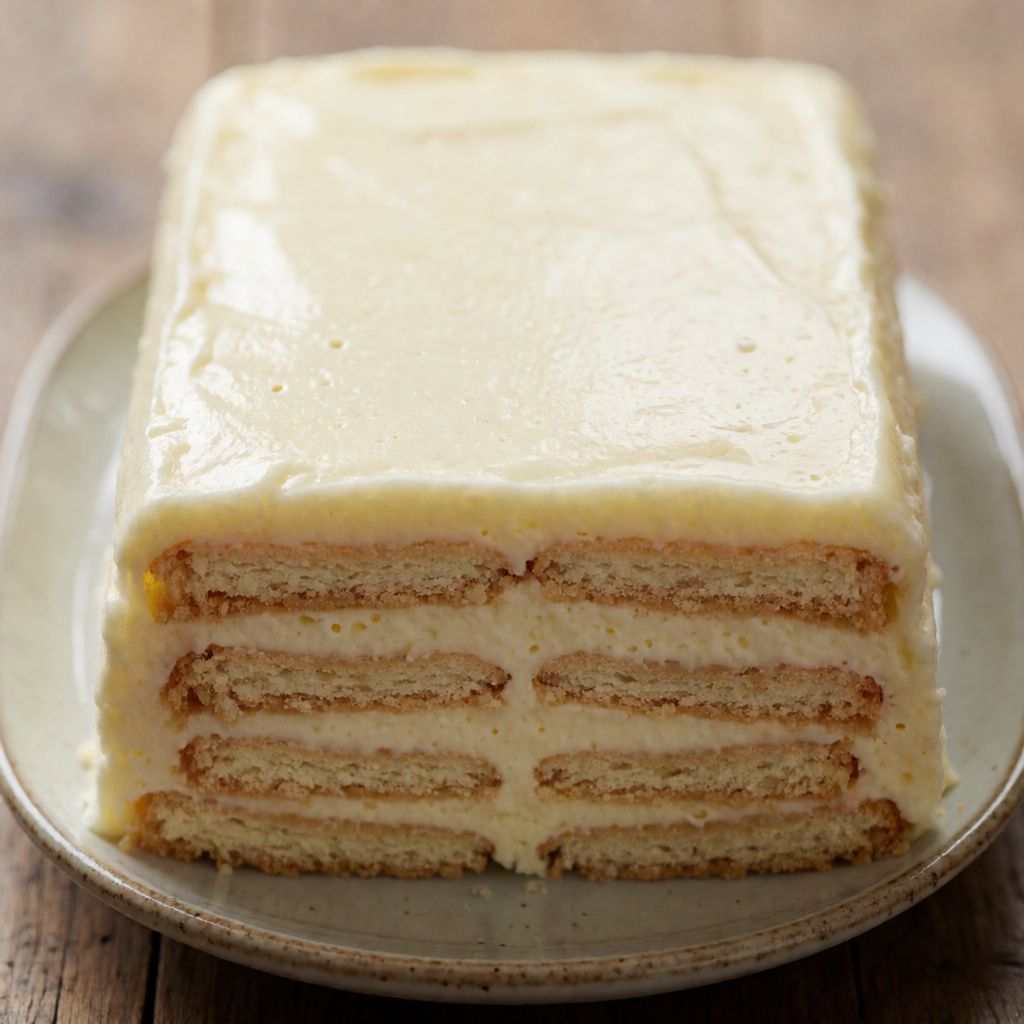
 AI photo
Easy No-Bake Savoiardi and Lemon Cream Cake
A no-bake dessert of milk-soaked savoiardi biscuits topped with a tangy lemon custard cream.
Labels are worked out automatically from the ingredients and can be wrong. Check the packaging if it matters to you.
Ingredients
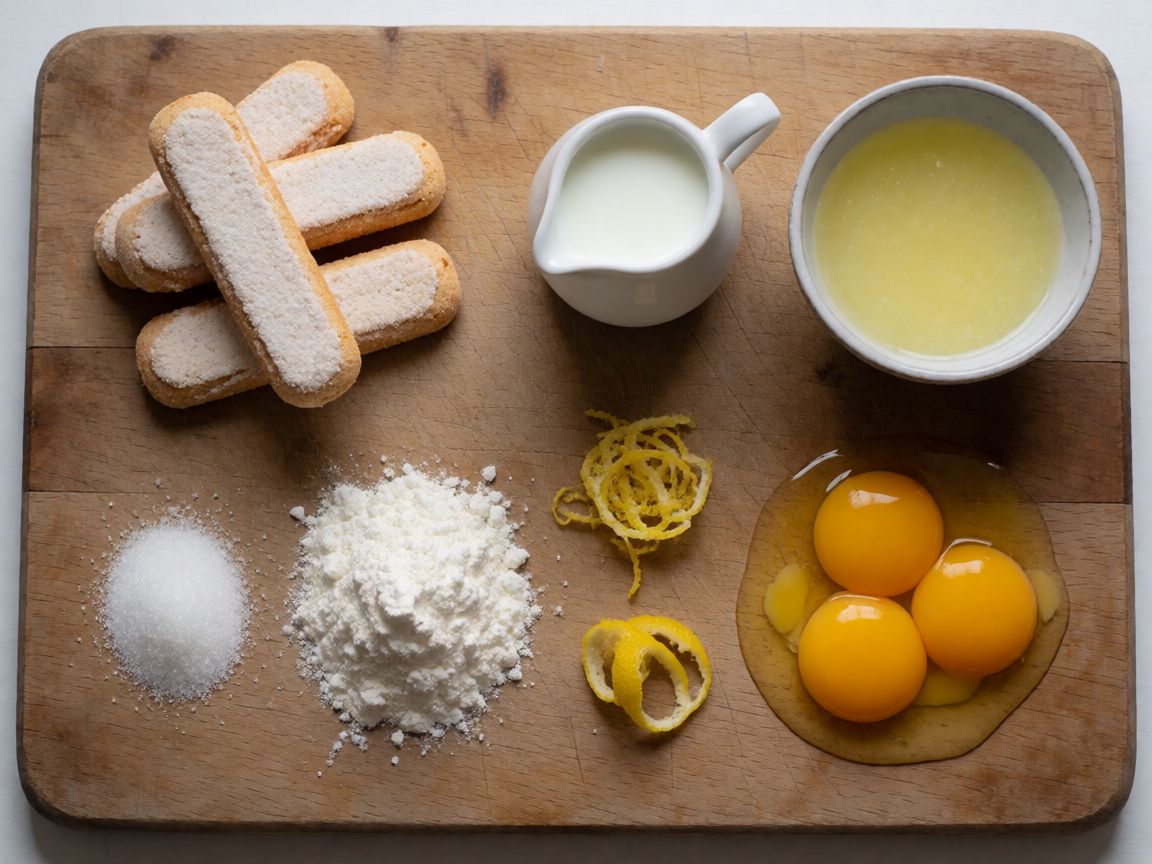
- 450 g Savoiardi biscuits
- 300 ml Milk
- 100 ml Lemon juice
- 100 g Sugar
- 30 g Flour
- 10 g Potato starch
- 3 pcs Egg yolk
- 2 pcs Lemon zest zest of 2 lemons







Steps
Measure the height of your cake tin ring and trim the savoiardi biscuits to match this height.
5 minDip the biscuits in milk and arrange them on the serving plate inside the set ring, starting from the outer edge and working inward in concentric circles until the base is fully covered.
10 minPrepare the lemon cream: in a bowl, whisk the egg yolks with the sugar, then add the sifted flour and potato starch. Mix until smooth and free of lumps.
5 minBring the milk to the boil, then over low heat stir in the lemon juice and lemon zest.
5 minAdd the egg and sugar mixture and whisk quickly until the cream thickens.
2 minPour the finished cream over the biscuit base, spreading it evenly across the surface.
2 minLet it cool at room temperature, then refrigerate for at least 4-5 hours.
270 minBefore serving, carefully remove the cake ring and decorate the top with desiccated coconut or mint leaves, if desired.
5 min
This is a lemon curd built as a custard, poured into a wall of soaked sponge fingers, and left to set in the fridge rather than the oven. Nobody bakes anything here — the heat happens once, in a saucepan, to cook the egg yolks and gelatinise the starch, and after that the fridge does the rest of the work. So the whole dish stands or falls on two mechanisms: how far you let the biscuits drink milk, and how carefully you cook three egg yolks without scrambling them.
Savoiardi are dry on purpose. There's no butter in them — just whipped egg and flour baked into a light, porous sponge, originally made in the Savoy court because a biscuit with almost no fat keeps for weeks and travels well. That dryness is exactly why they're useful to you now: dip, don't soak. A quick pass through milk and the sponge pulls liquid in by capillary action, softening in seconds. Leave it in the milk and you're not softening it anymore, you're dissolving its structure — no gluten web, no fat to hold it together once wet, so it collapses into paste. The 'dip' word in the recipe is doing real work; treat it as a splash, not a bath.
Some people assume anything built in a ring and chilled, not baked, must be 'just cream and biscuits' — the same family as a fridge cheesecake. No: this one has a cooked custard at its centre. The egg yolks go through real heat, past 60-something degrees, enough to coagulate their proteins and set the structure permanently. That's what lets you slice it in neat wedges later rather than spoon it out like a mousse. Skip the cooking and you'd have raw egg and a filling that never sets past 'thick soup' — the heat isn't ceremony, it's the one irreversible step holding the whole cake together.
On the flour-and-starch pairing: they're not doing the same job, which is why both are in there in small amounts rather than a bigger dose of one. Flour brings a little body and a faint milkiness that rounds out sharp lemon. Potato starch is the one that actually sets the cream into something sliceable — it gelatinises cleanly, stays glossy, and carries no raw-flour taste to muddy the lemon. If you only have cornflour, use it in place of the potato starch; it sets slightly firmer and a touch more opaque, but it's the same mechanism — a starch with no flavour of its own, there purely for thickening.
Milk should be whole, if you can — the fat carries some of the lemon zest's aromatic oils and keeps the custard rounder rather than thin and sharp. Semi-skimmed works, you'll just lose a little of that roundness; skimmed will taste leaner and more purely acidic, which some people actually prefer if they find lemon desserts too soft-edged.
Lemon juice: squeeze it yourself and strain out the pips. Bottled juice carries preservatives that leave a flat, slightly metallic aftertaste once it's cooked — you'll taste it precisely because this cream has so little else going on to hide behind. Zest is doing a separate job from the juice: the oil glands in the peel hold aromatic compounds that juice alone doesn't carry, and warming the zest in milk pulls those oils out into the fat where they belong. Zest only the yellow — the white pith underneath is bitter and brings nothing useful.
For the biscuits themselves, Savoiardi (ladyfingers) are the right shape and the right dryness, but the principle you actually need is: a plain, low-fat, dry sponge that won't turn to mush the moment it meets liquid. Boudoir biscuits are the same thing by another name. Digestives or any butter-rich biscuit are the wrong tool here — too much fat, too crumbly, they'll break apart under the weight of the cream instead of standing as a wall.
Serves eight, which in a British kitchen usually means: make it the day before a Sunday gathering, because the fridge time (four to five hours, more if you can spare it overnight) isn't flexible, and nobody wants to be hovering over a half-set lemon cream when the kettle's already on for tea.