
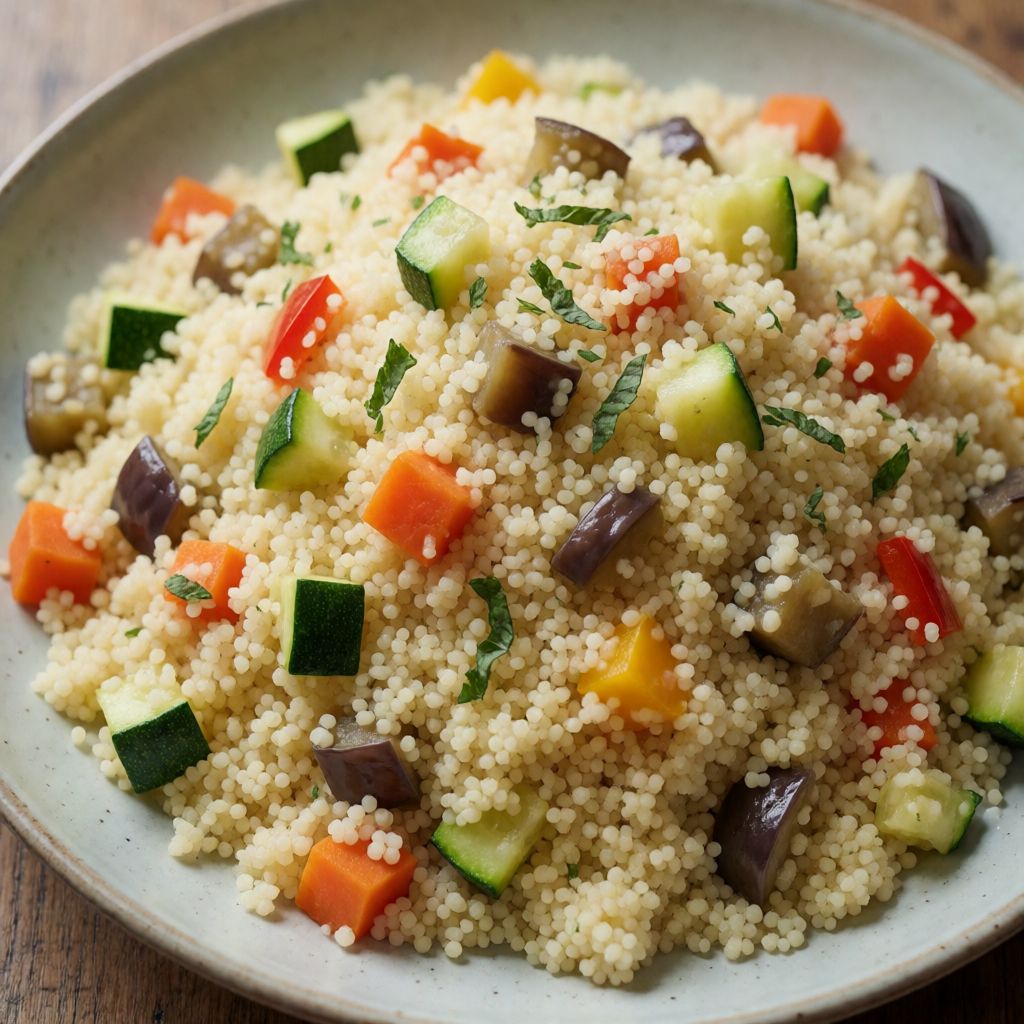
 AI photo
Couscous with Lemon and Mint
A fresh couscous side with pan-fried courgette, aubergine, pepper and carrot, tossed with chickpeas, lemon and mint.
Labels are worked out automatically from the ingredients and can be wrong. Check the packaging if it matters to you.
Ingredients












Steps
Wash all the vegetables thoroughly. Cut the pepper in half, remove the seeds and dice finely. Dice the courgette and aubergine.
Heat a few tablespoons of olive oil in a frying pan, add the crushed garlic and the chopped vegetables.
Fry the vegetables over medium heat.
Peel the carrot and blanch it in salted water to soften slightly, then dice it.
Add the carrot to the rest of the vegetables.
Add the cooked chickpeas, mix and season with salt to taste.
In a separate pan, toast the couscous with a little olive oil.
Transfer the couscous to a bowl and pour over the same amount of boiling water.
Once the couscous has absorbed all the water, season with olive oil, the juice of half a lemon and the grated lemon zest.
Let the couscous cool slightly.
Add all the cooked vegetables to the couscous.
Transfer the couscous to a serving plate, garnish with fresh mint leaves and serve.
This isn't really a couscous recipe — it's a vegetable sauté with couscous underneath it, soaking up everything the pan gave off. The couscous itself cooks in about ninety seconds of actual work, and the entire dish stands or falls on what you do to the vegetables before that.
What decides whether this works: whether you fry the aubergine and courgette hot enough to colour, or whether you stew them. Dice them, throw them in a pan that's properly hot, and you get caramelisation — browned edges, a bit of char, real flavour. Crowd a cold pan with wet, just-washed vegetables and you get grey, weeping cubes releasing water into oil, essentially boiling in their own juice. Same ingredients, two completely different dishes, and the difference is patience before the pan, not in it — pat the vegetables properly dry, and cut them small enough that they cook through before they turn to mush.
The couscous part is almost a trick: you're not cooking it, you're hydrating it. Equal volume boiling water to couscous, cover, walk away, come back to fluffy grains. The lemon and mint aren't decoration — the acid cuts through the olive oil and roasted vegetable sweetness, and the mint brings something green and cold against all that warm, soft texture. Serve this warm, not hot — straight off the heat the lemon flavour is muted, and the couscous is still tightening up as it sits.
Couscous is just crushed, pre-steamed semolina — in North Africa it traditionally gets steamed three times over a simmering stew, which is real work and real skill. The "instant" couscous sold in UK supermarkets has already done that steaming for you at the factory; all it wants now is boiling water and a lid. So don't hunt for a couscoussier or treat this with reverence — it's a convenience food, and using it that way is just honest.
Toasting the couscous dry (or in a touch of oil) before the water goes in isn't a ritual — it's there to coat each grain in fat so they separate instead of clumping into a paste. Skip it and you can still eat the result, you'll just be picking apart lumps with a fork.
On the vegetables: aubergine's real enemy is its own sponge-like flesh — it will drink oil indefinitely if the pan isn't hot enough to seal the surface fast. A few tablespoons of oil in a cool pan just vanishes into the flesh and you're left frying in a dry pan a minute later. Get the oil properly shimmering first, then add the vegetables in a layer, not a heap — a domestic hob's single ring rarely has the raw output of professional burners, so don't crowd the pan, do it in batches if your pan is small, otherwise you're steaming, not frying.
The carrot gets a separate step — blanching — because raw carrot dice takes far longer to soften than the others and would hold the whole dish back; a few minutes in salted water first means it finishes in the pan at the same rate as everything else, not a crunchy intruder in an otherwise soft dish. Any firm root vegetable that resists the pan's heat benefits from this pre-cook; it's not special to carrot.
Chickpeas: cooked, meaning already soft — tinned is completely fine here, drained and rinsed, nobody will know or mind. They're added right at the end, warmed through rather than fried, because they're already cooked and more time in the pan only dries them out and turns them mealy.
Lemon zest versus juice: zest carries the oil-soluble citrus aromatics, the smell of lemon without the sourness; juice carries the acid. Using both means you get perfume and brightness rather than relying on juice alone, which would just make things sharp. Wash the lemon before zesting if it's waxed — that wax is there to survive shipping, not to end up in your bowl.
Mint goes in at the very end, torn or left whole, never cooked — heat turns its bright top notes muddy within a minute. If you've only got dried mint, use it earlier, in the vegetable pan, where its flatter flavour has time to bloom in the oil; it's a different ingredient in practice, not a straight swap.
Oil: anything neutral enough not to fight the lemon and mint — a light olive oil works, but save anything you'd call "extra virgin and peppery" for drizzling raw at the end, over the finished plate, where you can actually taste it, rather than burning it off in the frying pan. This feeds four as a side, comfortably, alongside something like grilled chicken or lamb — think of it the way you'd think of new potatoes at a Sunday roast: it's there to be eaten warm, not hot off the stove, and it's just as happy at room temperature the next day for lunch.