
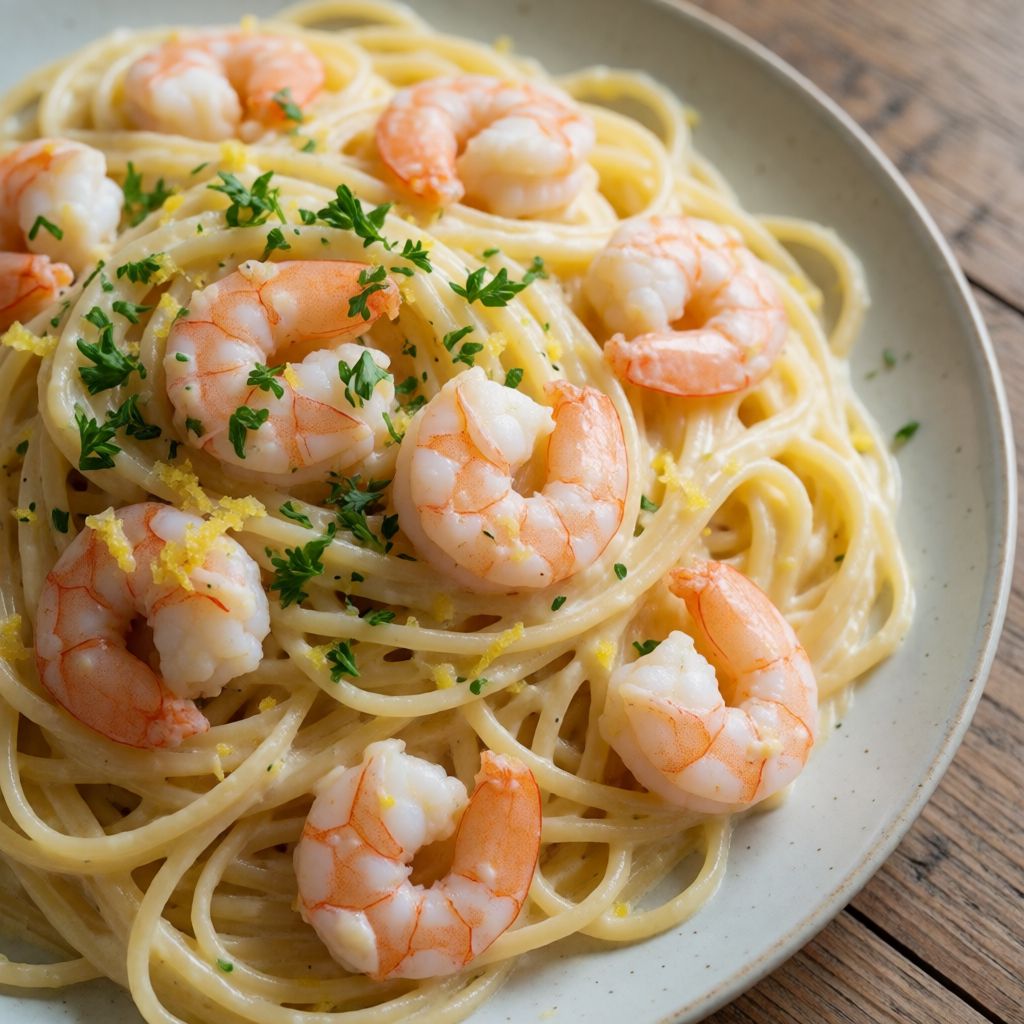
 AI photo
Lemon and Prawn Pasta
A creamy pasta with prawns, lemon and parsley, ready in about 20 minutes.
Labels are worked out automatically from the ingredients and can be wrong. Check the packaging if it matters to you.
Ingredients
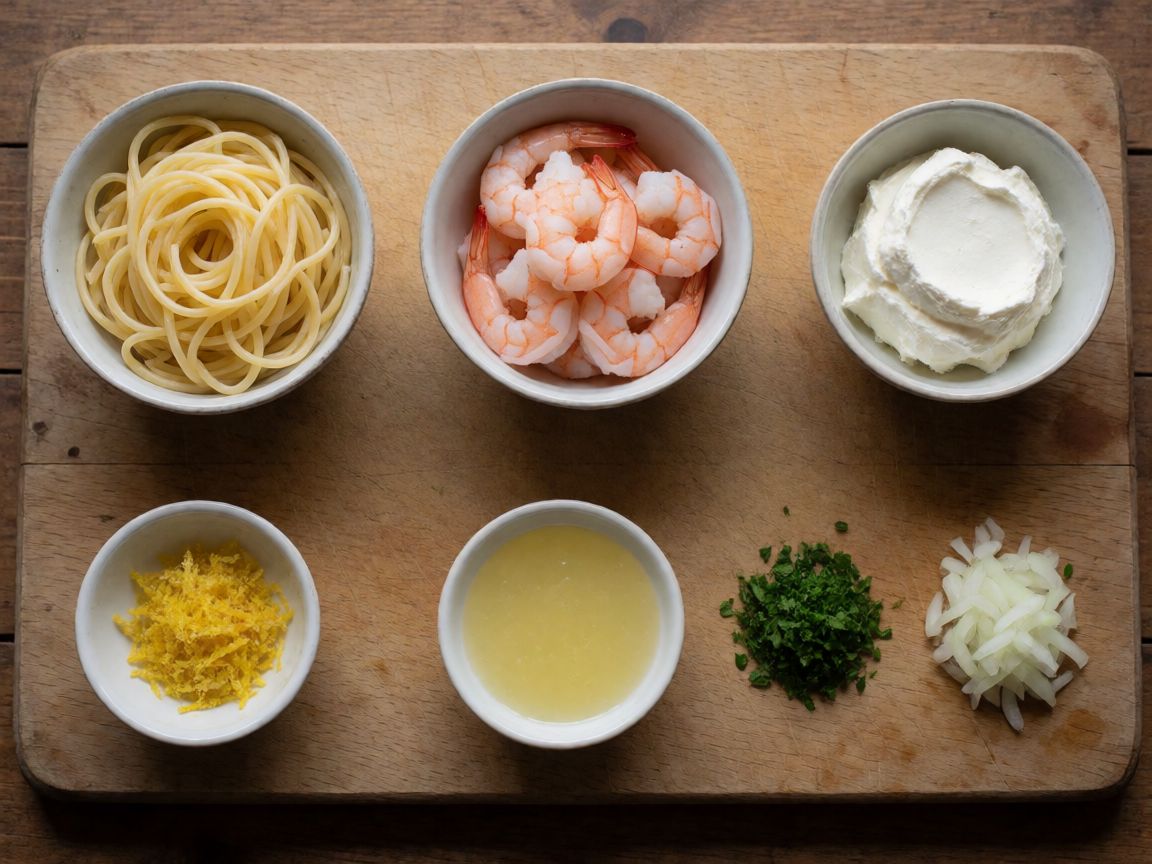
- 320 g Pasta
- 250 g Prawns
- 300 g Cream cheese
- 1 pcs Lemon zest
- 0.5 pcs Lemon juice
- Parsley to taste
- Salt to taste
- Black pepper to taste
- 40 g Onion
- Olive oil a little










Steps
Bring a large pot of water to the boil, add salt and cook the pasta according to the packet instructions.
Heat the olive oil in a large pan, add the chopped onion and sauté until golden.
Pour in the lemon juice, stir, then add the prawns and cook for 3-4 minutes, stirring occasionally. Done when the thickest part reaches 63°C.
4 minLower the heat, add the cream cheese and let it soften. Season with salt and pepper to taste.
Drain the pasta and transfer it to the pan with the sauce, mixing well.
Add the lemon zest and chopped parsley, and mix again.
Serve the pasta.
This is a weekday pasta, not a Sunday-roast dish. The whole logic is speed: a protein that cooks in minutes, a sauce that doesn't need reducing because it starts out already thick — a tub of cream cheese — and acid to cut the richness so the thing doesn't sit heavy in the pan or in you. Where a slow dish spends time building flavour from nothing, this one spends its twenty minutes entirely on timing, because the ready-made richness is already there in the fridge.
What decides whether it works is almost entirely the prawns. Some say you sear seafood hard and fast "to seal in the juices" — no, heat doesn't seal anything, the muscle fibre just contracts and pushes water out, and it does that whether the pan is roaring or gentle. The only lever you actually control is time off the heat. Stop the moment the flesh turns from translucent grey to opaque white-pink and curls into a loose, open C. A tight, tense curl means you've already gone past that point, and they're on their way to rubber — no amount of sauce fixes that afterwards.
The second failure point is the cheese. Cranking the heat to melt it faster feels efficient, but cream cheese doesn't melt smoothly under a hard simmer — the milk proteins tighten up and the fat weeps out separately, and you get an oily, grainy sauce instead of something glossy that clings to the pasta. Keeping the heat low here isn't fussiness for its own sake; it's the only way fat and protein stay mixed together instead of pulling apart.
Pasta: any short-to-medium shape that can carry a thick, clingy sauce works — penne, fusilli, even a long shape like linguine if you don't mind twirling cream cheese sauce rather than scooping it. Keep a cupful of the starchy cooking water back before you drain. If the sauce looks tight once the pasta goes in — and with cream cheese it often does, since it has almost no water in it — a splash of that water loosens it without diluting the flavour, because it's carrying dissolved starch, not just water.
Prawns: raw, shell-off is easiest for a home pan, because pre-cooked ones are already past the point you're trying to catch — reheating them is how you guarantee the rubber texture this dish is trying to avoid. Fresh or frozen-and-thawed makes little difference once they're dry on the surface before they hit the pan; wet prawns steam and release water into your sauce instead of browning at all, even gently. If you have no prawns, the criterion for a substitute is simple: something lean that cooks through in minutes and turns tough the moment you overshoot — thin chicken breast strips, scallops, or chunks of firm white fish all follow the same rule, just watch them by eye, not by the clock the recipe gives for prawns specifically.
Cream cheese: its whole job here is body — fat and milk solids giving you, in seconds, the thickness that a proper béchamel or a reduced cream sauce would take real time to build. A full 300g tub rather than a half-used one matters less for flavour and more because manufacturers sell it in that size precisely because it's a convenience product, built for exactly this kind of dish — open it, use it, done. Light versions split more easily, because there's less fat to hold the emulsion together once heat is involved. If you have none, the criterion for a substitute is a soft, high-fat dairy that melts rather than boils — mascarpone, crème fraîche, or double cream thickened with a little flour if it's thin enough to need help.
Onion: sautéed first and gently, because a raw onion's sharpness comes from sulphur compounds that heat breaks down slowly into sweetness. Some say you need it properly browned for flavour — no, not here. Gold is the point; past gold the sugars start to burn and turn bitter, and in a sauce this delicate there's nowhere for that bitterness to hide. If you're out of onion, any sharp allium softened the same way will do — shallot, or the white ends of spring onion, cooked until it loses its bite rather than its colour.
Lemon zest wants an unwaxed lemon if you can get one — supermarket wax coats the oil glands in the peel and you end up grating wax instead of flavour. Oil should be something with no smell of its own, since the cream cheese and lemon are doing all the talking; a fruity extra virgin olive oil here is wasted, a light one or a neutral vegetable oil does the same job for less money. Parsley should be fresh if at all possible — dried parsley has lost almost all its aromatic oil to the drying process and adds colour more than taste, so if it's all you have, use it, but don't expect it to do what fresh does.
One honest note on the pan: a UK hob, electric or induction, heats the centre of a flat pan harder than the edges, unlike the even curve of a kazan that this kind of cooking was shaped around elsewhere. So move the pan, or stir more than you think you need to, especially once the cream cheese goes in — that's the point patience actually matters in a twenty-minute dish. Give the onion its minute to turn gold instead of rushing it, and give the cheese its low, slow minute to go glossy instead of turning the heat up to save time you don't really save.