
 AI photo
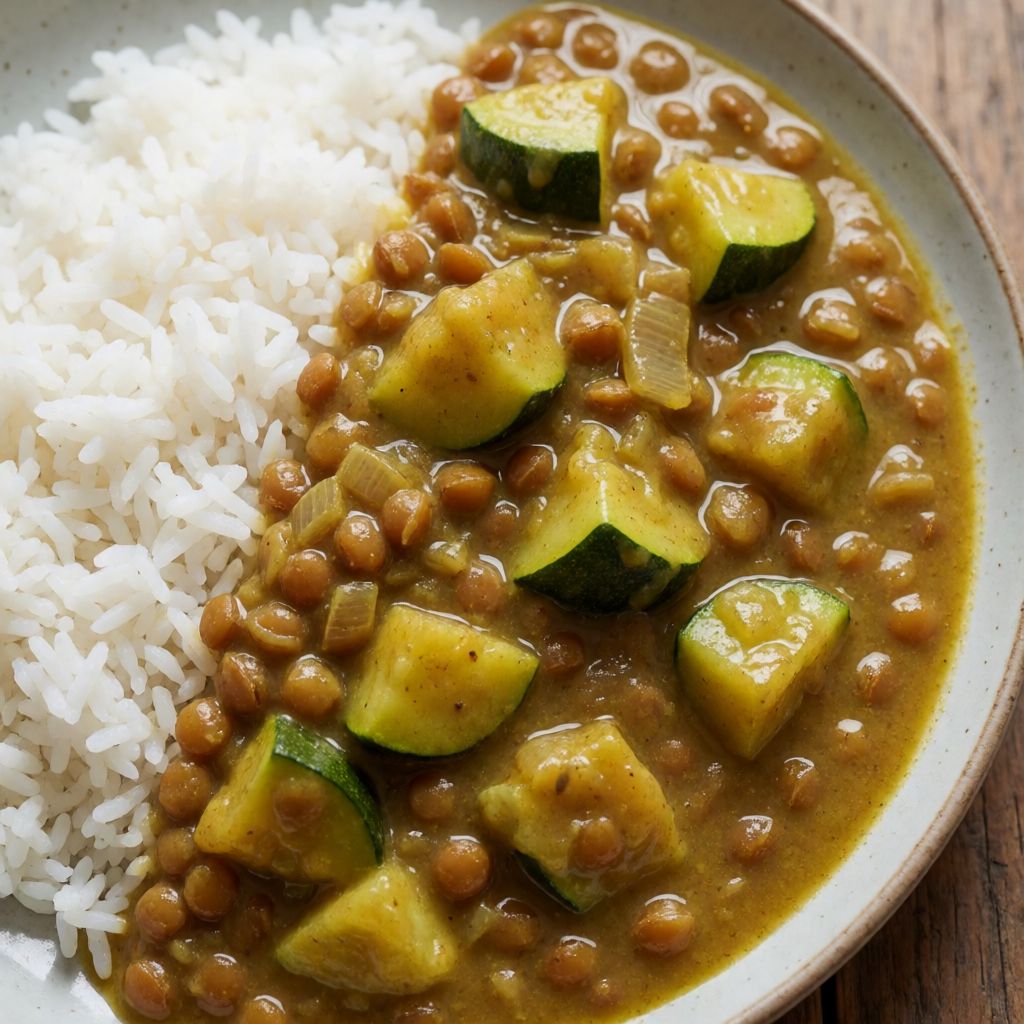
Lentil Curry with Rice
A warming lentil curry with courgette and coconut milk, served over basmati rice with a zesty coriander yoghurt.
Labels are worked out automatically from the ingredients and can be wrong. Check the packaging if it matters to you.
Ingredients
- 1 tbsp Curry powder medium hot
- 3 clove Garlic finely chopped
- 1 pcs Onion finely chopped
- 1 tbsp Ginger finely grated
- 150 g Lentils
- 200 g Courgette coarsely grated
- 400 g Chopped tomatoes tinned
- 400 ml Coconut milk
- 1 tbsp Olive oil for frying
- Salt
- Black pepper freshly ground
- 100 ml Greek yoghurt 10%
- 1 bunch Coriander fresh
- ½ pcs Lemon organic, juice and zest
- Salt
- Black pepper freshly ground
- 1 tsp Chilli flakes















Rice


Steps
Toast the curry powder in a dry pan over medium heat until fragrant.
Add the oil, garlic, onion and ginger and fry, stirring, until the onion has softened.
Add the lentils, courgette, chopped tomatoes and coconut milk to the pot and mix well.
Simmer covered for about 30-40 minutes, until the lentils are soft.
Rice with ginger and garlic. Add oil, ginger and garlic to a pot and fry the ginger over low heat until lightly fragrant.
Add the water, basmati rice and salt.
Stir well, cover with a lid and slowly bring to the boil.
Cook the rice covered over low heat for 10 minutes.
Remove from the heat and let the rice rest for a further 10 minutes in the covered pot.
Mix the Greek yoghurt with finely chopped coriander, lemon zest, a little juice, salt and pepper.
Serve the rice in deep bowls, top with the lentil curry and coriander dressing, and sprinkle with chilli flakes.
This is a lentil curry that doesn't actually need a curry house or a tin of "curry paste" to taste like something — it needs a dry pan and patience for about ninety seconds. Everything else that follows is just building on top of that first move.
What decides whether this works is two separate things: whether the curry powder gets toasted before anything wet touches it, and whether the lentils are given long enough, uncovered of excess liquid worry, to actually fall apart into the sauce rather than sit in it like gravel. Courgette and coconut milk are there to carry fat and sweetness so the dish doesn't taste like health food — tinned tomatoes give it acidity to cut through that fat.
The rice is cooked separately with its own ginger and garlic, which is a small bit of discipline most people skip — they'd just throw plain rice under the curry. Doing it this way means the rice has a flavour of its own instead of being a blank sponge, and the yoghurt-coriander-lemon dressing at the end is what stops the whole bowl tasting one-note brown. Four people, one pot for the curry, one pot for the rice — ordinary hob, no kazan required.
Start with the curry powder in a dry pan. Some say spices should go in with the oil, straight away — no, because oil below a certain temperature does nothing to wake spices up; it just sits there as lubricant. A dry pan gets hot faster and more evenly against the spice particles themselves, and you'll smell the difference: raw curry powder smells of cardboard and turmeric dust, toasted it smells like itself, finally. Thirty seconds too long and it's bitter and acrid — so this isn't "medium heat for a bit," it's watch the pan and pull it the second the smell changes from dusty to warm.
The onion, garlic and ginger go in after, with the oil now, because raw garlic in a screaming dry pan burns before it softens — oil moderates that. You're waiting for the onion to go from sharp white to soft and slightly gold, translucent at the edges, not for a clock. That's the whole test.
Lentils: these are the collagen of the dish — they don't hold their shape, they dissolve into the sauce and thicken it, which is the entire point of using split lentils rather than, say, chickpeas. If yours still have a bite and a skin after the stated time, they're not done — give them more time and a splash more water rather than turning up the heat, because high heat on a thick tomato-coconut base scorches the bottom before the lentils in the middle are even warm. A wide domestic pan actually helps here — more surface in contact with the heat than a tall pot, less risk of catching.
Coconut milk and chopped tomatoes aren't interchangeable with "a bit of cream and a squeeze of ketchup" despite what some kitchens try — coconut milk brings fat that carries the spice's aroma onto your tongue (spice compounds are largely fat-soluble, which is why a curry made with water alone always tastes thin), and tinned tomatoes bring acid that coconut milk has none of. If you've no coconut milk, any full-fat dairy-free milk with body — cashew cream, for instance — does the fat job, though you'll lose some of the specific sweetness.
Courgette, coarsely grated, isn't there for virtue. It melts into the sauce in the same twenty minutes the lentils take and adds bulk and a little sweetness without announcing itself — grate it coarse, not fine, or it turns to mush and water rather than contributing texture.
The rice: cooking it with its own fried ginger and garlic rather than plain is a small economy of flavour — you're using the same pot of aromatics logic twice instead of once, so the rice isn't just a neutral base soaking up the curry, it's seasoned on its own terms. The resting time off the heat, lid on, is not optional laziness — it's the rice finishing on trapped steam rather than direct heat, which is why you don't lift the lid to check. Lifting it lets steam escape and you'll get a dry top layer and a wet bottom. Any lid-shaped object will do on a domestic hob if you've lost the actual lid — even a tight-fitting plate.
The yoghurt dressing is the acid and coolness the curry itself doesn't have enough of once the coconut milk has made everything rich. Greek yoghurt specifically because it holds together and doesn't split or go watery against hot rice the way a thinner yoghurt can. Lemon zest, not just juice, because zest carries the lemon's oil and that's where most of the actual citrus smell lives — juice alone gives you sour without the perfume.