
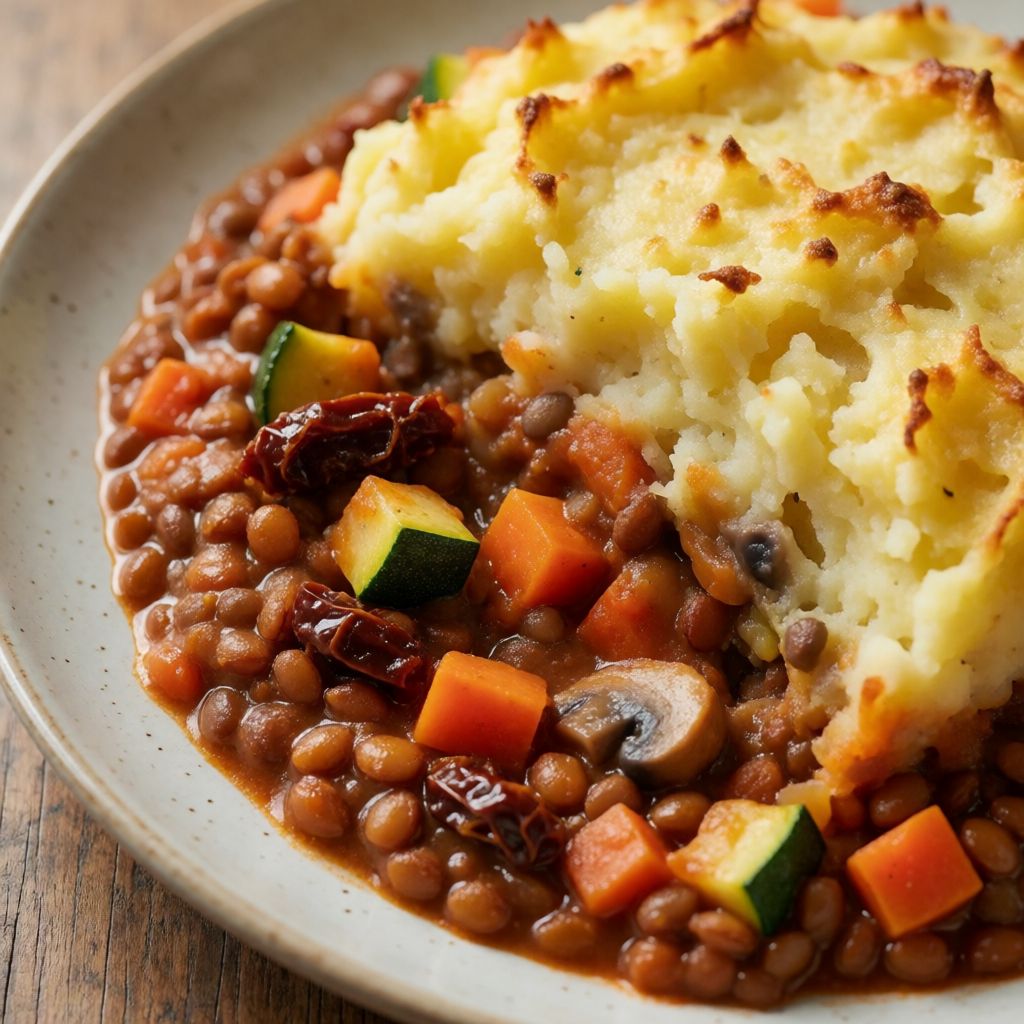
 AI photo
Vegetarian Lentil Shepherd's Pie
A hearty vegetarian take on shepherd's pie, with a rich lentil and vegetable base topped with creamy mashed potato.
Labels are worked out automatically from the ingredients and can be wrong. Check the packaging if it matters to you.
Ingredients
- 2 pcs Onion finely chopped
- 3 clove Garlic finely chopped
- 200 g Mushrooms finely chopped
- 30 g Sun-dried tomatoes finely chopped
- 2 pcs Carrot coarsely grated
- 1 pcs Courgette coarsely grated
- 2 pcs Celery stalks, coarsely grated
- 1 pcs Aubergine coarsely grated
- 400 g Chopped tomatoes canned
- 100 g Tomato purée
- 100 ml Vegetable stock
- 100 g Red lentils
- 1 tsp Dried rosemary
- 1 tsp Fennel seeds
- 1 tsp Dried thyme
- 1 tsp Smoked paprika
- 2 tbsp Olive oil for frying
- Salt
- Black pepper freshly ground
- 1 kg Potatoes
- 50 g Butter
- 100 ml Milk
- Salt
- Black pepper freshly ground
- 2 tbsp Breadcrumbs dried





















Steps
Fry the mushrooms, onion and garlic in a little olive oil over medium heat until the onion is soft.
Add the sun-dried tomatoes, carrot, courgette, celery, aubergine, chopped tomatoes, tomato purée, stock, red lentils, fennel seeds, rosemary, thyme and smoked paprika.
Bring to the boil and simmer covered for 20 minutes.
Season with salt and black pepper to taste.
Simmer uncovered until the liquid has reduced slightly.
Boil the potatoes, then put the hot, soft potatoes into a large bowl together with cold butter cut into small cubes.
Mash with a mixer until light and fluffy, and add the warm milk to make the mash creamy and airy.
Season with salt and black pepper to taste.
Spread the sauce in a greased baking dish and cover with a layer of mashed potato.
Sprinkle with breadcrumbs and bake in a preheated fan oven at 175°C for 30–45 minutes.
This is shepherd's pie with the shepherd removed and the sheep's job handed to a vegetable committee — carrot, courgette, celery, aubergine, mushroom, all grated or chopped small and simmered down with lentils until they behave like mince. That's the whole trick of the dish: nothing here is naturally meaty, so the filling has to be built to taste meaty — through reduction, through umami stacked from three different directions, through a texture that chews like something rather than slumps like soup.
What decides whether it works isn't the lentils, it's the water. Grated vegetables are mostly water held in cell walls, and the moment you salt and heat them, that water comes out. If you stop simmering the second the lentils are soft, you get a wet, sliding filling that pools under the mash and turns the crust soggy from below. The real finish line is step 5 — uncovered, watching the sauce go from loose to glossy and reluctant to move when you drag a spoon through it. That's not a timed step, that's a texture you're waiting for.
The three savoury hits doing the meat's work are sun-dried tomatoes, tomato purée, and mushrooms — concentrated tomato, caramelised tomato, and the natural glutamates in mushroom all landing in the same register that beef stock usually occupies. Lentils don't add flavour so much as structure: they break down just enough to thicken the sauce from inside, so you're not relying on flour or heavy reduction alone to get a filling that holds its shape when cut.
Grate rather than chop the carrot, courgette, celery and aubergine — coarse grating multiplies surface area, which means more contact with the pan and faster, more even breakdown. Chop those same vegetables instead and you'd need twice the simmering time to get the same softness, by which point everything else would be overcooked. The aubergine specifically needs no salting-and-draining ritual here, because it's going into a long wet simmer, not a dry fry — the bitterness that salting fixes only matters when you're trying to crisp aubergine in oil, not stew it.
Red lentils are the right choice because they collapse — unlike green or brown lentils, which hold their shape, red lentils break down into the sauce and thicken it, doing roughly the job cornflour would do in a meat version. If you only have green lentils, cook them separately until properly soft first, otherwise they'll still be gritty when the vegetables are done.
Smoked paprika is standing in for the smoke and fat you'd get from browned meat and its rendered drippings — it's the one ingredient here doing a job nothing else in the pot can fake. Fennel seed is the quieter trick: a background anise note that reads as "slow-cooked" even when nothing's been cooked slow, the same reason it turns up in sausage seasoning. Leave it out and the dish tastes thinner without you being able to say why.
For the mash: cold butter into hot potato, not the other way round. The heat of the potato melts the butter gradually as you work it in, which keeps the fat emulsified through the starch rather than pooling and making the mash greasy — the classic failure of adding soft butter too fast. Warm milk matters for the same reason in reverse: cold milk shocks the starch and tightens it, giving you gluey mash instead of airy. Any potato that's floury rather than waxy will do — Maris Piper or King Edward if you're shopping in Britain, waxy salad potatoes if that's all you've got, though you'll get a denser, slightly gluier mash and there's no fixing that except accepting it.
Breadcrumbs on top aren't decoration, they're insurance against the one flaw mash can't fix itself — a flat, pale surface that never crisps, because potato alone doesn't brown well under a domestic oven's heat. The starch and fat in the crumb catches and colours where the mash underneath would just dry out. A fan oven at 175°C is gentle enough that this is really about watching, not timing: you want the peaks of the mash ridges gone golden-brown, the filling audibly bubbling at the edges of the dish. Thirty minutes is the earliest you'd check, not the moment you take it out — ovens vary enough in real kitchens that the dish itself has to tell you when it's ready.
Any neutral oil works for the frying stage — olive oil is specified, but anything without a flavour strong enough to compete with the rosemary and thyme does the same job; it's there for heat transfer, not taste. This feeds four generously alongside nothing else, or six if you're treating it the way a Sunday roast treats its sides — a plateful with greens, not the whole meal.