
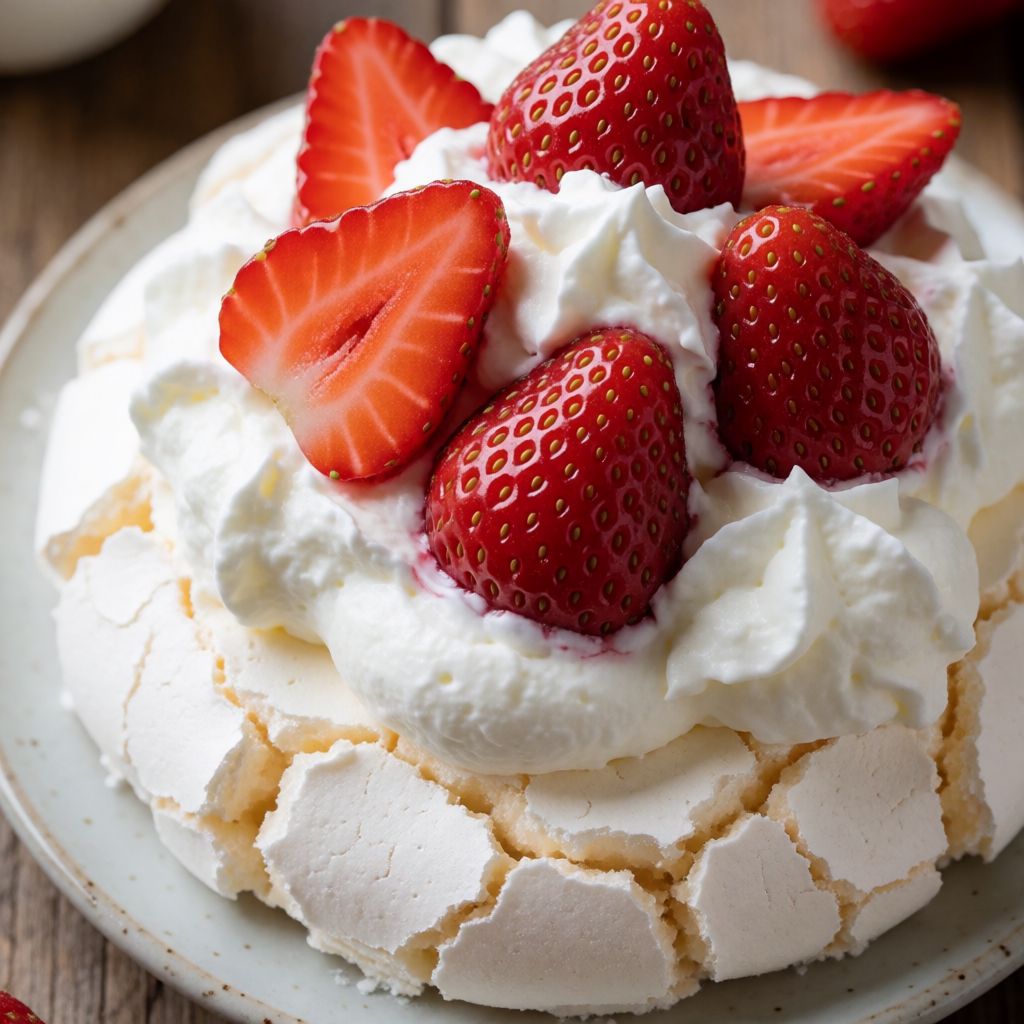
 AI photo
Meringue with Cream and Berries
A light meringue dessert layered with sweetened strawberries, whipped cream and dark chocolate.
Labels are worked out automatically from the ingredients and can be wrong. Check the packaging if it matters to you.
Ingredients
- 90 g egg whites
- 150 g icing sugar
- 1 pinch salt
- 0.5 pcs vanilla pod
- 40 g caster sugar
- 450 g strawberries quartered
- 200 ml double cream
- 30 g dark chocolate chopped
- 1 bunch mint fresh








Steps
Whisk the egg whites until light, firm and holding peaks.
5 minGradually whisk in the icing sugar until fully dissolved, then whisk in the salt.
3 minWhisk until the meringue mixture is glossy, springy and holds firm peaks.
3 minTransfer the meringue mixture to a piping bag fitted with a star nozzle and pipe meringues onto a baking tray lined with baking paper.
2 minBake in a preheated oven at 80°C for 45-60 minutes.
52 minTurn off the oven, prop the door open and leave the meringues to cool inside.
60 minMix the vanilla seeds with the sugar and sprinkle over the strawberries in a bowl.
1 minLeave the strawberries to macerate for about a quarter of an hour.
15 minWhip the cream until light and billowy.
3 minCrumble a few meringues and layer the strawberries, whipped cream and chocolate in serving glasses.
2 minSprinkle with chocolate and add a couple of meringues before serving.
1 min
Meringue is not baking, it's drying. That's the whole mechanism, and it decides everything. You're not cooking egg white, you're pulling water out of a foam at a temperature low enough that the sugar doesn't catch and the protein doesn't scramble into something rubbery. 80°C is below the point where egg white sets hard — it's there to evaporate, not to set. That's why the time has such a wide window, 45 to 60 minutes: your oven's real temperature, your tray, your tap water in the kettle you boiled for tea while this was in — none of it matches mine. Watch instead for a shell that lifts clean off the paper and sounds hollow when you knock it. If it's tacky underneath, it needs longer, full stop.
The oven-off, door-open cooling is not fussiness, it's the same drying mechanism running on momentum. Pull a hot meringue into cold kitchen air and the outside shell contracts faster than the moist inside — you get cracks, or a sticky collapse. Let it ride down slowly in the dying heat and it holds its shape and crispness. Skip this and you'll blame the recipe for what is actually a temperature shock.
What decides success here is less the meringue, honestly, than the layering at the end. You build this in a glass, in front of whoever's eating it, the moment before serving — crumble, berries, cream, chocolate, repeat. Meringue is pure sugar and air; the second cream touches it, it starts dissolving. There's no fixing that once it's gone soft, so this isn't a make-ahead pudding. Make the shells today, eat them whenever, but assemble the glasses at the table or just before.
Egg whites: 90 g is roughly three medium whites, but weigh them — egg sizes lie, and meringue is proportion-sensitive in a way most recipes aren't. The bowl must be bone dry and grease-free; a trace of yolk or washing-up residue stops the proteins linking into a stable foam, so you get a wet, slumping mess no amount of whisking fixes. That's the real reason behind "use a spotless bowl" — not ritual, chemistry.
Icing sugar vs caster sugar: icing sugar here dissolves into the already-whipped whites gradually, keeping the foam glossy and preventing the grainy, weeping meringues you get when sugar crystals don't fully melt before baking. Caster sugar goes in later, with the vanilla, onto the strawberries — there it doesn't need to dissolve instantly, just draw out juice over the resting time. Don't swap their jobs.
Vanilla pod: half a pod scraped for seeds gives you real perfume, not sweetness — it's doing a job sugar can't. If you don't keep pods in the cupboard, a teaspoon of good vanilla paste stirred into the sugar does nearly the same thing; vanilla extract works but washes out faster, so use slightly more.
Strawberries: quartered, then macerated in sugar for about fifteen minutes — not timed for the clock but for the sugar to pull juice out by osmosis, softening the fruit and making its own light syrup. If berries are properly ripe and sweet already, you can shorten this; if they're the pale, under-ripe sort sold out of season in British supermarkets, give them longer, or accept the compromise and add a squeeze of lemon to wake the flavour up. Any soft seasonal berry — raspberries, a mix with blackberries — follows the same logic: fruit that releases juice readily, macerated briefly in sugar.
Double cream: whipped only to "light and billowy," not stiff — this isn't a cake that needs to hold a knife-cut edge, it's a spoonable layer. Over-whip it and it turns grainy and heavy against the airy meringue, losing the contrast that makes the whole thing work. Single cream won't whip at all — not enough fat — so don't substitute down.
Dark chocolate: chopped rough, not melted, for texture and a bitter edge against all that sugar and cream. Any chocolate with real cocoa content and no filling will do; milk chocolate just adds more sweetness where you need contrast, not more sugar.
Patience is the real ingredient twice over here: once in the slow dry-out in the oven, and again in the slow collapse-free cooldown. Rush either and you're eating sticky shards instead of crisp shells — still edible, just not what you were aiming for.