
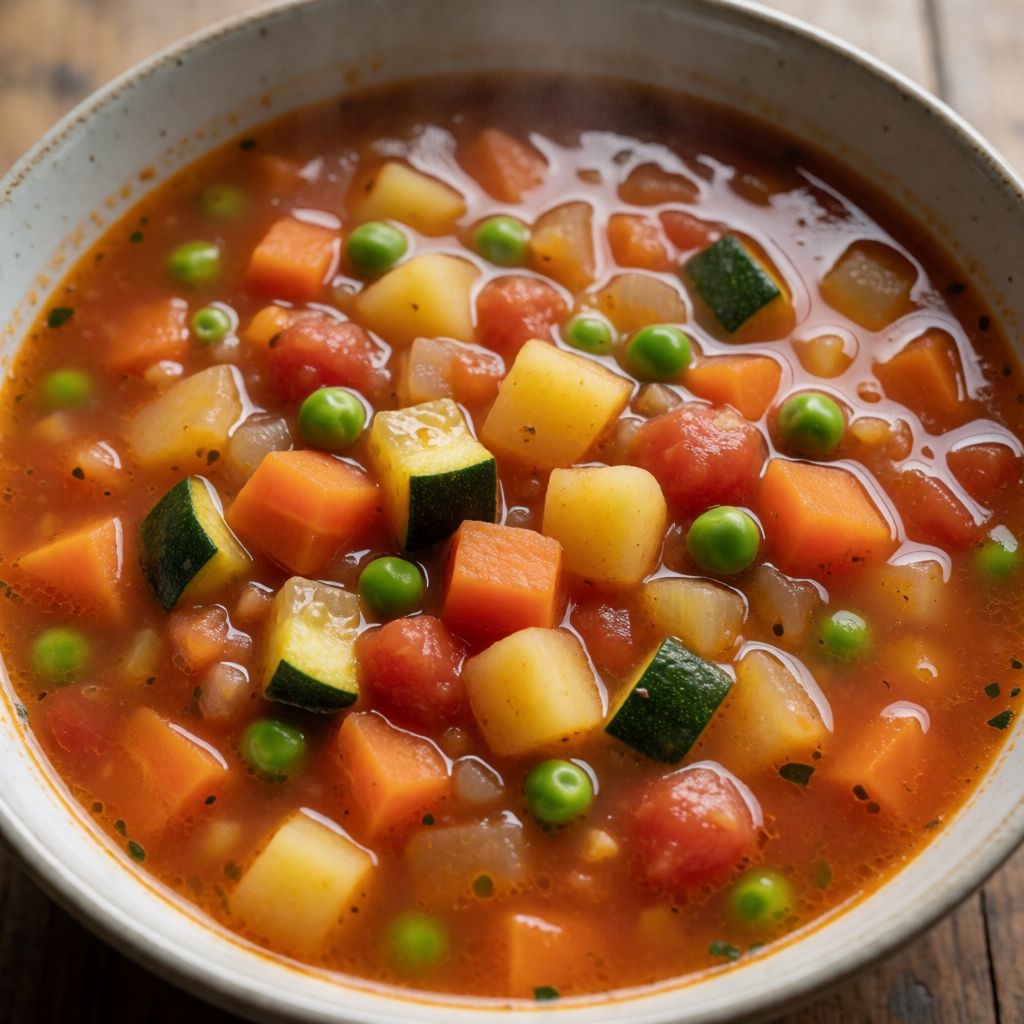
 AI photo
Milanese Minestrone
A hearty Milanese vegetable and rice soup, simmered slowly with a savoury lardo base.
Labels are worked out automatically from the ingredients and can be wrong. Check the packaging if it matters to you.
Ingredients

















Steps
Peel and deseed the tomatoes, wash the rest of the vegetables thoroughly and cut them into small pieces.
Make the base: put the lardo in a blender with the onion, garlic, parsley and celery, and blend until smooth.
In a saucepan combine the vegetables, add the base and the olive oil.
Pour in water (about 2 l) and bring to the boil.
Season with salt, lower the heat and simmer gently.
120 minAdd the peas and shredded Savoy cabbage, and cook for a further 10 minutes.
10 minAdd the rice and cook for about 20 minutes, stirring occasionally.
20 minServe hot, sprinkled with Parmesan, with bread.
This is minestrone the way Milan actually ate it before minestrone became a word on Italian restaurant menus everywhere — thick, slow, built on fat and vegetables rather than stock from a cube. Some say minestrone is "whatever vegetables you have, thrown in water" — no, because what separates a good one from a watery vegetable soup is the base, and the two hours it takes to stop tasting like separate ingredients and start tasting like one thing.
The base is the whole argument of the dish: lardo, onion, garlic, celery and parsley blended to a paste and fried into the vegetables before the water goes in. Lardo is cured back fat — pale, soft, almost translucent — and when it melts it carries flavour the way oil can't, because oil has none of its own to give and fat does. This is the north of Italy's answer to a question the south answers with olive oil and the Veneto answers with butter: whatever was cheap and plentiful where you lived became your cooking fat, and Lombardy raised pigs. A blender does in ten seconds what a mezzaluna used to do in ten minutes of chopping by hand — no loss of face in using it.
Go through what's actually doing the work, piece by piece. The lardo is non-negotiable in spirit even if you substitute it: the criterion is a cured, unsmoked pork fat that melts rather than crisps. If your shop doesn't carry lardo, pancetta chopped fine does a reasonable job, or failing pork altogether, a knob of butter plus a spoon of olive oil gets you fat with some body to it — not the same, but it won't collapse the dish. What you're avoiding is a thin vegetable broth that tastes of nothing but boiled water and good intentions.
The vegetables are deliberately a mixed bag of textures and this matters more than the exact list. Potato breaks down and thickens; carrot holds its shape longer and gives you something to test doneness against — it should bend, not snap, when you press it, and that bend is your actual clock, better than any stated minute. Courgette turns soft and almost disappears, tomato (peeled and deseeded so you don't get bitter skin or watery seeds diluting the broth) gives acid and a bit of sweetness as it cooks down, and the celery and onion in the base do what they always do in Italian cooking — build a savoury floor under everything else, the soffritto principle even though here it's blitzed rather than diced.
Borlotti beans and Savoy cabbage are the two ingredients that earn minestrone its name — "big soup," from minestra — because they're what you'd have had dried and stored through winter in a Lombard farmhouse. Dried beans you'd normally soak overnight and simmer separately for an hour before they're tender; if you're using tinned or already-cooked beans instead, add them later, with the peas, not at the start, or they'll turn to paste in two hours of simmering. Cabbage goes in near the end deliberately — in early, it turns grey and bitter, its sulphur compounds released by long cooking; shredded and added with the peas, it keeps some bite and a cleaner green taste.
Peas added late is the same logic in miniature — fresh or frozen, they only need the ten minutes to cook through, any longer and they go grey and mealy, losing the sweetness that's the whole reason to add them.
Rice at the very end, twenty minutes or so of stirring — the stirring matters because rice settles and sticks to the bottom of a pan faster than you'd think, especially once the broth has thickened with potato starch. You want it tender but not blown out and starchy-soft; bite one before you call it done. Any short-to-medium grain rice works, nothing fancy required — this isn't risotto, you're not chasing a specific starch release, just something that holds its shape in a spoonful of soup.
In a UK kitchen, none of this asks anything unusual of your setup: a wide pan stands in fine for what would be a bigger pot in an Italian kitchen, and a plate over the pan does the job of a lid if yours doesn't fit well — the point is just to keep enough steam in that the level doesn't drop too fast over two hours, not to seal it airtight. Sage, basil and parsley at the end are there for a top note the long cooking can't give you — the base flavours come from two hours of patience, the fresh herbs come from thirty seconds of not forgetting them. Finish with Parmesan and bread and you've got Sunday-roast-sized portions for four, the kind of soup that asks for a spoon and nothing else.