
 AI photo
Carrot Muffins
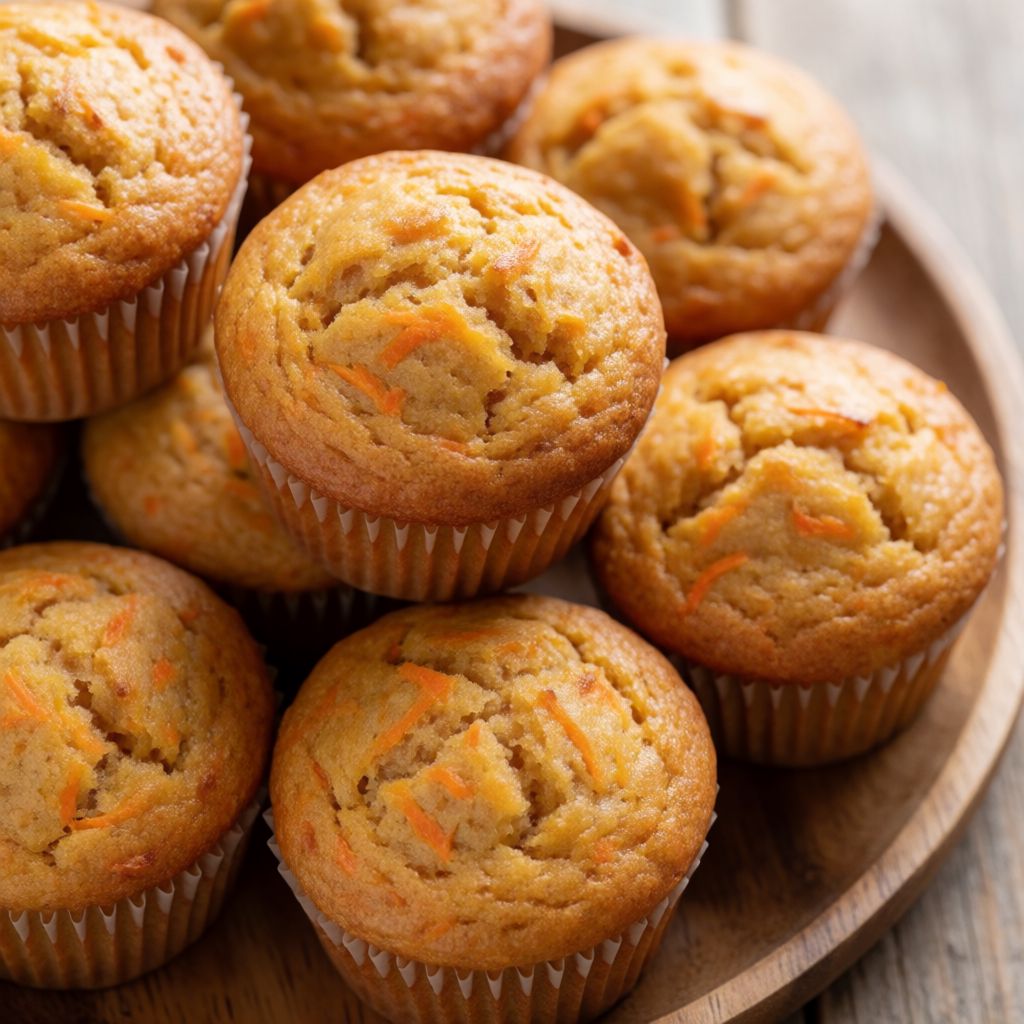
Soft carrot muffins with orange zest and a hint of cinnamon, finished with a dusting of icing sugar.
Labels are worked out automatically from the ingredients and can be wrong. Check the packaging if it matters to you.
Ingredients
- 250 g Carrot
- 250 g Plain flour
- 3 pcs Eggs
- 150 g Caster sugar
- 200 ml Yoghurt
- 240 ml Corn oil
- 150 ml Milk
- 80 g Ground almonds or 100 g chopped almonds
- 16 g Baking powder
- 50 g Orange zest
- 1 tsp Vanilla extract
- 90 g Butter melted
- 1 pinch Salt to taste
- 1 pinch Cinnamon to taste
- 1 pinch Icing sugar for dusting















Steps
Wash the carrots under running water, trim the ends and grate into fine strips using a mandoline or grater.
In a large deep bowl, beat the eggs with the caster sugar and salt until light, smooth and foamy.
Add the sifted plain flour, corn oil, melted butter, ground almonds, vanilla extract and cinnamon. Mix with an electric whisk until smooth.
Fold in the yoghurt, milk, orange zest, grated carrot and baking powder, stirring gently from the bottom upward.
Divide the batter among well-oiled muffin tins.
Bake in a preheated fan oven at 180°C for about 20 minutes.
20 minCool the muffins on a wire rack and dust with icing sugar if you like.
What was changed
Vanilla extract was swapped in because UK shoppers more easily find vanilla extract than packaged vanillin.
Carrot muffins are a cake pretending to be breakfast — grated carrot gives moisture and a faint sweetness, not crunch, and the whole thing lives or dies on whether that carrot gives up its water into the batter instead of sitting there as damp orange threads. Done right, the crumb is dense in a good way, almost pound-cake dense, held up by three eggs and two fats working at once.
What decides it is fat and leavening doing separate jobs. You've got corn oil and melted butter both in play — the oil keeps the crumb soft for days because it stays liquid at room temperature, butter gives flavour and a bit of structure as it sets. Skip one and you either get a muffin that dries out by Tuesday or one that tastes of nothing. And 16 g of baking powder for 250 g flour is a lot — that's a deliberate push for height and lightness against all that wet carrot and yoghurt, not a typo.
Some say grated carrot should be squeezed dry first, the way you'd do with courgette for a savoury bake. Don't — here the carrot's water is part of the recipe's moisture budget, mixed with yoghurt and milk; squeeze it out and you'll need to add liquid back some other way, and you've just made work for yourself.
For 8, this is generous — you'll likely get a dozen smaller ones out of a standard UK muffin tin rather than 8 large American-style ones, so don't panic if the tin stretches further than expected.
The grating matters more than people think. Fine strips off a mandoline or the fine side of a box grater break down into the batter and almost disappear into the crumb; coarse grating leaves visible orange flecks and a slightly wetter bite near them, because thick strands hold onto moisture the batter around them doesn't absorb in 20 minutes of baking. Either is fine — just match your grate to what you want to see when you cut one open.
Eggs beaten with sugar and salt until "light, smooth and foamy" isn't decoration language — that's you folding air into the batter mechanically, because the baking powder can't do all the lifting alone against this much liquid fat and yoghurt. Under-beat this stage and the muffins come out flatter and denser than they should, no matter how fresh your baking powder is.
The almonds — ground or chopped — aren't there for almond flavour so much as for fat and a bit of structure that flour alone doesn't give; if you have neither, fine semolina or more flour will hold the crumb together, you just lose the slight nuttiness and a touch of moistness. Corn oil is picked because it has no taste of its own and stays liquid, so any neutral oil — sunflower, rapeseed, even a mild light olive oil — does the same job; what you must not use is something with a strong flavour of its own like a heavy extra virgin olive oil, because now the oil is competing with the orange and cinnamon instead of carrying them.
Yoghurt and milk together are doing acid-and-liquid work against the baking powder, and against the carrot's own moisture — this is why squeezing carrot dry would throw the balance off, as said above. If your yoghurt is very thick Greek-style, loosen it with a splash more milk; if it's thin, you're already close to right.
Orange zest at 50 g is a proper amount — that's the zest of several oranges, not a token grate — so taste your zest before committing all of it if your oranges are very bitter-skinned; you want the orange there as a background note with the cinnamon, not fighting the carrot.
On a UK fan oven, 180°C for about 20 minutes is your lower bound, not a deadline — go by a skewer coming out clean and the top springing back when pressed, because every oven runs slightly differently and muffin tins vary in how they hold heat. Oil your tins well rather than relying on paper cases alone if you want a proper crust on the sides, not just the top — a dry muffin stuck to unoiled metal is a defect that starts at this step, not at the end when you're prying it out. Let them cool properly on a rack before dusting with icing sugar; dust them hot and the sugar just melts into a wet patch, which teaches you nothing except patience, which is most of what baking actually asks of you anyway.