
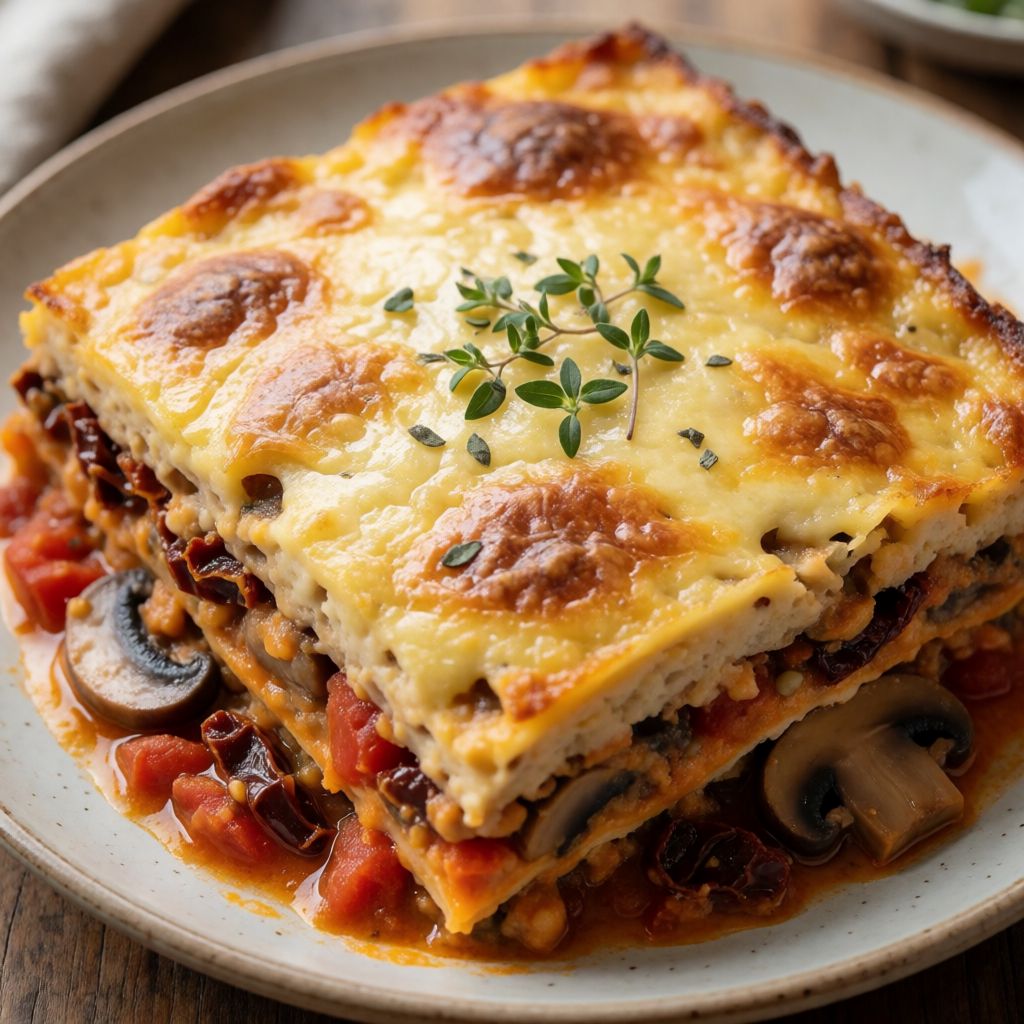
 AI photo
Vegetarian Moussaka
A layered vegetable moussaka with aubergine, courgette and potato in a tomato sauce, topped with cheese sauce.
Labels are worked out automatically from the ingredients and can be wrong. Check the packaging if it matters to you.
Ingredients
- 2 pcs Onion finely chopped
- 2 clove Garlic finely chopped
- 250 g Mushrooms finely chopped
- 800 g Canned chopped tomatoes
- 3 tbsp Sun-dried tomatoes finely chopped
- 1 tsp Oregano dried
- 0.5 tsp Rosemary fresh, finely chopped
- 1 tsp Cumin dried
- 1 tsp Cinnamon dried
- 2 tbsp Olive oil for frying
- Salt
- Black pepper freshly ground
- 1 tbsp Butter
- 1 tbsp Plain flour
- 300 ml Milk
- 250 g Mozzarella diced
- 1 pinch Nutmeg freshly grated
- 1 pcs Courgette cut into very thin slices
- 1 pcs Aubergine cut into thin slices
- 400 g Potato boiled and sliced
- 1 tbsp Butter for the baking dish

















Steps
Put the onion, garlic and olive oil into a pan and fry over medium heat until the onion softens.
5 minAdd the mushrooms and fry over high heat, stirring.
4 minAdd the canned chopped tomatoes and sun-dried tomatoes to the pan along with the oregano, rosemary, cumin and cinnamon. Mix well.
1 minLeave to simmer uncovered over low heat until the sauce reduces slightly.
10 minSeason with salt and black pepper.
Melt the butter in a pan over low heat, stir in the flour and gradually add the milk, stirring.
2 minBring to the boil and stir the sauce well until smooth and lump-free.
3 minAdd more milk if needed.
Add the mozzarella to the sauce and stir until the cheese melts.
2 minSeason with nutmeg, salt and black pepper.
Fry the aubergine slices until soft in a pan with a little olive oil.
5 minSpread the béchamel sauce over the bottom of a greased 24 x 30 cm baking dish.
Layer the tomato sauce, courgette, aubergine slices and boiled potato slices.
Make two such layers.
Finish with a layer of béchamel sauce.
Bake in a preheated fan oven at 180°C for 30-45 minutes, until the vegetables are soft.
37 min
This is moussaka with the lamb mince taken out and mushrooms and potato put in to do the work of filling you up and carrying the fat. Everything else about the dish's logic stays the same: a wet, spiced tomato layer, a dry vegetable layer, and a white sauce on top that sets into something you can cut with a fork. What decides whether it holds together as a slice and not a swamp is how much water you drive out of the vegetables and the sauce before they ever meet in the dish.
Moussaka is a Balkan and Eastern Mediterranean answer to a cook's oldest problem: how to make a tray of cheap vegetables feel like a main course. Potato and aubergine are both bulk — starch and spongy flesh — and the sauce base built from mushroom and tomato gives you the savoury depth meat would otherwise supply, the umami rather than the protein. None of this is a trick; it's just what onions, garlic and long-cooked tomato have always done for vegetable dishes that needed more backbone.
The béchamel is the part people get precious about, as if it's fragile. It isn't — it's flour and fat cooked together until the raw-flour smell goes, then milk added slowly so it doesn't clump. The reason you add milk gradually and keep stirring isn't ritual, it's physics: flour granules swell and burst as they heat, and if they burst all at once in a flood of cold milk they clump before they can thicken anything evenly. Add the milk a little at a time and you're giving the starch room to swell in order.
Start with the aubergine, because it's the one vegetable in this dish that will betray you if you don't deal with its water first. Aubergine flesh is mostly air pockets and water held in a spongy structure, and if you throw raw slices straight into a tray with sauce, that water leaks out during baking and pools — you get a slick, grey-brown layer instead of one that holds its shape when you cut a square. Frying the slices first in a little oil, until they go soft and start to colour, drives some of that water off as steam and lets the flesh collapse under control instead of in the oven, where you can't see it happening. If you've got time, salting the slices and leaving them twenty minutes to sweat beforehand does the same job with less oil — but frying alone, done properly until they're soft rather than just warm, will cover you.
The mushrooms stand in for the lamb mince and they need the same discipline: high heat, finely chopped, stirred so they don't sit and steam in their own liquid. Mushrooms are almost 90% water, and on a domestic hob — which runs cooler and loses heat faster than you'd like the moment you add cold ingredients to the pan — the temptation is to crowd the pan and end up boiling them instead of browning them. Give them space, keep the heat up, and you want them taking on a bit of colour and shrinking, not just going slippery. That colour is where the savoury depth actually comes from; it's not optional theatre.
The sun-dried tomato alongside the tinned tomato isn't decoration — it's concentrated tomato that's already lost most of its water to the sun or a drier, so it adds intensity without adding more liquid you'll then have to cook off again. Cinnamon and cumin look like an odd pairing next to tomato until you remember this dish's roots run through Ottoman and Levantine cooking, where warm spice in a savoury meat-or-vegetable sauce is completely ordinary — it's not a modern fusion flourish, it's just the family the dish comes from.
For the béchamel, butter and flour in equal spoonfuls cooked together is the whole secret, and the one thing to watch is colour — cook it only until the raw smell goes and it's pale, not until it's taken on any brown, because browning the flour cuts its thickening power and you'll end up adding cheese to a sauce that never quite sets. Milk itself is not replaceable with a substitute "that tastes the same" — any full-fat milk works, but skip anything watered down or you're fighting the same thinning problem the roux was built to prevent. Mozzarella melted into it gives you stretch and a milder, set finish rather than the sharper bite a mature cheddar would give — if that's what's in your fridge, it'll still work, just expect a firmer, more savoury top.
Courgette goes in raw-thin and potato goes in already boiled, and that's deliberate layering of cooking times rather than inconsistency: courgette is thin enough and wet enough to cook through in the oven's residual time, while potato, cut thicker and needing real heat to soften starch all the way through, gets a head start on the stove so it isn't still faintly raw in the middle when everything else is done. If your potato slices go in at a thickness much over a coin's width without pre-boiling, that's usually the defect behind "the moussaka was fine but the potato was chalky" — it's not a flaw in the dish, it's a step skipped.
On patience: the tomato sauce wants that low simmer to actually reduce, not just warm through — you're watching the surface go from loose and watery to glossy and holding its shape on a spoon, and rushing that stage is exactly what leaves a wet moussaka after all the careful work on the aubergine. And the long bake at the end, thirty-odd minutes and sometimes more, is there because this is a dish of layers needing to become one — not a dish you pull early because the top has browned. The top browning is the béchamel; the middle setting is the actual vegetables giving in. A proper 24×30 dish feeds four generously as a main, with maybe a plain green salad alongside rather than anything heavier — it's already a full plate on its own, in the way a Sunday roast is a full plate on its own, no bread required to pad it out.