
 AI photo
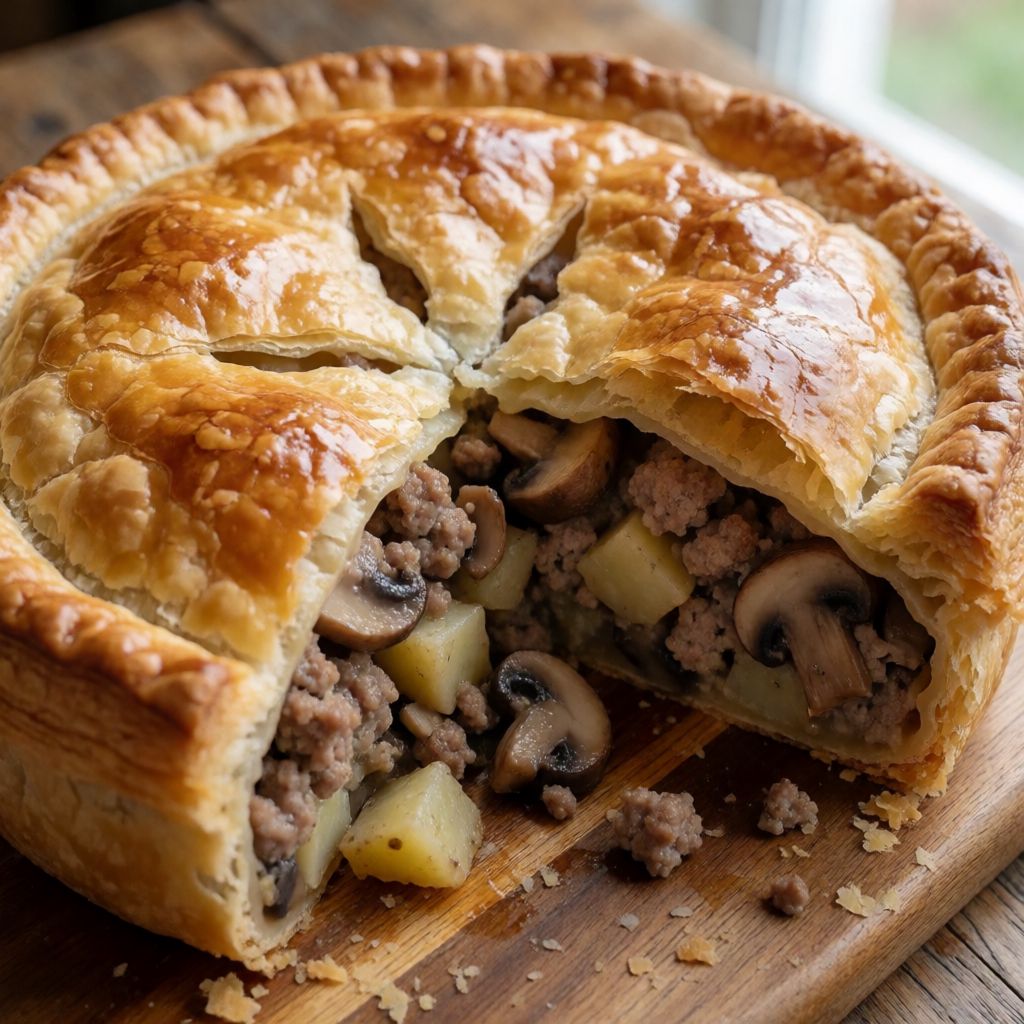
Mushroom and Sausage Puff Pastry Pie
A savoury pie with mushrooms, sausage and potato wrapped in puff pastry.
Labels are worked out automatically from the ingredients and can be wrong. Check the packaging if it matters to you.
Ingredients
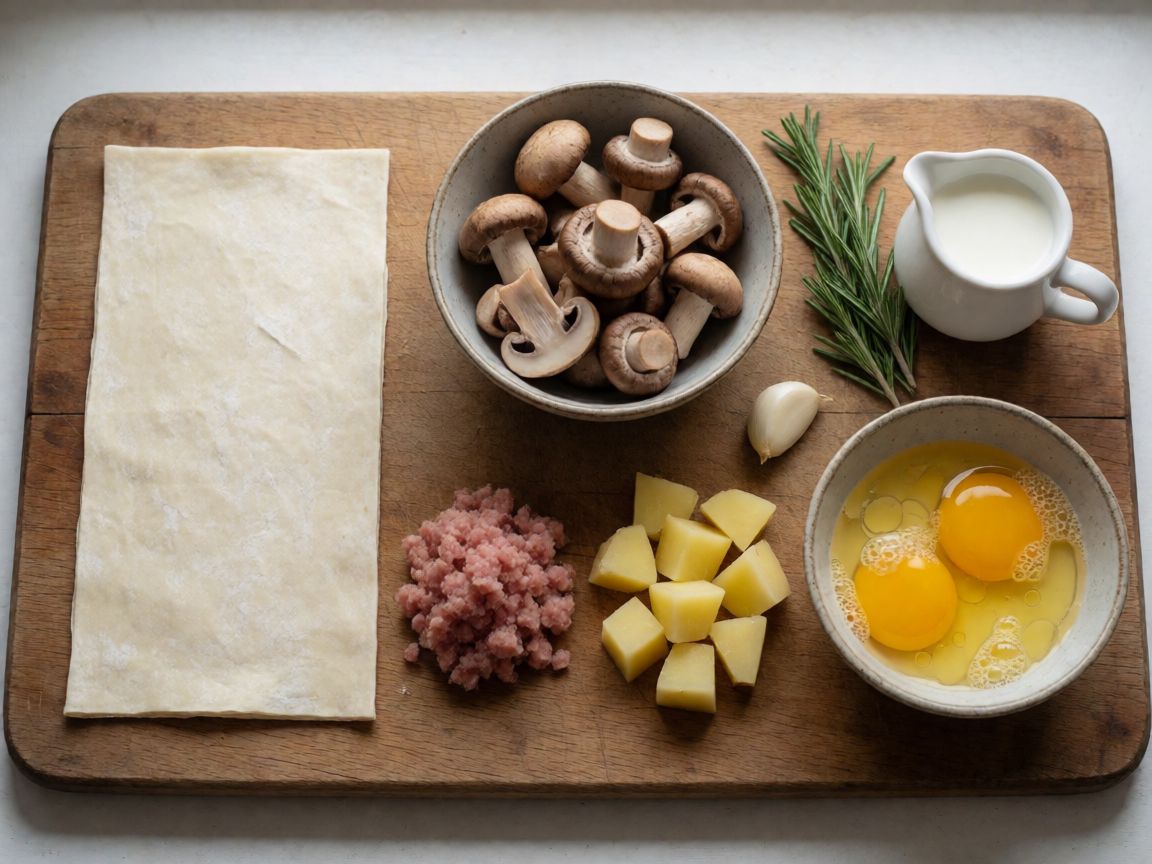
- 1 pcs Puff Pastry
- 500 g Mushrooms
- 200 g Sausage Meat crumbled
- 2 pcs Potatoes diced
- Olive Oil to taste
- Salt to taste
- Black Pepper to taste
- 1 clove Garlic
- 2 pcs Eggs beaten
- 60 ml Double Cream
- Rosemary to taste









Steps
Clean the mushrooms with a damp cloth, trim the base of the stalks and slice them.
Fry the garlic in a little olive oil, add the mushrooms and cook over high heat, stirring.
15 minPeel the potatoes, dice them and fry in another pan with olive oil.
Add the crumbled sausage meat and continue cooking over high heat until browned. Done when it reaches 70°C inside.
Add the potatoes and sausage meat to the mushrooms, mix and let cool.
Lay the puff pastry into a 22-24 cm tin, leaving the edges overhanging.
Spread the filling evenly over the pastry.
Pour the beaten eggs, mixed with the double cream and a pinch of salt, over the top.
Fold the pastry edges in towards the centre of the pie and bake at 200-220°C fan.
35 minRemove from the oven, let it rest briefly and serve.
This is a galette, not a proper pie — pastry folded up and over the filling like you're wrapping a parcel badly on purpose, no tin walls doing the work for you, no lid pretending to seal anything. That's the whole logic of it: puff pastry is brittle and shrinks when it meets heat, so instead of fighting it into a lined, lidded pie, you let it fail elegantly — the edges fold in, gape a little, and the filling peeks through. That gap is not a mistake. It's where the steam escapes instead of turning your crisp pastry into a sog-bottomed sack.
What decides whether this works is moisture, and you deal with it before anything touches the pastry. Mushrooms are mostly water held in a cell structure that gives up the moment it meets a hot pan — that's why you cook them hard and fast, not gently, letting the water boil off rather than seep out slowly and stew everything into mush. Same reasoning with the potato and sausage meat: browned separately, driven dry, because any one of these three going into the pastry wet means a soggy base no amount of oven time will fix afterwards. You're not just building flavour by browning — you're removing the enemy.
The second decision is temperature of the filling itself. It goes in cooled, and that's not fussiness — raw puff pastry is mostly butter in thin sheets, and butter that starts melting before it hits the oven never puffs; it just turns greasy and flat. Hot filling on cold pastry is how you get a pie that lies there instead of rising.
Mushrooms, cleaned with a cloth rather than run under a tap — some say washing mushrooms ruins them, turns them slimy. No: washing them under water they'll happily absorb some of it, since they're basically a dense sponge, and that's moisture you've already fought hard to avoid putting in. A cloth gets the grit off without the extra drink. If you've only got a tin of mixed mushrooms from the back of the cupboard, drain them properly and fry them harder and longer than you would fresh ones — they've already taken on water, so you're working against time, not with it.
Sausage meat here isn't a British breakfast sausage squeezed from its skin, though that works fine — it's just meat with fat and seasoning that renders and browns, the way mince does, giving you savoury depth without the chew of a whole sausage. If you only have sausages, skin them yourself; it's two seconds with a knife and saves you buying a separate product. The "done when it reaches 70°C inside" instruction isn't fussy food-safety theatre for the sake of it — pork products carry risk raw, and colour alone lies to you, especially in a crowded pan where the outside browns before the inside's cooked through. A thermometer here is honest in a way your eyes aren't.
Potatoes diced and fried separately rather than boiled — boiling adds water to something you're trying to dry out, and you'd have to fry them afterwards anyway to get any colour. Frying from raw, in their own pan, means they pick up a crust and cook through at the same time, no extra step, no extra water. Any firm, waxy-leaning potato works; a floury one like a Maris Piper will fall apart in the pan before it browns, so if that's what's in your cupboard, cut it slightly larger and give it a gentler hand so it doesn't disintegrate.
Olive oil "to taste" really means: any oil with no smell of its own strong enough to fight the mushrooms and sausage meat. Olive oil's fine, a light vegetable or sunflower oil is fine, and in fact for high-heat frying a neutral oil behaves itself better than a fruity extra virgin, which can turn bitter and smoky if you push it too hard — and you will be pushing it hard here, because high heat is the whole point of step two.
The double cream and eggs are a ratio you can remember rather than measure religiously: enough cream to loosen two beaten eggs into something pourable, not enough to drown the filling in custard. If you're out of cream, use milk — the pie sets a little less richly, slightly firmer, but it holds. Rosemary is the one note of fragrance in a dish that's otherwise all savoury-brown; dried works, just use less, since drying concentrates it.
On the tin: a 22-24cm tin, in a British kitchen, is your regular quiche or sandwich-cake tin, nothing exotic. If you haven't got one with a loose base, any oven dish of roughly that width does the job, since you're not relying on the tin to shape the pastry walls — the fold is doing that. And the fold itself wants patience: pastry straight from the fridge is stiff and will crack if you rush the edges round; let it sit a minute at room temperature first, fold slowly, and it'll bend instead of tearing — the same logic as the carrot that bends rather than snaps when it's properly cooked, just applied to dough instead of vegetable.
200-220°C fan is hot enough to puff the layers of butter and flour before the butter has time to fully melt and run — that's the whole trick of puff pastry, steam forcing the layers apart faster than gravity and heat can collapse them. Go cooler and you get a pale, dense biscuit instead of lift. The 35 minutes is a floor, not a verdict: you're looking for pastry that's deep gold, not blond, with the custard set rather than wobbling when you nudge the tin. And when it comes out, let it sit — cutting straight away, with a custard filling still moving, gets you a puddle on the plate instead of a slice. A few minutes of patience there is the difference between serving a pie and serving a mess that tastes like one.