
 AI photo
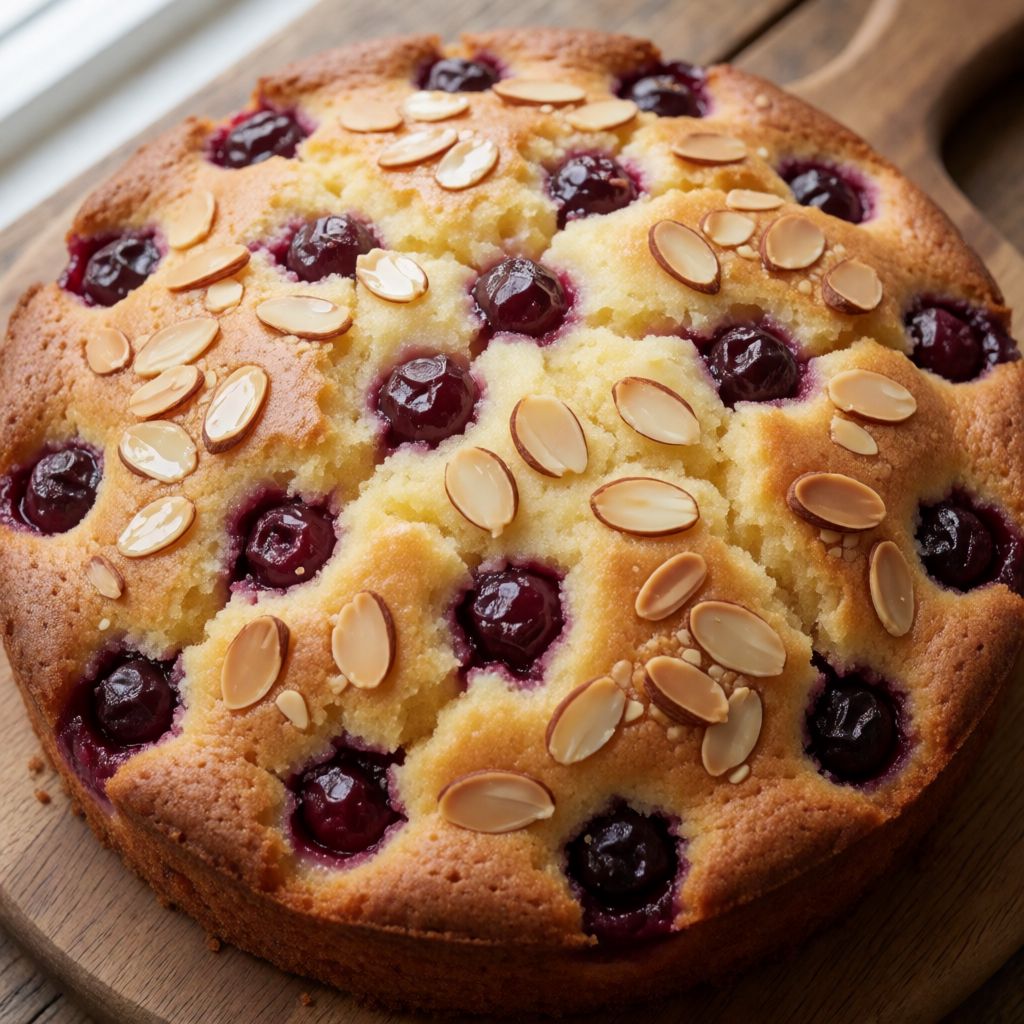
Cherry and Almond Cake
A soft almond sponge studded with whole cherries, finished with a hint of maraschino liqueur.
Labels are worked out automatically from the ingredients and can be wrong. Check the packaging if it matters to you.
Ingredients
- 2 pcs Eggs
- 700 g Cherries stoned
- 100 g Caster sugar
- 100 g Plain flour
- 100 g Ground almonds
- 80 g Butter
- 2 tbsp Maraschino liqueur
- 5 g Baking powder
- 1 pinch Salt
- Brown sugar to taste










Steps
An hour before starting, take the butter and eggs out of the fridge.
Rinse the cherries, pat dry, then remove the stalks and stone them with a cherry stoner.
Break the soft butter into pieces, add the sugar and salt, and beat with a mixer.
Add the ground almonds and stir in with a spoon.
In a separate bowl, whisk the eggs vigorously until pale and fluffy, then fold into the batter.
Sift the flour and add it to the batter along with the baking powder and maraschino liqueur.
Grease a round 24 cm tin with butter and dust with brown sugar.
Spoon the batter into the tin, smooth the surface and arrange the cherries closely together on top.
Bake the cake in an oven preheated to 180°C for about 45 minutes.
45 minLet the cake cool completely before serving.
This is a clafoutis cousin dressed up with ground almonds instead of all flour — a thick, custardy almond batter studded with whole stoned cherries, baked until it sets but still wobbles like a good bread pudding under the crust. What decides whether it works is restraint in two places: how much you beat the eggs, and how long you leave it in the oven after the top browns.
The almonds are doing more than flavour. Ground almonds carry fat and almost no gluten, so they soften the crumb and stop the cake turning rubbery the way a pure flour sponge can when it's this wet from fruit. That's also why you only need 100 g of flour against 100 g of almonds — the almonds are half your "flour" here, just one that can't form the elastic strands that make a cake tough.
Butter and eggs at room temperature isn't fussiness, it's physics: cold butter won't trap air when beaten, it just smears, and cold egg shocks melted or softened butter into little hard lumps that never come back into suspension. An hour on the counter and both are pliable enough to actually combine.
The brown sugar dusting on the buttered tin isn't decoration, it's a release and caramel layer in one. As the cake bakes, that sugar melts into the butter and forms a thin amber shell against the tin — this is what lets a soft, fruit-heavy batter come out in one piece instead of welding itself to the metal. If you've only got white sugar, use it; you lose a shade of toffee flavour on the crust, not the function.
The maraschino liqueur isn't there to get anyone tipsy — two tablespoons in a cake this size barely register as alcohol by the time it's baked off. It's there because cherries, cooked, taste flatter than raw ones; the liqueur is distilled from cherries and gives back the sharp, almondy top note that baking strips out. If you don't have maraschino, use kirsch or amaretto — anything cherry- or almond-adjacent and clear-spirited — rather than skipping it, because water or milk in its place adds moisture with none of the lift.
Beat the eggs "until pale and fluffy" for a real reason: you're folding air into the batter mechanically, since this cake has no extra leavening beyond 5 g baking powder — not enough on its own to carry 700 g of cherries. Whip them hard and you get a cake that rises and holds; whip them lazily and the baking powder alone has to do a job it can't manage, and you get a dense, wet-bottomed slab under the fruit.
Butter here should be real butter, unsalted if you can, because you're also adding a pinch of salt separately — margarine or spread will melt wrong, releasing water that ground almonds then soak up unevenly, giving patches of greasy crumb. Ground almonds should smell faintly sweet and nutty, not musty or rancid — they go off faster than flour because of their oil content, so buy in small bags and keep them in the fridge if you bake this more than once a season.
On "medium oven" or any heat without a cue: 180°C here is set because it's hot enough to firm the egg-almond structure through the centre before the cherries' juice can pool and turn the crumb soggy, but not so hot that the crust sets before the inside is cooked — a classic failure that bites people using British fan ovens, which run fierce. 45 minutes is your floor, not your finish line: look for a top that's deep gold, slightly domed, and a skewer through the middle of a gap between cherries that comes out with moist crumbs, not wet batter. If the top's browning too fast and the middle still wobbles like jelly past the hour mark, that's your fan oven running hot — drop it 10°C next time rather than pulling it early.
Letting it cool completely before cutting isn't patience for its own sake dressed up as a rule — the almond-egg structure is still setting as it cools, the way a baked custard firms on the counter, not just in the oven. Cut it warm and you get a cake that slumps and a knife full of cherry juice; cut it cold and it holds its slice. Patience is the last ingredient on this list, and it's the one with no substitute.
Served with tea, as it will be, it wants nothing more than that — maybe a dusting of icing sugar if you're feeding more eyes than mouths, but the cake doesn't need defending.