
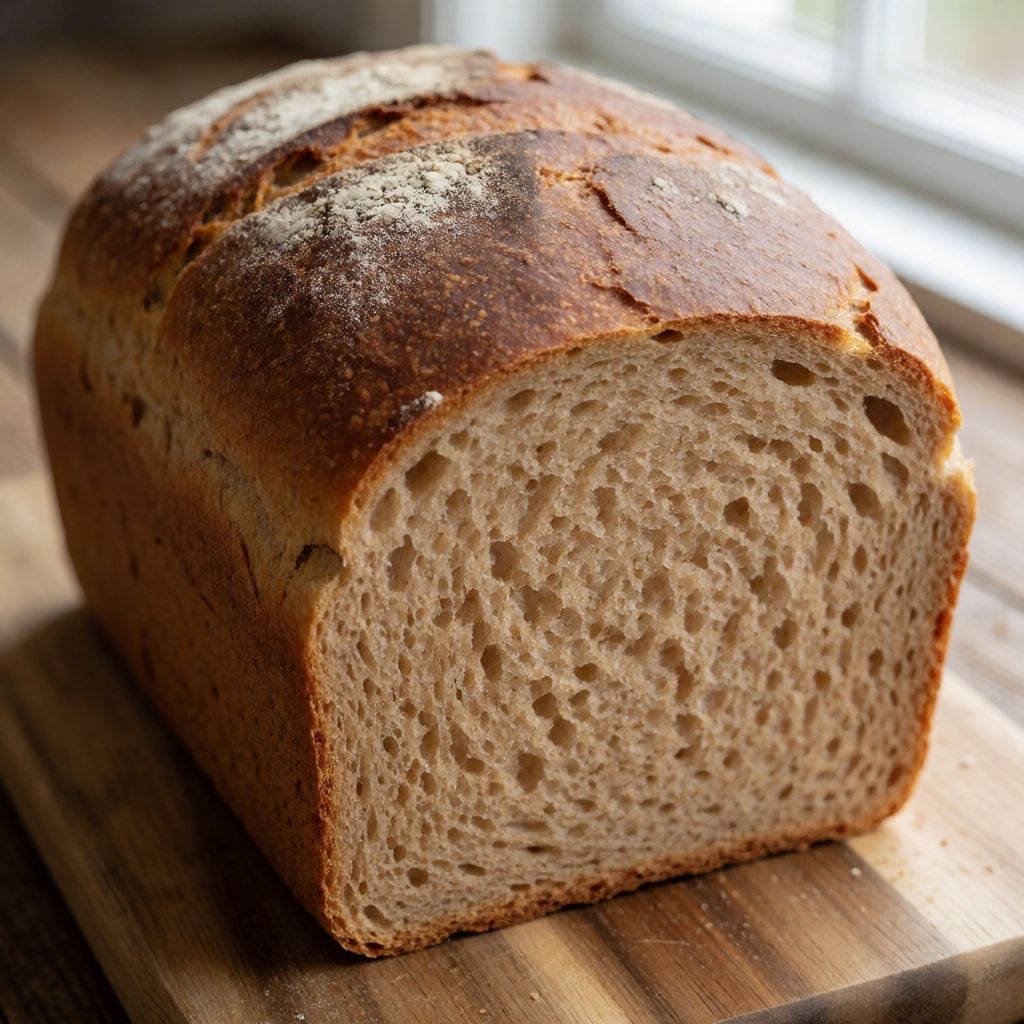
 AI photo
No-Knead Bread in a Loaf Tin
A simple no-knead bread baked in a loaf tin, with a crisp crust from a long, slow rise.
Labels are worked out automatically from the ingredients and can be wrong. Check the packaging if it matters to you.
Ingredients
- 250 ml Water at room temperature
- 250 ml Buttermilk
- 5 g Yeast
- 1 tbsp Sugar
- 1 tsp Salt
- 70 g Wholemeal Flour
- 550 g Plain Flour
- 1 pcs Egg White whisked
- 1 tsp Salt
- 1 tsp Dried Rosemary








Steps
Dissolve the yeast in a bowl with the room-temperature water. Add the buttermilk, sugar, salt and wholemeal flour, and mix until smooth. Stir in the plain flour quickly, mixing until no dry lumps remain.
5 minCover with a clean cloth or lid and let the dough rise on the kitchen counter for 10–12 hours.
600 minTip the dough out onto a flour-dusted surface and fold it over a few times using a spatula.
5 minTransfer the dough to a greased loaf tin (2 litres) and let it rise on the counter for about 2 more hours.
120 minCarefully brush with the whisked egg white (trying not to pierce the dough) and sprinkle with flaky salt and dried rosemary.
2 minBake in a preheated oven at 200°C (fan) for 20 minutes, then increase the temperature to 220°C and bake for a further 25–30 minutes, until the bread is fully cooked through.
27 minPlace the bread on a wire rack and let it cool completely.
35 min
This is batter pretending to be bread. Measure the liquid against the flour — 500ml of wet stuff to 620g of flour — and you get a dough so slack it can't stand up on its own. That's not a mistake, that's the whole method: a loose dough with no gluten yet to speak of, left alone long enough that fermentation does the shaping instead of your hands. It goes into a tin because a tin is the only thing willing to hold its shape for it.
Some say you have to knead bread, that without ten minutes of arm work the gluten never links up and the crumb stays flat and dense. No — because gluten links up perfectly well on its own, given water and time. Flour hydrates, the proteins swell and find each other, and enzymes already in the flour start cutting starch into sugar for the yeast to eat. Kneading just speeds that linking along mechanically. Ten to twelve hours of sitting on the counter does the same job without you lifting a finger — it's a trade of muscle for patience, and patience is free.
What tells you the dough is ready isn't a clock, it's the look of it: doubled, domed, pocked with bubbles under the surface, and when you nudge the bowl the whole thing wobbles like it's barely holding together. That wobble is the gluten web, fully formed, just not yet given a shape to keep.
Buttermilk is doing real work, not just flavour. It's acidic, and that acidity gently works on the gluten too, which is why buttermilk breads come out a touch more tender than a water-only dough — less chew, finer crumb. If you don't have buttermilk, soured milk does the same job: stir a tablespoon of lemon juice or vinegar into ordinary milk and let it sit five minutes until it thickens slightly. The criterion is acidified dairy, not a brand name.
The wholemeal flour is 70g out of 620g total — a flavour and nutrition top-up, not a structural choice. Wholemeal flour carries bran, and bran is sharp-edged at a microscopic level; too much of it and the bran shreds the gluten strands as they try to form, leaving you a loaf that won't rise properly no matter how long you wait. Keep it as a minority ingredient and it adds nuttiness without sabotaging the structure the plain flour is building.
Plain flour here, not strong bread flour — that's deliberate, because this dough already gets its strength from time, not from a high-protein flour fighting against vigorous kneading. If all you've got is strong flour, use it; the loaf will just be slightly chewier, no disaster.
Salt appears twice and the two lots do different jobs. The teaspoon inside the dough slows the yeast down — salt is mildly inhibiting to fermentation, which is exactly what you want over a ten-hour rise, otherwise the yeast exhausts its food supply halfway through the night and collapses the dough before morning. The flaky salt on top, after the egg wash, is pure texture and burst of flavour on the crust — don't swap one role for the other or mix them together before baking.
The sugar is yeast food for the first hour or two, before the flour's own enzymes get busy breaking starch into sugar on their own — after that it mostly just helps the crust colour. Five grams of yeast for over a kilo of liquid-and-flour is a small, patient amount on purpose; this is a slow ferment, not a quick one, and too much yeast here would mean the dough peaks and starts to collapse long before you're awake to catch it.
The egg white wash, brushed on without piercing the risen dough, is there for shine and to glue the rosemary and flaky salt to the crust — egg white alone gives gloss with very little extra browning, unlike a whole egg or yolk wash. Piercing the dough at this stage lets the trapped gas escape through the hole like a slow puncture in a tyre, and you lose your second rise's whole purpose. A standard UK 2lb loaf tin is close enough to the 2-litre size here; go up a size and the loaf spreads thin and finishes baking before it's had a proper rise in the oven. And once it's out, let it cool fully on the rack before you cut it — the crumb is still setting as it cools, starch firming up as it loses heat, and a warm slice looks sliced but feels gummy on the tongue. That wait is the last ingredient, and it's the one people skip.