
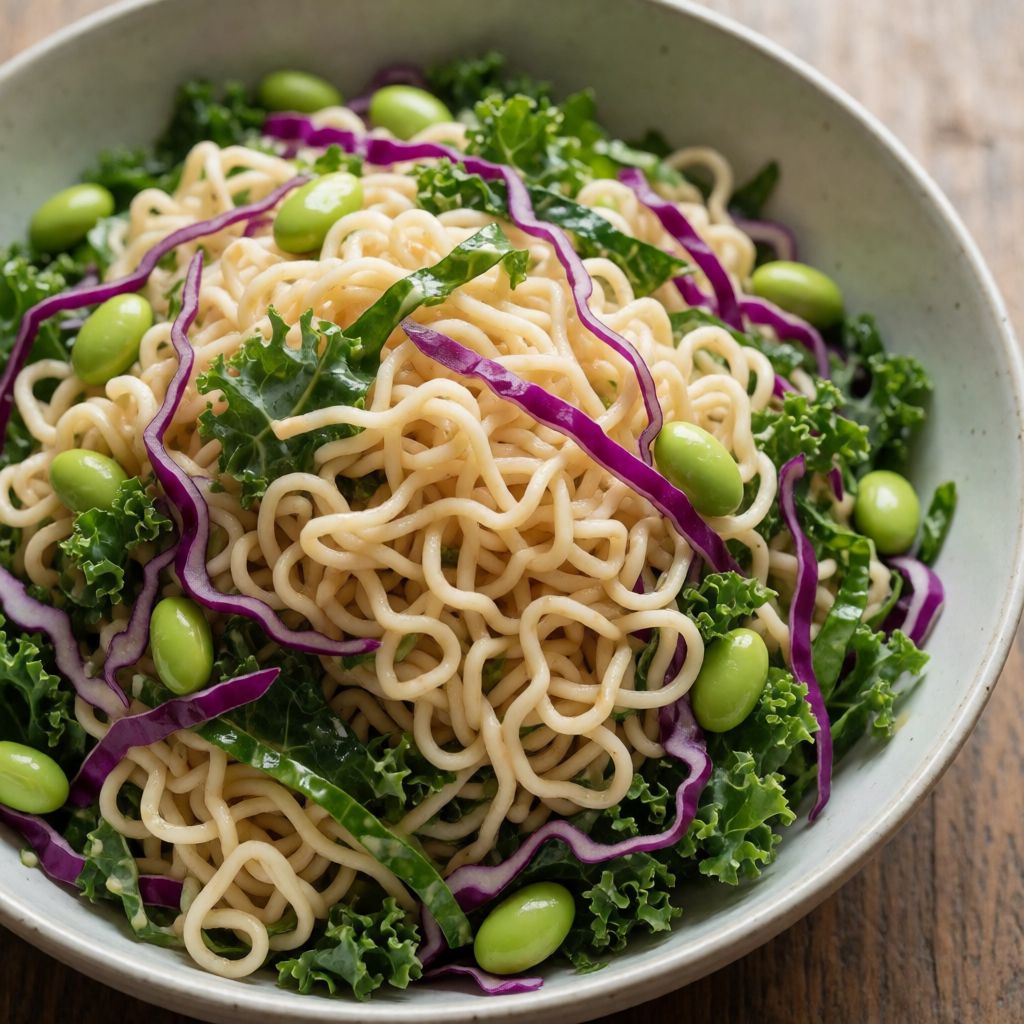
 AI photo
Noodle Salad with Peanut Dressing
A crunchy noodle salad with cabbage, edamame, mango and avocado, tossed in a zesty peanut dressing.
Labels are worked out automatically from the ingredients and can be wrong. Check the packaging if it matters to you.
Ingredients
- 250 g Noodles
- 1 tbsp Sesame oil
- 1 tbsp Soy sauce
- 100 g Kale finely chopped
- 100 g Red cabbage finely chopped
- 100 g Edamame shelled
- 1 pcs Red onion thinly sliced
- 75 g Spinach
- 1 pcs Mango thinly sliced
- 2 pcs Avocado thinly sliced
- 25 g Peanuts roughly chopped, salted
- 20 g Sesame seeds toasted
- ½ tsp Chilli flakes
- 1 bunch Coriander roughly chopped, fresh








For the peanut dressing
- 1 clove Garlic finely grated
- 100 ml Water
- 1 tsp Sugar
- ½ tsp Chilli flakes
- 75 g Peanut butter
- 1 tbsp Soy sauce
- 1 pcs Lime juice and finely grated zest
- 2 tsp Sesame oil
- 1 tbsp Ginger finely grated





Steps
Pour boiling water over the garlic and leave to infuse for 5 minutes.
5 minStir in the sugar, chilli flakes and peanut butter until smooth and creamy.
3 minSeason the dressing with soy sauce, lime juice, lime zest, sesame oil and ginger, mixing well.
1 minCook the noodles according to the packet instructions, then drain immediately and rinse under ice-cold water to stop the cooking and prevent sticking.
5 minToss the noodles with 1 tbsp sesame oil and half the soy sauce.
2 minPut the kale in a bowl and massage it with the remaining soy sauce.
Pour boiling water over the edamame and leave for 1-2 minutes, then drain.
2 minArrange the kale, red cabbage, edamame, red onion and spinach in a large bowl or platter. Scatter the noodles and peanut dressing over the top.
2 minTop the salad with avocado and mango slices, then sprinkle with fresh coriander, sesame seeds, peanuts and chilli flakes before serving.
2 min
This is a cold noodle dish held together by a sauce that isn't a sauce at all — it's an emulsion of peanut butter, water, acid and heat that you build in a jug before a single noodle touches a pot. Everything else — the cabbage, the kale, the mango, the avocado — is architecture around that dressing. Get the dressing wrong and you have a bowl of cold spaghetti with vegetables on it. Get it right and the whole thing reads as one dish instead of a pile of leftovers.
What decides it is two things: how you cool the noodles, and how you loosen the peanut butter. Noodles carry on cooking in their own heat after you drain them — that's not a myth, that's starch physics, the inside of the strand is still hotter than the surface and it keeps gelatinising. Shock them in cold water and you stop that dead, which is also what stops them gluing into a single felt block in the bowl. Some people skip the rinse because "it washes off the flavour" — no, there's no flavour on them yet, you haven't seasoned them. The rinse is purely a brake pedal.
Start with the noodles, because they're the one thing in this bowl that goes through actual cooking. Any noodle that holds its shape cold works — egg noodles, rice noodles, soba, even spaghetti in a pinch if that's what's in the cupboard, though the texture will read more "pasta salad" than "noodle salad." Cook to packet time, not a minute over — you want al dente with margin, because the carry-over heat we just talked about will eat into that margin before the cold rinse catches up. Toss them immediately in sesame oil and soy, while they're still slightly warm: oil on a wet noodle slides off, oil on a just-dried noodle clings. That's the actual reason you do it straightaway and not "whenever."
The kale needs physical persuasion, not just time. Raw kale is structurally stubborn — thick cell walls, a waxy surface — and if you just dress it and wait, it stays leathery for longer than you'll want to wait on a weeknight. Massaging it with soy sauce (the salt and the manual pressure together) breaks down those cell walls mechanically, the same way salt draws water out of cabbage for slaw. You'll see it darken and soften under your hands within a couple of minutes — that colour change is the cue, not a clock.
Red cabbage goes in raw and fine — it's there for crunch and that sharp, slightly peppery bite, and finely chopped it won't dominate a mouthful the way a thick shred would. Edamame gets a short hot-water soak rather than a boil: they're already cooked when frozen, you're just thawing and warming them through, and a minute or two in just-boiled water is enough — boil them properly and they go mealy, which is a texture problem, not a flavour one.
The fruit and fat — mango and avocado — are sliced thin and added last, on top, not tossed through. Toss avocado into a bowl with sharp dressing and vigorous mixing and it turns to mush; it bruises easily because it's mostly soft fat with very little structural fibre. Keeping it as a garnish layer protects both its shape and the clean lines of the slices, which also just makes the dish look like someone meant it.
On the dressing itself: peanut butter is the backbone, but it's not interchangeable with "any nut butter" without consequence — the criterion is a nut or seed paste with enough natural oil to loosen and enough protein to hold an emulsion with water and soy. Tahini will do this and gives you a sesame-forward version instead; almond butter works but is sweeter and blander, so push the chilli and lime harder to compensate. Smooth, unsweetened peanut butter is the safer default — the sweetened spreading kind will throw off the sugar measurement you've already built into the recipe.
Sesame oil earns its place twice — once raw in the dressing for its perfume, once as the coating oil for the noodles — and this is a case where there's no real substitute: its smell is the point, not a side effect, so don't reach for a neutral oil here and expect the same result. Where you do want neutral is nowhere else in this dish — everything else is raw or barely blanched, so there's no cooking oil doing silent work.
Patience here isn't about long cooking — there's barely fifteen minutes of actual heat in the whole dish. It's about not rushing the sequence: infusing before mixing, cooling before dressing, slicing before assembling. Skip a gap and you taste it — raw garlic instead of rounded, sticky noodles instead of separate, mushy avocado instead of sliced. None of it is hard. All of it is order.