
 AI photo
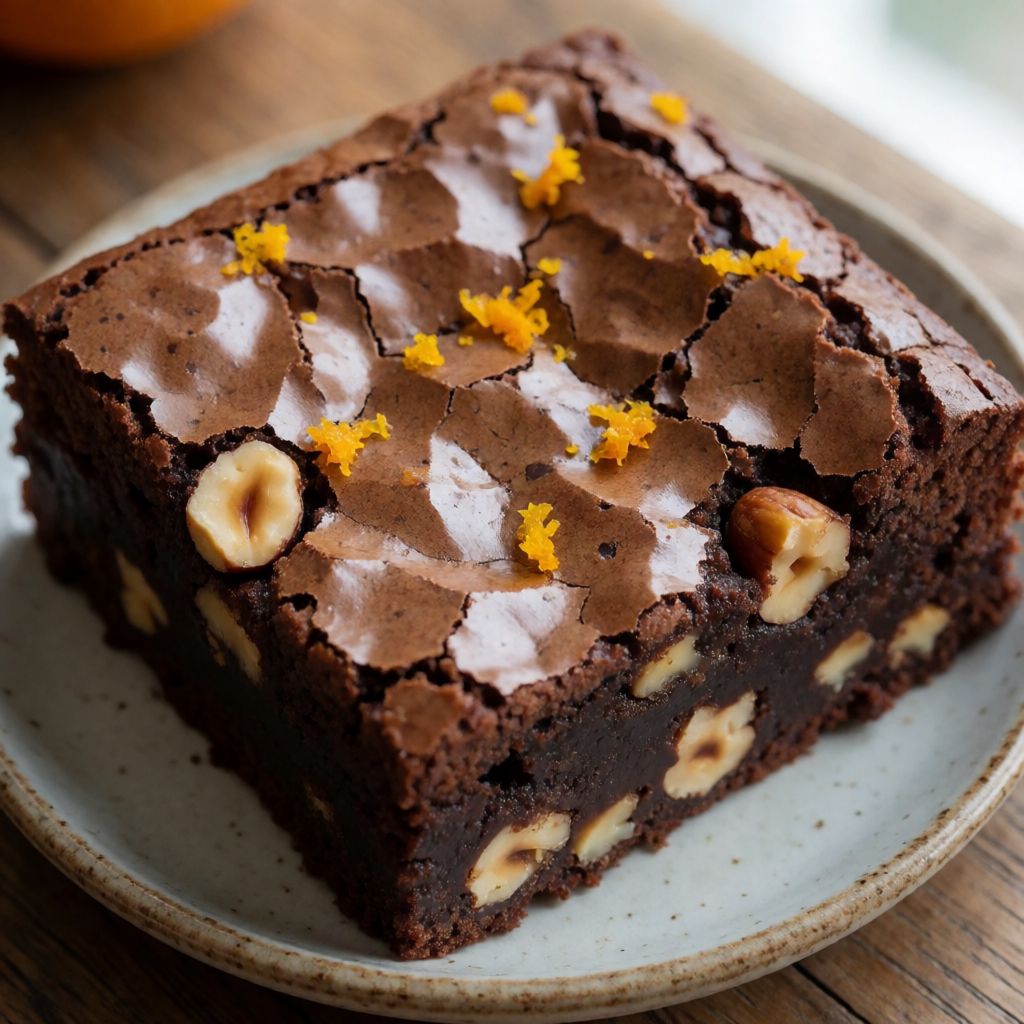
Orange and Hazelnut Brownie
A rich chocolate brownie with orange zest and hazelnuts, finished with a chocolate ganache topping.
Labels are worked out automatically from the ingredients and can be wrong. Check the packaging if it matters to you.
Ingredients
- 200 g Butter
- 200 g Dark chocolate roughly chopped
- 4 pcs Eggs
- 1 pcs Orange unwaxed, finely grated zest
- 225 g Sugar
- 1 tsp Vanilla sugar
- 110 g Plain flour
- 1 pinch Salt
- 75 g Hazelnuts finely chopped






Chocolate ganache
- 150 ml Whipping cream
- 175 g Milk chocolate finely chopped
To serve
Steps
Melt the butter in a saucepan over low heat. Remove from the heat and stir in two-thirds of the chocolate. Stir until smooth.
5 minWhisk the eggs, orange zest, sugar and vanilla sugar until light and fluffy. Fold in the chocolate-butter mixture.
5 minMix the flour with the salt, sift into the batter and mix well. Add the remaining third of roughly chopped chocolate and the finely chopped hazelnuts. Mix the batter well.
3 minPour the batter into a 20 x 20 cm tin lined with baking paper, and bake in a fan oven preheated to 170°C for 25–27 minutes. Baking time may vary depending on your oven, but the brownie should still feel slightly underbaked in the middle when removed.
26 minLeave the brownie to cool in the tin, then chill in the fridge until the next day to set.
120 minChocolate ganache: heat the cream until almost boiling, then remove from the heat. Stir in the milk chocolate until the mixture is smooth. If needed, blitz briefly with a stick blender. Chill in the fridge for at least 1 hour, or until the next day.
60 minTo serve: stir the ganache and spread it over the cake. Sprinkle with the roughly chopped hazelnuts and a pinch of flaky salt.
5 min
A brownie lives or dies on the inside, and this one is built to stay wet in the middle on purpose. Two chocolates do two different jobs here: the dark chocolate melted into the butter is the backbone, bitter enough to carry 225 g of sugar without tipping into fudge; the milk chocolate only turns up later, in the ganache, where its sweetness and softer set are actually wanted. Treat them as interchangeable and you'll either get a brownie too sweet to bear or a ganache too stiff to spread.
What decides success is the 170°C bake and what you do the moment it comes out. Some say a brownie is done when a skewer comes out clean — no, that's a cake rule, and if you apply it here you'll have a dry, crumbly square that's technically "cooked" and actually ruined. A brownie sets as it cools, not in the oven. You're baking the edges and the first centimetre under them; the middle finishes setting from stored heat and then, more slowly, from a night in the fridge. Pull it when the top has a dull, crackled crust and the centre still gives like a just-set jelly under light finger pressure — not liquid, just unresolved. If it looks fully firm at 170°C, it will be sand by the time it's cold.
Butter first, and don't rush it past "melted" into "sizzling" — a saucepan over a flat you don't fully trust the dial of will scorch milk solids before you notice, and burnt butter under chocolate reads as bitter in a bad way, not a good one. Low heat, melt, off the heat, then the chocolate goes in to the residual warmth. That order matters: chocolate added to butter that's still actively boiling will seize and grain instead of going glossy.
On the two chocolates: dark chocolate for the batter wants to be properly dark — 60–70% cocoa solids is the useful range, because this bake is carrying a lot of sugar and needs bitterness to hold its own against it. Any chocolate "with no flavour of its own but cocoa" will do; what you're avoiding is the cheap stuff bulked with vegetable fat, which won't melt the same way and leaves a waxy film on the tongue. Milk chocolate for the ganache is the opposite choice on purpose — soft, sweet, melts into cream without a fight, and sets to a spreadable rather than a snap-firm finish. Swap them and the ganache will be gritty-sweet and the cake underpowered.
Eggs, whisked until "light and fluffy" with the sugar and zest, are doing real aeration work — this is what gives the brownie its thin, crackled top crust, the thing people actually mean when they argue about "the best part of a brownie." Don't skip the whisking time to save three minutes; a flat, unwhisked egg mixture gives a flat, matte top with no crust at all.
Flour is a small quantity here — 110 g against 200 g of chocolate and 200 g of butter — because this is meant to be fudge with structure, not cake with chocolate in it. Sift it in and fold, don't beat, once it's in: overworking flour develops gluten, and a "chewy, bready" brownie is the usual complaint when someone's beaten the batter like they're making bread dough.
Hazelnuts do two separate jobs and that's why they're two different cuts. Finely chopped, in the batter, they're mostly texture and toasted-nut flavour threaded through every bite — any nut with a good roast flavour works here if hazelnuts aren't to hand: walnut, pecan, even blanched almonds, though almonds are the least interesting of the three. Roughly chopped, on top, they're about contrast — crunch against ganache, something to bite into after a soft square. If you only have one bag of nuts, chop some fine for the batter and leave the rest rough for the top rather than using all one size; uniform texture all the way through is actually a bit boring to eat.
A 20 x 20 cm tin lined with paper isn't fussiness — chocolate-and-butter batter at this ratio will stick to bare metal hard enough to tear the crust off when you try to lift it out, so the paper is there to prevent that specific failure, not general tidiness. If your tin's a different size, the only thing that travels badly is the bake time — a shallower spread will set at the edges before the middle's anywhere near ready, so watch the crust and the wobble, not the clock, same as the recipe already tells you.
Vanilla sugar is there in a small quantity to round off the orange and chocolate rather than to taste of vanilla itself — if you've only got vanilla extract, a teaspoon stirred into the egg mixture does the same rounding job; it's not a dish-defining ingredient so don't go out of your way for it.