
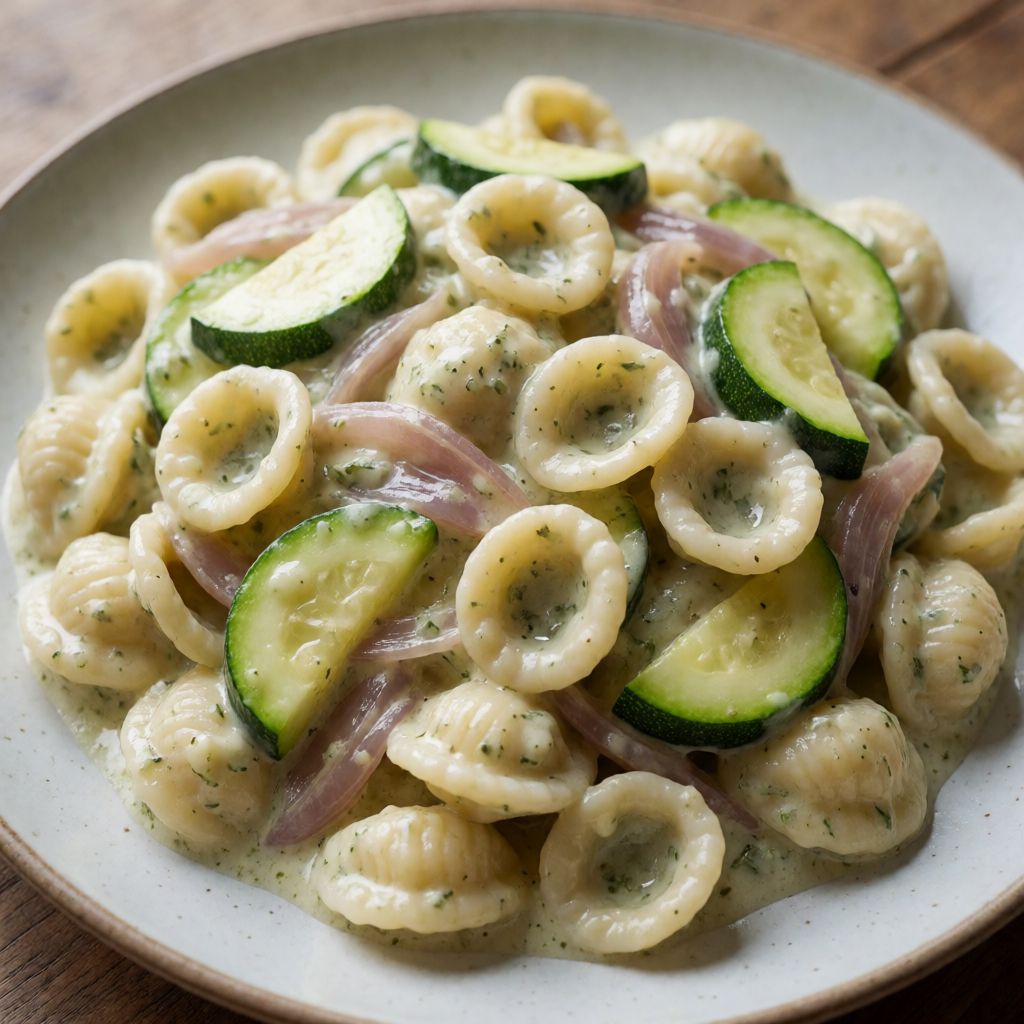
 AI photo
Orecchiette with Gorgonzola and Courgette
A quick pasta dish with orecchiette, sweet gorgonzola, courgette and walnuts.
Labels are worked out automatically from the ingredients and can be wrong. Check the packaging if it matters to you.
Ingredients
- 400 g Orecchiette
- 1 pcs Shallot
- 2 pcs Courgette
- 150 g Gorgonzola Dolce cut into pieces
- 2 tbsp Milk
- 30 g Butter
- Parsley to taste
- Salt to taste
- Black Pepper to taste
- 40 g Walnuts
- Parmesan to taste








Steps
In a frying pan, sauté the shallot in butter, add the courgette and simmer on low heat for 10 minutes.
10 minWhen the courgette has softened, add the gorgonzola dolce, cut into pieces, and melt together with the milk.
Sprinkle with parsley and walnuts.
Cook the orecchiette until al dente and drain.
Add the pasta to the pan with the sauce and sauté for a few minutes, sprinkling with parmesan.
Orecchiette means little ears, and that's not a cute name — it's a job description. The curl holds a dollop of sauce in its cup; the rough surface (made by dragging a knife across dough, not by extrusion) gives the cheese something to cling to. A smooth shape would just slide the sauce off onto the plate. So before anything else, the pasta shape is already doing half the work this recipe needs.
What decides whether this dish is good or a sad beige puddle is three separate battles, all fought with heat you don't see mentioned by number. First: the courgette, which is 90-odd percent water, has to lose that water slowly enough to soften instead of just weeping and going grey. Second: the gorgonzola has to melt into a sauce, not split into oil and curd — which is exactly what happens to any blue cheese pushed too hard too fast. Third: the pasta has to finish its life in the pan with the sauce, not in the colander waiting for you to catch up.
Some say you simmer courgette on low heat out of laziness, to free you up to do something else. No — you do it because courgette's cell walls are mostly water held in a loose net, and if you hit that net with high heat, the water flashes out all at once, the courgette collapses on the outside while staying raw and watery inside, and you get slimy coins with no backbone. Slow heat lets the water leave gradually, so the courgette softens evenly all the way through and what's left behind is flavour, concentrated, not washed out.
Shallot, not onion, and not for snobbery. A shallot is sweeter and milder — less sulphur, less bite — so it disappears into the butter instead of announcing itself over the cheese. If you've only got a regular onion, use half of one, finely cut, and give it longer and gentler heat so it goes translucent without colouring; what you're avoiding is onion that's sharp enough to compete with gorgonzola, which is already a loud ingredient.
Butter, not oil, because this whole sauce is a dairy conversation — butter, milk, cheese, parmesan — and a neutral oil would sit outside that conversation instead of joining it. If you need to keep it dairy-light at this one stage, use any oil with no smell of its own (a light olive oil, not extra virgin, or a plain vegetable oil) — you'll lose some roundness in the base, but the cheese sauce later will still carry the dish.
Courgette: pick ones that feel heavy and firm for their size — a courgette that's gone soft and bendy is already losing water on its own, before it's near the pan, and will cook unevenly. Two courgettes for four people is about right because courgette shrinks hard as it loses water; what looks like plenty raw will look modest in the pan. This is where patience is genuinely an ingredient — rushing the ten minutes doesn't save you ten minutes, it just gives you watery, undercooked courgette with scorched edges, because a crowded domestic pan on a UK hob heats unevenly and courgette dumped in all at once will steam in its own liquid before it browns anywhere.
Gorgonzola dolce, cut in pieces so it melts evenly rather than one big block that's molten on the outside and cold in the centre. If dolce isn't on the shelf, look for any soft blue that melts smoothly — Cambozola, a young Dolcelatte, even a mild, creamy Stilton will behave the same way; what you're choosing on is fat content and youth, not brand. The milk goes in with it and does one job: it buys you a wider window of heat where the cheese stays an emulsion instead of breaking into oil and grit. Keep the pan gentle here — once it's smooth, it doesn't need more convincing.
Walnuts and parsley aren't decoration, they're the correction. The sauce is rich, soft, and one texture; the walnut gives you something to bite against, and its own faint bitterness cuts the fat the way a squeeze of lemon would in a different dish. Parmesan, added at the pan stage rather than at the table, melts slightly into the hot pasta and sauce instead of sitting on top as a dry dust — grate it finely so it has a chance to actually join the sauce rather than clump.
Last thing, and it's the step easiest to skip in a flat with no proper gas ring: the pasta has to go into the pan with the sauce and get a couple of minutes together, not just get spooned over at the table. That short marriage is what lets the starch on the orecchiette's rough surface grab the sauce and hold it, instead of the sauce staying a puddle at the bottom of the bowl. 400 g dried orecchiette feeds four properly — not a starter, a proper plate — and if your pan's too narrow to toss pasta and sauce together without it ending up half on the hob, use the widest pan you own; this dish was always meant for a kazan's worth of room to move, and a crowded saucepan is the quiet cause of a lot of sauce left behind, uneaten.