
 AI photo
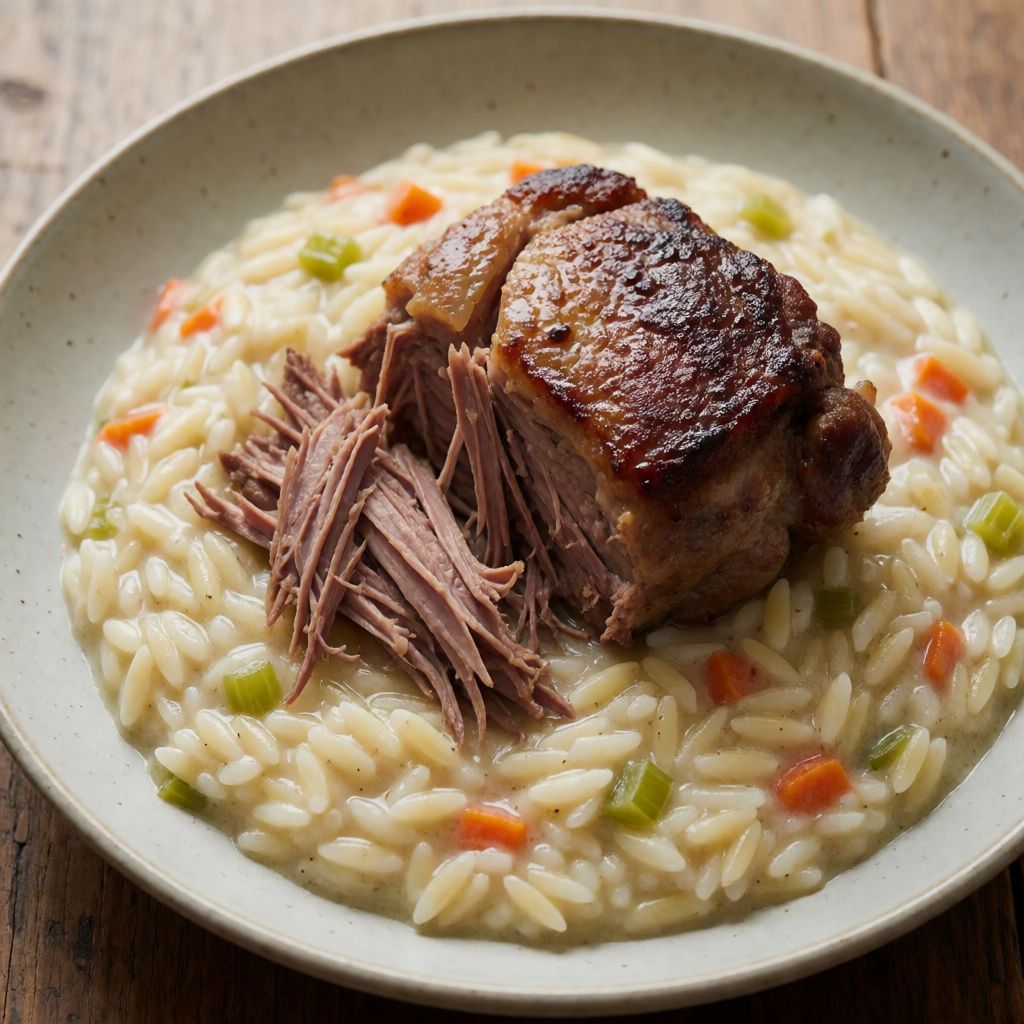
Creamy Orzo with Slow-Braised Lamb Shoulder
A comforting dish of creamy orzo topped with tender, slow-braised lamb shoulder.
Labels are worked out automatically from the ingredients and can be wrong. Check the packaging if it matters to you.
Ingredients
- 750 g Lamb shoulder
- 20 g Butter
- 2 pcs Onion finely chopped
- 3 pcs Carrot finely diced
- 2 pcs Celery finely diced
- 200 ml White wine
- 500 ml Stock
- 0.5 tsp Dried rosemary
- 1 tsp Dried thyme
- Salt to taste
- Black pepper freshly ground, to taste
- 500 g Orzo pasta
- 75 g Parmesan grated
- 100 ml Parsley finely chopped
- 1 pcs Lemon finely grated zest












Steps
Trim the lamb shoulder of any membrane and pat dry with kitchen paper. Brown the meat in the butter in a large pot, then set aside.
Add the onion, carrot and celery to the pot and cook over medium heat until the onion has softened.
Add the browned meat, white wine, stock, rosemary, thyme, salt and freshly ground pepper.
Cover, bring to the boil, then reduce to a simmer, skimming off any foam a few times.
Lower the heat to a minimum, cover again and simmer gently for 2½ hours, until the meat is tender.
150 minRemove the meat from the pot and strain the vegetable broth. Add half of the broth to the pot with the orzo.
Bring to the boil, stirring, and cook until the orzo is perfectly tender, adding more broth as needed.
Mix the parsley with the lemon zest.
Stir the braised vegetable mixture from the lamb into the cooked orzo, and season with salt and freshly ground pepper to taste.
Spoon the orzo into deep bowls, break the meat into pieces and arrange on top. Sprinkle with lemon zest, parsley, grated Parmesan and freshly ground pepper.
What was changed
The name for the lamb shoulder ingredient was corrected to match the actual meat used in the recipe Lamb shoulder.
This is a two-stage dish pretending to be one pot: first you make a lamb broth, slowly, with the meat still in it, then you use that broth to cook a pasta risotto. The lamb shoulder isn't there to be a "cut" you eat like a chop — it's a flavour engine. Shoulder is full of collagen and connective tissue, the stuff that won't soften in twenty minutes no matter how high you turn the hob. Give it two and a half hours at a bare simmer and that collagen melts into gelatine, which is what makes the broth cling to the orzo later instead of running off it like water.
What decides whether this works isn't the meat, oddly — it's restraint at two points. First, the heat under the braise: it has to be low enough that the liquid barely trembles, not boils. A rolling boil toughens meat fibres before the collagen has time to break down — that's the actual mechanism behind "boiled meat goes rubbery," not some vague kitchen superstition. Second, the orzo stage: you're not boiling pasta in a lot of water and draining it, you're cooking it in just enough broth, stirring, topping up as it drinks — same logic as risotto, and for the same reason: starch released slowly into a small amount of liquid thickens that liquid into a sauce, rather than disappearing down the sink with the pasta water.
Lamb shoulder, trimmed of the membrane: that thin silvery skin doesn't render, it just tightens and chews like a rubber band, so off it comes before the meat sees heat. Pat it properly dry — wet meat steams in the butter instead of browning, and browning is not decoration, it's where half the eventual flavour of your broth comes from. No shoulder in the shop? Neck fillet or shin will do the same job — anything with enough connective tissue to need hours, because that's the whole point of this cut, not a flaw to work around.
The butter is there to brown the meat and soften the vegetables, nothing mystical — any fat that can take the heat without burning works, though butter also leaves a little milk-solid sweetness in the fond at the bottom of the pot, which the wine will later lift off. If you want it dairy-free, a neutral oil, one with no smell of its own, does the browning just as well; you lose a faint sweetness, not the structure of the dish.
Onion, carrot, celery, cooked in that order of patience — not for a stock-cube flavour, but because they're going back into the finished orzo at the end, so they need to be soft enough to melt into it, not sit there as crunchy confetti. The white wine isn't for the alcohol, which cooks off, but for the acid — it cuts through the richness of the lamb fat and keeps the broth from tasting flat and one-note. No wine open? A splash of wine vinegar in water gets you the acidity without the ceremony.
Stock, enriched later by the lamb's own juices, becomes the cooking liquid for the orzo — this is the entire reason you braise the meat in liquid rather than roasting it dry. Rosemary and thyme, dried, go in early with the liquid because dried herbs need time and heat to open up; fresh herbs, by contrast, you'd add at the very end so they don't cook to nothing. Skimming the foam a few times during the first boil isn't fussiness — it's removing the coagulated proteins that would otherwise cloud your broth and leave a slightly bitter, muddy edge on the finished dish.
Orzo itself behaves like rice here, not like spaghetti — that's why it drinks broth gradually rather than boiling in a flood of water. Parmesan and lemon zest go in at the very end, off the heat or near it, because both lose their character if they cook too long: Parmesan turns stringy and greasy past a certain heat, and lemon zest's oils evaporate fast once warmed. Break the meat apart with your hands or a fork rather than slicing it — after two and a half hours it should come apart on its own, and if it needs a knife, it simply hasn't had long enough yet. That's your real test for doneness, not the clock.