
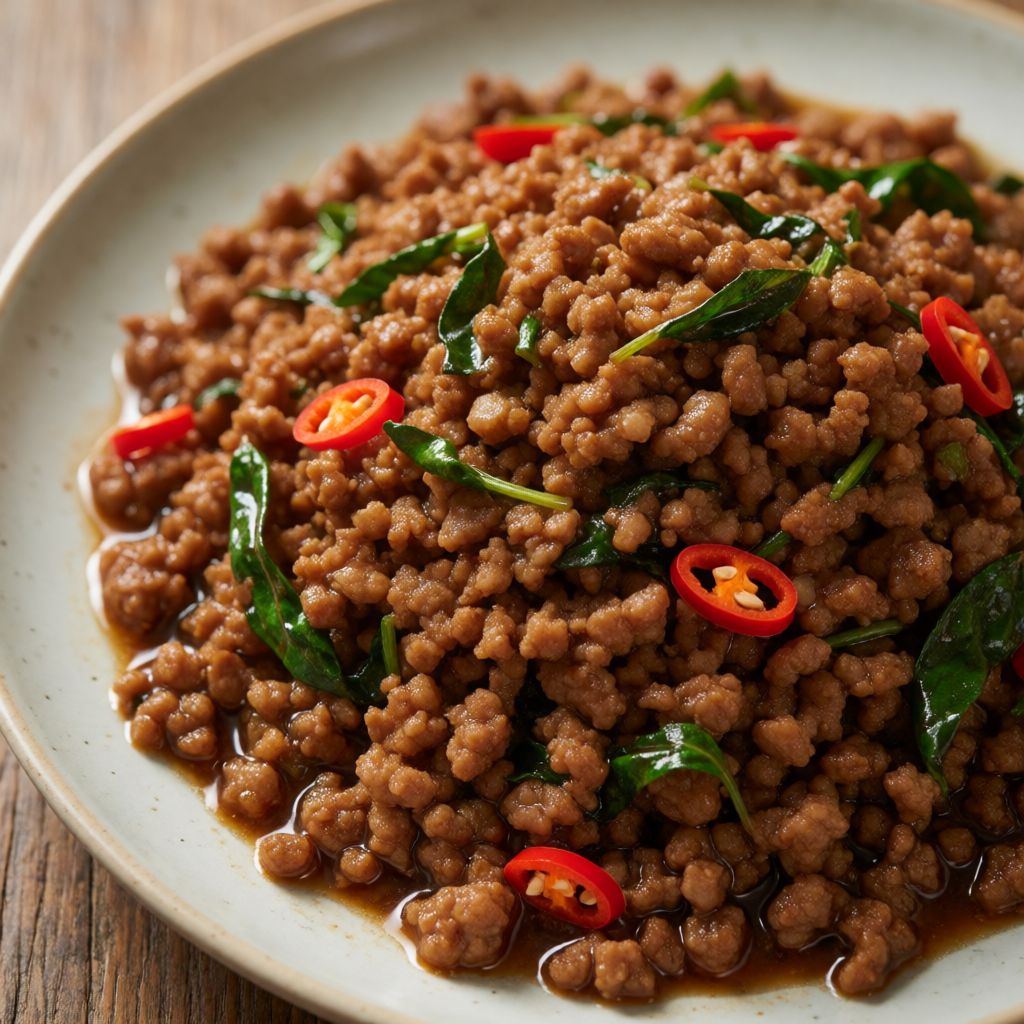
 AI photo
Pad Kra Pao with Pork and Holy Basil
A quick, spicy Thai stir-fried pork with holy basil, served with jasmine rice and a fried egg.
Labels are worked out automatically from the ingredients and can be wrong. Check the packaging if it matters to you.
Ingredients
- 3 clove Garlic finely chopped
- 1 pcs Red chilli finely chopped
- 500 g Minced pork
- 2 tbsp Fish sauce
- 2 tbsp Oyster sauce
- 1 tbsp Soy sauce
- 0.5 tsp Sugar
- 1 bunch Holy basil roughly chopped
- 4 tbsp Sesame oil
- 300 ml Jasmine rice
- 4 pcs Eggs
- 0.5 bunch Holy basil











Steps
Cook the rice according to the packet instructions.
Heat a pan with oil over medium heat and fry the garlic and chilli, stirring, for half a minute so the garlic doesn't brown.
1 minAdd the minced pork, turn the heat to high and fry the meat well.
4 minAdd the fish sauce, oyster sauce, soy sauce and sugar and stir for 1–2 minutes until the meat caramelises slightly.
2 minTurn off the heat and stir in the holy basil.
1 minHeat another pan with oil over high heat.
2 minCrack in the eggs and fry until the whites are crisp at the edges and the yolk stays soft.
3 minServe the Pad Kra Pao with jasmine rice and the fried egg, sprinkled with fresh holy basil.
1 min
Pad kra pao is Thai fast food in the truest sense — a street-cart dish built to go from raw mince to a plate in the time it takes a hungry person to lose patience. The name tells you the one ingredient that isn't optional: kra pao, holy basil, which is peppery and almost clove-like, nothing like the sweet basil sitting next to it in a UK supermarket. Everything else — garlic, chilli, a trio of salty-sweet sauces — exists to season the pork, not to define the dish. Swap the basil for Italian basil and you've made a perfectly nice stir-fried mince with an egg on top; you have not made pad kra pao.
What decides whether it works is heat and timing, not a long ingredient list. This is a dish of two short, violent cooking events — the pork, then the egg — separated by nothing. In a Bangkok kitchen that's a gas burner roaring under a flat-bottomed wok that heats in seconds. On a UK electric or induction hob, "high" takes longer to arrive and holds less heat once the cold meat hits it, so give the pan the time to actually get hot before you add anything, or the pork will stew in its own liquid instead of frying.
Holy basil (kra pao) is the whole point, so it's worth saying plainly what you're looking for and what to do if you can't find it. It has narrow, slightly fuzzy leaves and a sharp, almost medicinal smell — closer to cloves and pepper than to the sweet aniseed of the basil in your local greengrocer. Some UK Thai/Asian grocers sell it fresh or frozen; if you truly can't get it, Thai basil (bai horapa, the purple-stemmed one, sold more widely) is the nearer substitute, and ordinary sweet basil is the last resort — it'll still taste good, just not of this dish. There's a persistent idea that any basil will do because "it's just a herb for colour." No — basil here is the seasoning, not the garnish; it's doing the job chilli does in other dishes.
The minced pork wants enough fat in it to fry rather than steam — a lean, dry mince just goes grey and crumbly. If your butcher's mince looks very lean, a tablespoon of extra oil in the pan corrects for it. Pork shoulder mince is traditional because it's cheap and fatty, which is also why this is street food and not banquet food — it was built around what a cart cook could buy in bulk and cook fast, not around luxury cuts.
The three sauces — fish sauce, oyster sauce, soy sauce — aren't interchangeable, they're doing three different jobs: fish sauce brings the savoury depth (its smell cooks off; don't judge it from the bottle), oyster sauce brings a sticky, slightly sweet body that helps the meat caramelise rather than just sit in liquid, and soy sauce rounds out the salt and darkens the colour. If you're out of oyster sauce, a touch more sugar and soy gets you closer than leaving it out altogether. Garlic and chilli are fried briefly and gently at the start specifically so the garlic doesn't scorch — burnt garlic turns bitter and you taste it in every bite after, which is the real reason that first half-minute over moderate heat matters more than it looks like it should.
The egg is cooked separately and fried hard enough that the edges go lacy and brown while the yolk stays soft — that contrast of crisp white and running yolk against the salty pork is the dish's actual finishing touch, more than any garnish. Use a pan that's properly hot before the egg goes in, and resist moving the egg around; a Western habit of nudging and flipping fried eggs works against the crisp-edge effect you want here.
Sesame oil is listed for frying, but it has a fairly low smoke point and a strong smell of its own — in Thailand this dish is usually cooked in a neutral oil, with sesame oil (if used at all) added at the end for aroma. If you want the pork to fry rather than smoke, use any oil with no smell of its own — vegetable, sunflower, groundnut — for the actual cooking, and you lose nothing of the dish's character.
Jasmine rice is non-negotiable in spirit if not in letter: it's sticky enough to hold the sauce but not glutinous, and its faint floral smell is part of what makes the plate smell like Thai food rather than just "stir-fried mince." Any long-grain rice will feed you, but jasmine is cheap enough in the UK now that there's little reason to substitute it. Cook it while the pork is resting between steps rather than first — it holds its heat and texture far better than it reheats.
And the quiet ingredient the recipe doesn't list: pace. The whole cooked portion of this dish takes minutes, but those minutes only work if you've got the rice already going, the eggs cracked and ready, the basil already chopped before the pork hits the pan. Pad kra pao punishes a cook who stops mid-recipe to find an ingredient — that's not a flaw in the dish, it's the dish telling you street food was never meant to wait for you.