
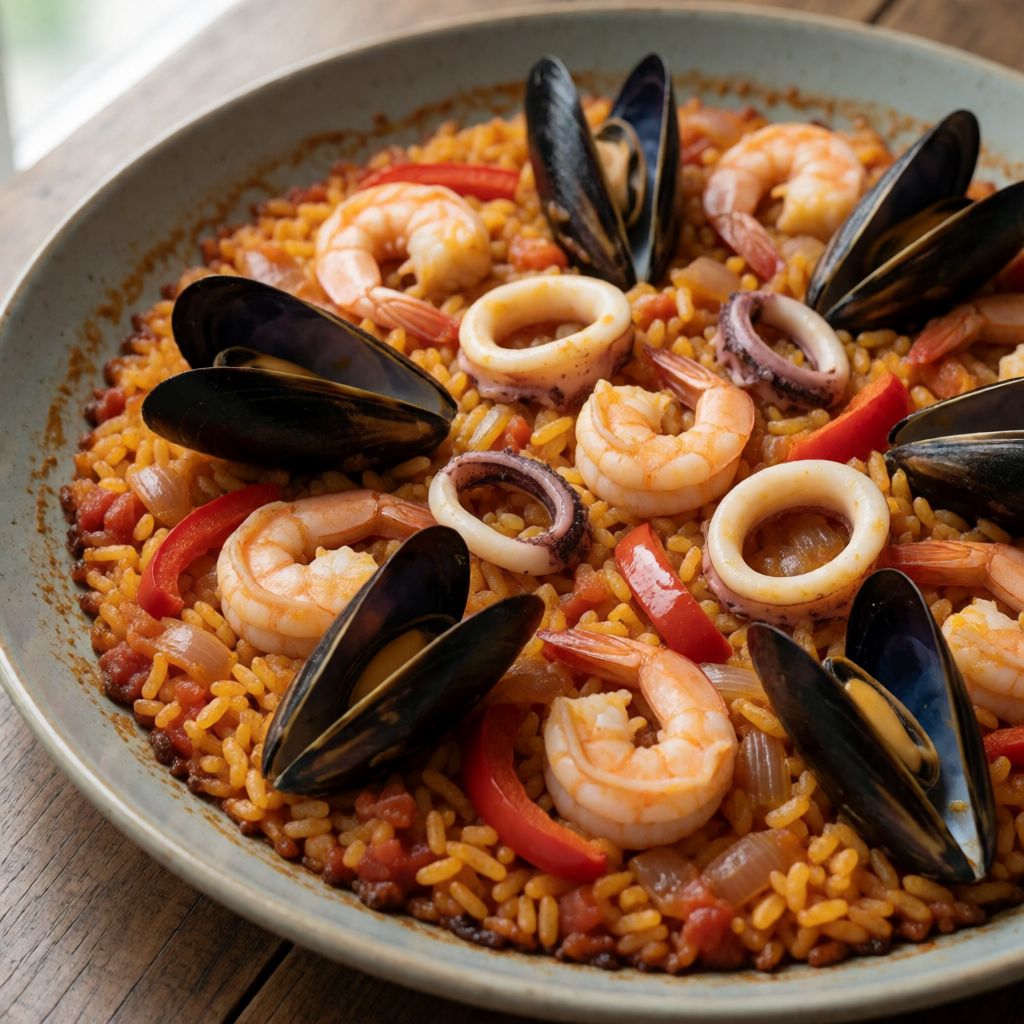
 AI photo
Seafood Paella
A classic seafood paella with prawns, mussels, squid and cuttlefish in saffron-tinted rice.
Labels are worked out automatically from the ingredients and can be wrong. Check the packaging if it matters to you.
Ingredients
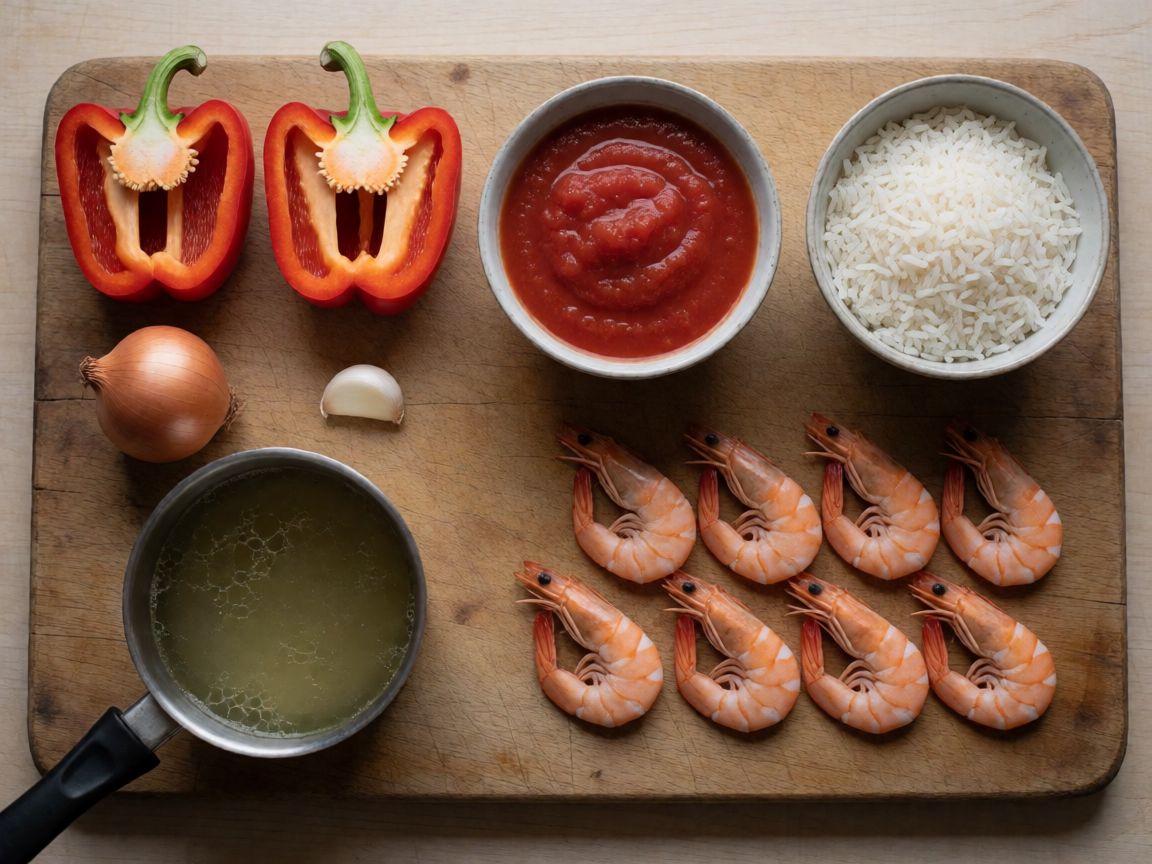
- ½ pcs Red pepper about 80 g
- ½ pcs Green pepper about 80 g
- ½ pcs Onion about 50 g
- 1 clove Garlic
- 220 g Tomato passata
- Olive oil to taste
- 180 g Rice bomba variety
- 260 ml Shellfish stock or fish stock
- 6-8 pcs King prawns
- 500 g Mussels
- 1 pcs Cuttlefish about 70 g
- 200 g Squid
- 2 g Paella colouring or ½ sachet of saffron
- Salt to taste
- Black pepper to taste













Steps
Chop the red pepper, green pepper and onion, then blend them with the garlic until finely chopped.
Pour olive oil into a 22 cm paella pan, add the vegetables and salt, and cook, stirring.
15 minAdd the tomato passata, stir and cook for 10 minutes, then set half aside.
10 minRinse the prawns and cut the squid and cuttlefish into pieces.
Put the mussels in a pan with water, cover with a lid and cook over high heat.
6 minRemove the mussels from their shells, keeping 6 in their shells, and strain the "sea water" through a paper towel.
Add the squid and cuttlefish to the sofrito, cook for 5 minutes, season with salt and pepper.
5 minAdd the mussel water, stock, paella colouring (or saffron) and shelled mussels, and stir.
Add the rice once the stock boils, place the prawns on top and reduce the heat.
Cook for 18-20 minutes over the lowest heat without stirring, only shaking the pan. Doneness: 63°C at the thickest point.
Add the reserved mussels in their shells, cover with foil and let rest for 10 minutes before serving.
10 min
Paella is not a rice dish with seafood thrown in — it's a sofrito-and-stock dish where rice happens to be the thing that drinks it all up. The whole mechanism rests on one decision made in the first fifteen minutes: build a base (sofrito) concentrated enough to flavour 260 ml of stock and 180 g of rice, because once the rice goes in, you add nothing else. No stirring in extra salt, no splash of wine to fix it. What you build at the start is what you eat at the end.
That's also why step 2 and step 3 matter more than their short time suggest. The peppers, onion and garlic are blitzed, not left chunky, because a blended sofrito releases its sugars into the oil fast and evenly — a chopped one would leave pockets of raw onion sharpness fighting sweet tomato. You're cooking out water, not colour, so judge it by smell and texture: when the vegetable smell turns from raw-green to toasted-sweet, and the mixture stops looking wet and starts looking jammy, it's ready for the tomato, not before.
The second myth worth naming here: some say paella must never be stirred once the rice is in, as if stirring were sacrilege. No — stirring breaks the starch cells on the rice's surface and releases amylose, which is exactly how risotto gets creamy. Paella wants the opposite: separate grains, a dry top, a crust at the bottom. Shaking the pan redistributes heat and liquid without breaking the grain. That's not tradition for tradition's sake, it's physics working in your favour if you leave it alone.
On a British hob, be honest with yourself about the pan. A proper paella pan is wide and shallow so liquid evaporates fast and evenly — a kazan logic, really: surface area over depth. A deep saucepan from your Sunday-roast cupboard will not do this; the rice in the centre stays wet while the edges catch. If you don't own a paella pan, use the widest, shallowest thing you have with a flat base, even if it means doing two smaller batches rather than one deep one.
Bomba rice is specified for a reason that isn't snobbery: it's a short-grain variety bred to absorb three times its volume in liquid without blowing out and turning mushy, unlike long-grain or basmita which will either stay underdone or disintegrate. If you can't find bomba, a short-grain Italian risotto rice like arborio is the nearest cousin in starch structure — not perfect, but it holds its shape under the same stock ratio. Don't reach for easy-cook rice; its grains are pre-steamed precisely to resist absorbing liquid, which is the opposite of what you need here.
The "mussel water" step is the cheapest, most honest flavour trick in the whole method. Mussels release salty, faintly sweet liquid as they steam open — strained through a paper towel to catch grit, that liquid is free stock, essentially seawater filtered through a shellfish. Throwing it away and using stock alone would mean paying for flavour you'd already earned.
Paella colouring, by the way, is turmeric and food-grade colourant doing the visual job saffron does — the orange-yellow you associate with paella isn't flavour so much as it is signal, the dish announcing itself before you taste it. Saffron gives a genuine earthy, slightly bitter top note alongside the colour; the substitute gives colour only. Use saffron if you have it, use the sachet if you don't, but don't expect the sachet to taste of anything.
On the squid and cuttlefish: these cook fast and toughen fast, which is why they go into the sofrito for a mere five minutes before the stock arrives, and why the prawns go on top raw, cooking only in the residual heat and steam of the final 18–20 minutes. Put raw squid straight into boiling stock for twenty minutes and you get rubber; sear it briefly first in fat, and the proteins seize gently rather than violently.
Patience is the ingredient nobody weighs. The ten-minute rest under foil at the end isn't dead time — it's the rice finishing its absorption without the vapour pressure and churn of active heat, settling the grains so the bottom crust (the socarrat, if you've got one) sets rather than steams soft again. Skip the rest and you'll taste a dish that's technically done but hasn't settled into itself — rushed, the way tea tastes wrong if you drink it before it's drawn.