
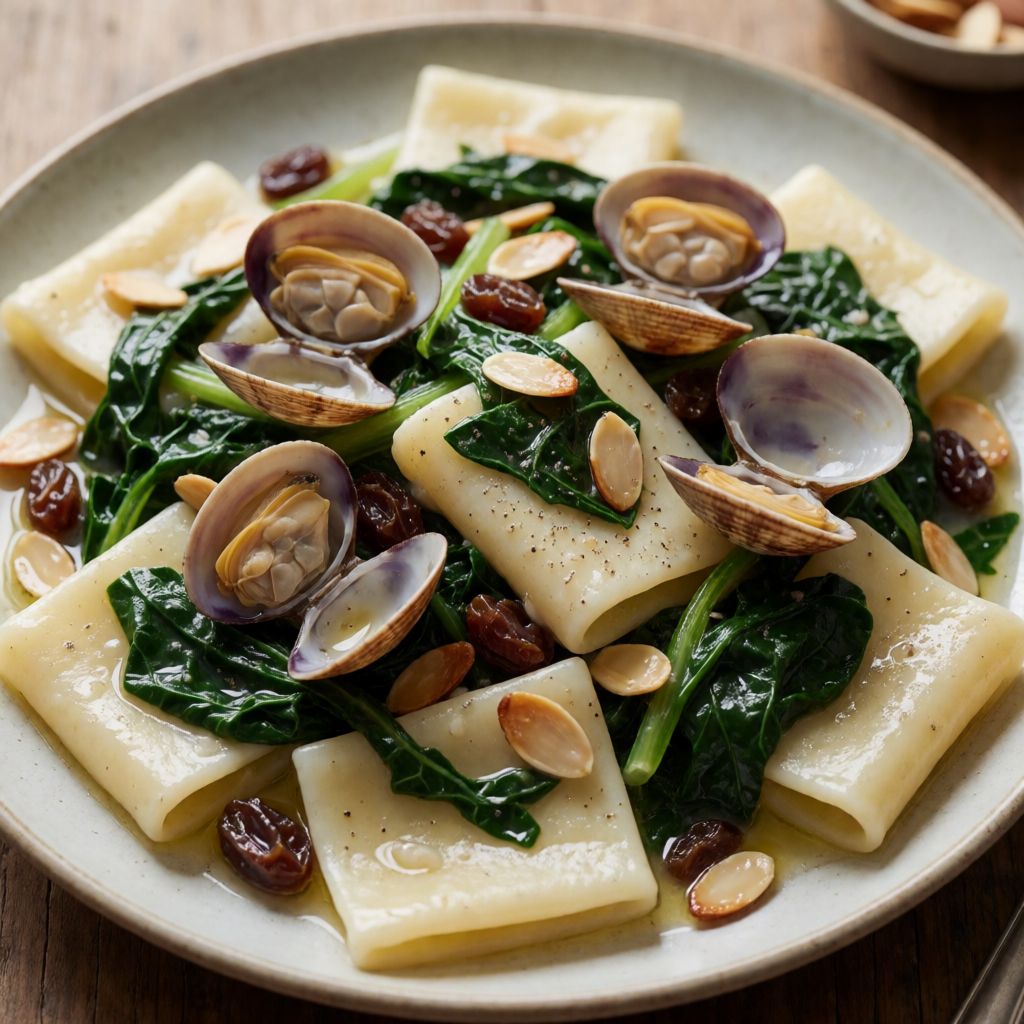
 AI photo
Paccheri with Escarole, Clams and Almonds
A pasta dish of clams and escarole, finished with soaked raisins and toasted almond flakes.
Labels are worked out automatically from the ingredients and can be wrong. Check the packaging if it matters to you.
Ingredients
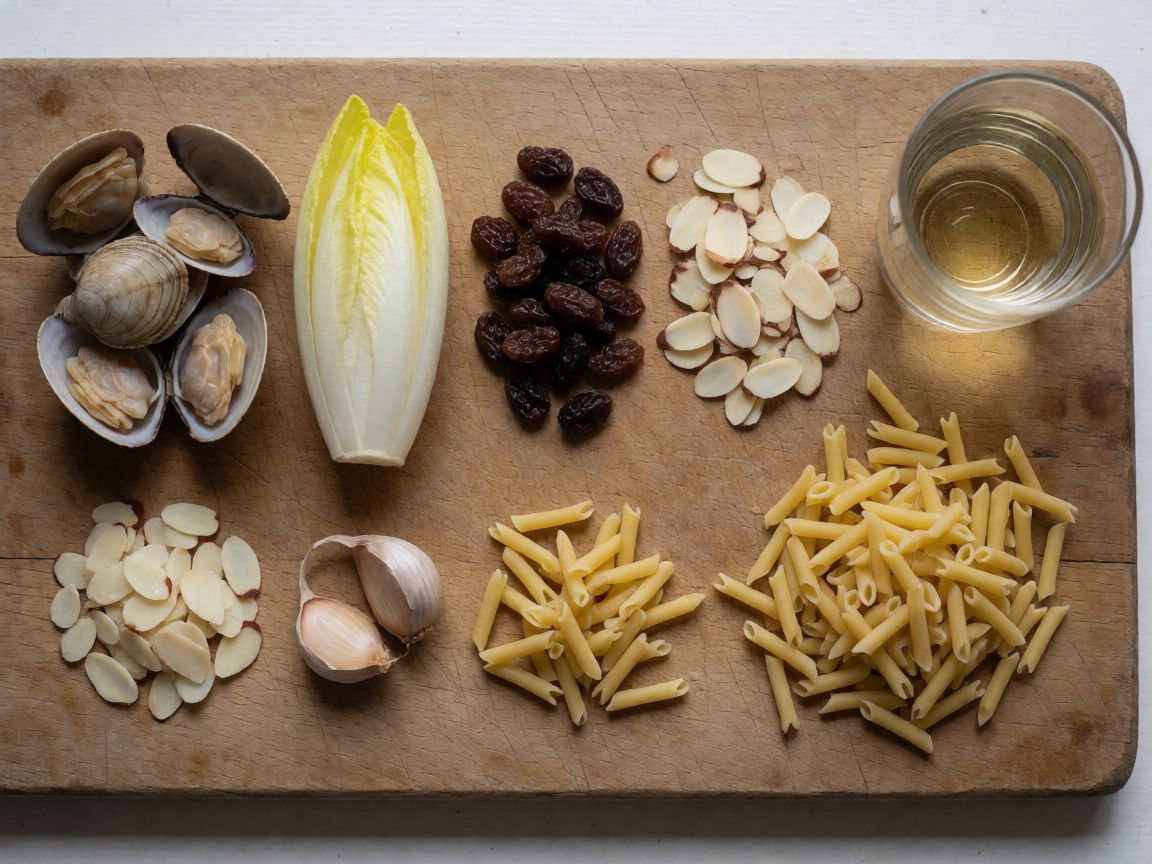
- Clams
- Escarole
- Raisins soaked and squeezed
- Almond flakes toasted
- Salt
- Black pepper
- 2 clove Garlic
- 200 g Paccheri
- 120 ml White wine
- Olive oil









Steps
In a pan, sauté the clams with a clove of garlic and olive oil, pour in the white wine and let it evaporate.
Cover the pan with a lid and cook the clams until the shells open fully.
Blanch the escarole leaves in salted water, then transfer to iced water.
Transfer the opened clams to a bowl.
In the cleaned pan, sauté the escarole with garlic, olive oil, salt and black pepper.
Transfer the escarole to a blender, add olive oil and water, and blend to a cream.
Strain the clam liquid and remove some of the clams from their shells.
In a pot of salted boiling water, cook the paccheri until al dente.
In a pan, heat the escarole cream with the clam liquid.
Transfer the paccheri into the pan with the cream.
Add the shelled clams and the remaining liquid, and finish cooking.
Add the soaked and squeezed raisins and mix through.
Serve the paccheri garnished with almond flakes, clams in their shells, pepper and olive oil.
This is a pasta where a bitter leaf is made to behave like a sauce base, and shellfish brine does the seasoning instead of a stock cube. Paccheri — those wide, stubby tubes that look like they've been cut from a hose — hold a thick sauce the way thin spaghetti never could. That's the whole point of choosing them: they're built to catch and carry, not to twirl.
What decides whether this works is the clam liquid. Clams open at a specific moment — when the muscle holding the shell shut can no longer resist the heat and steam — and the water that comes off them at that exact point is the only seasoning this dish needs. Oversalt the pasta water on top of that and you've doubled down on something already salty by nature. The myth that "pasta water must taste like the sea" comes from recipes with no shellfish in them. Here, the sea's already arrived through the clams; the pot just needs enough salt to cook the pasta, nothing more.
The other hinge is the escarole. Raw, it's bitter and tough as old lettuce. Blanched hot then dropped straight into iced water, it stops cooking instantly — that's what keeps it green instead of the khaki-grey of a leaf that's gone on stewing in its own heat after you've drained it. Blended with oil and a little water, it turns from "vegetable" into "cream," which is really just a way of saying the bitterness gets diluted and spread thin enough to taste like depth rather than punishment.
Clams: buy them alive, shut or clamping shut when tapped, and if any stay open and gaping after a sharp knock on the worktop, bin that one — it's already dead and will turn rubbery and sour the broth of everything near it. In the UK ask for palourdes or carpet shell clams at a fishmonger or a decent supermarket fish counter; they're sold already fairly clean, but soak them in cold salted water for half an hour before cooking anyway, so they purge grit rather than leaving it for your teeth to find. No clams at all, and mussels will do the same job — they open the same way, release a similar briny liquid, just with a slightly stronger, more mineral flavour.
Escarole is the frilly, slightly bitter cousin of lettuce you'll find labelled "escarole" or sometimes "broad-leaved endive" — in a UK supermarket it may simply not be there, and curly endive or even the darker outer leaves of a Batavia lettuce will carry the bitterness this dish wants. What you're after is a leaf that's bitter raw and mellows with heat; iceberg or baby spinach won't do it, they have none of that edge to tame.
Raisins get soaked in warm water first and squeezed dry before going in — soaking plumps them back up so they don't steal moisture from the sauce once they hit the hot pan, and squeezing stops that reconstituted water diluting the cream you've just built. Sultanas work the same way if that's what's in the cupboard; the sweetness is the job, not the specific grape.
Almonds are toasted flaked almonds, and toasting is not optional garnish-polish — raw almond flakes taste faintly of nothing, dry cardboard with a vague nuttiness; a few minutes in a dry pan, moved so they don't catch, brings out the oil sitting inside them and that's where the actual almond flavour lives. Watch them, don't walk away — flaked almonds go from pale to burnt in the time it takes to answer the phone.
Garlic: two cloves, used whole or bruised rather than chopped fine, since you want their perfume in the oil, not little scorched bits of garlic turning bitter in a hot pan — bitterness you're trying to coax out of the escarole deliberately is not a flavour you want arriving by accident from burnt garlic too.
White wine needs no vintage chasing — anything dry and drinkable you'd actually pour in a glass. Its job is to deglaze whatever's stuck to the pan from the clams and to add acidity that balances the richness of oil and cream; if there's no wine in the house, a splash of dry vermouth or even a spoon of vinegar loosened with water gets you partway there, though it won't be quite the same.
Olive oil, the rule for picking any oil in a recipe like this: it should carry flavour, not fight it — an oil with "no smell of its own" is wrong advice here, actually, because a fruity, grassy olive oil is doing real work alongside the garlic. Use a basic, everyday extra virgin, not your best bottle saved for drizzling — this one's going into a hot pan and getting cooked, so its subtlety would be wasted anyway.
Paccheri: 200g for two people is generous but right, because this is a sauce-heavy dish and you want tubes wide enough to trap sauce inside as well as around them. If your shop doesn't stock paccheri, rigatoni is the honest substitute — same wide-tube logic, just a smaller mouth; avoid anything thin like linguine, which will just slide through the cream without catching it, leaving you with a bowl of sauce and separately a bowl of noodles.
And patience, because it genuinely is an ingredient here, not a virtue you perform: the escarole needs its proper blanch-and-shock before it blends smooth, the clams need their own time to open rather than being forced with extra heat, and the cream needs a slow warm-through with the clam liquid rather than a hard boil that would just split the oil out of it. Rush any one of those three and you'll taste the rush.