
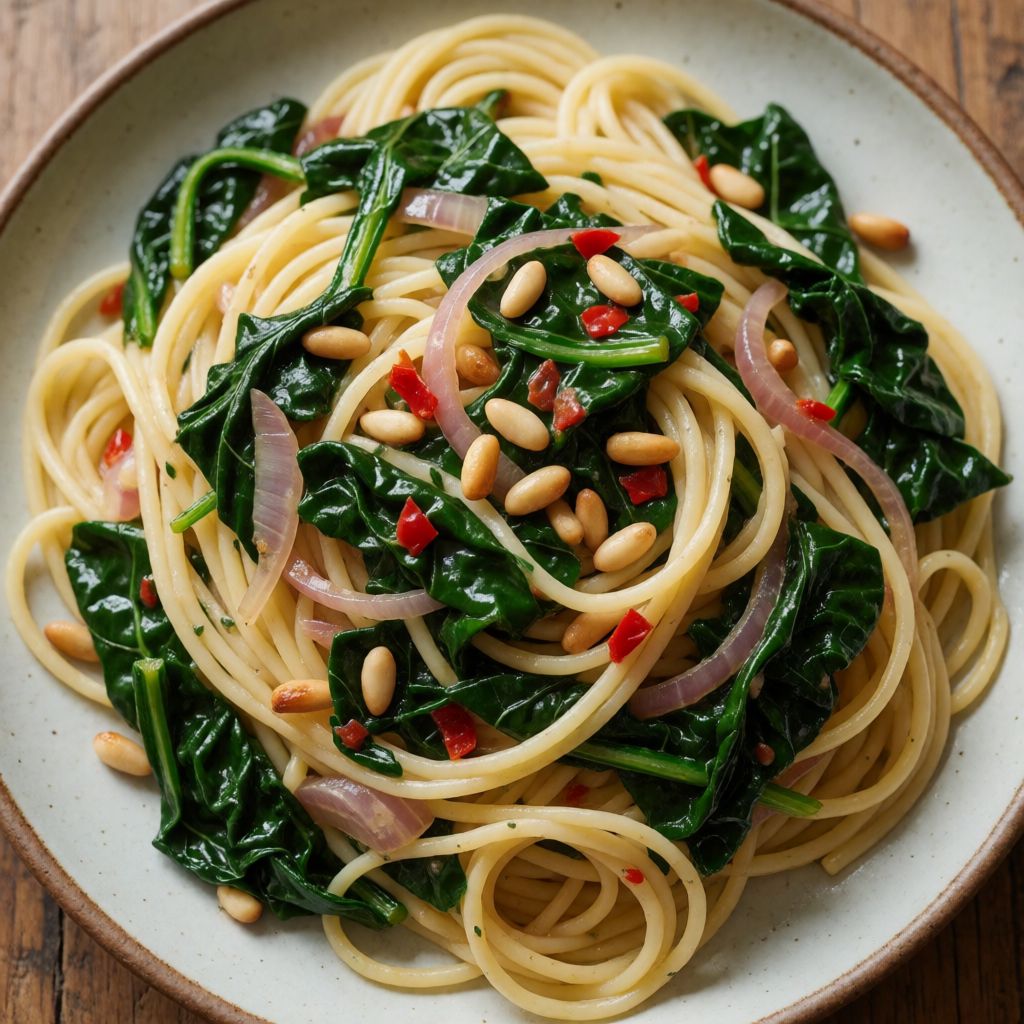
 AI photo
Pasta with Swiss Chard
A simple pasta dish where tender Swiss chard is cooked until almost creamy, then tossed with shallot, pine nuts and a touch of chilli.
Labels are worked out automatically from the ingredients and can be wrong. Check the packaging if it matters to you.
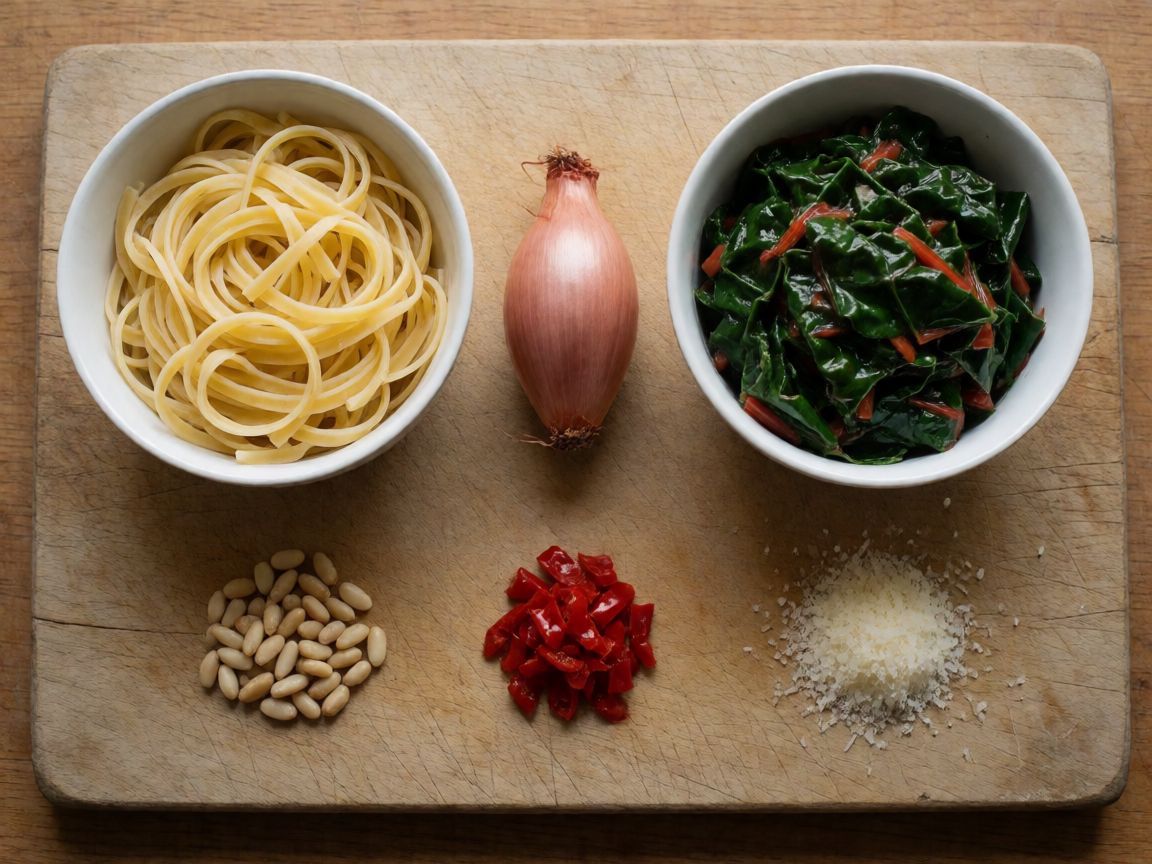
Ingredients






Steps
Remove the tougher part of the chard stalks, check the leaves for damage, rinse under running water and cut into pieces.
Boil the chard in plenty of lightly salted water for about 10 minutes.
10 minDrain the chard in a colander and let any excess water run off.
Chop the chard very finely, almost mashing it, so the sauce turns out almost creamy.
Heat a little olive oil in a pan with a pinch of chilli flakes.
Add the finely chopped shallot and let it soften slightly for a few minutes, stirring occasionally.
Add the pine nuts.
Add the boiled chard, stir it into the oil and shallots, and let it fry over high heat. Season with salt and pepper if needed.
Bring a large pot of water to the boil and season it with salt.
Cook the pasta according to the time on the packet and drain al dente.
Combine the pasta with the chard and toss together in the pan so the pasta binds well with the sauce.
Serve the dish hot, sprinkling with grated Parmesan if desired.
This is not a sauce in the Italian sense of something cooked down and reduced — it's chard, boiled, drained, chopped almost to a paste, then fried hard and fast so it stops being "boiled greens" and becomes something that coats pasta. The whole dish turns on one decision: how finely you chop the chard after boiling. Rough chop, and you get pasta with wilted spinach sitting on top. Fine chop, nearly a mash, and the leaf breaks down enough to behave like a sauce — it clings instead of sliding off.
Swiss chard looks like spinach's bigger, tougher cousin and that's exactly the problem it has to solve for. The stalks are fibrous — think celery crossed with a leaf stem — and if you boil them with the leaves you get crunchy bits in something meant to be smooth. That's why the stalks get trimmed out at the start: not fussiness, just removing the one part of the plant that won't soften to paste in the time the leaf takes.
Boiling first, rather than just frying the chard raw, is doing a specific job too. Chard leaves are thick enough that a few minutes in a pan won't break them down — they'll go dark and slippery on the outside while staying leathery in the middle. Ten minutes in salted water softens the whole leaf evenly, right through, so when you chop it after, it actually mashes instead of shredding into stringy bits.
On ingredients, start with the chard itself. 800 g sounds enormous for four people until you remember you're about to boil it, drain it, and chop it down — a pile of raw leaves collapses to a fraction of its size, the way spinach does, just slower and less dramatically. If you can't get chard, spinach is the obvious stand-in, but it cooks in a fraction of the time and holds far less water in its stem, so treat it as a different vegetable that happens to end up in the same role, not a straight swap on timing. Kale works at a push but needs longer boiling and a harder chop — it doesn't want to mash the way chard does.
The shallot's job here is sweetness without sharpness. A shallot softens into something mild and almost caramel-edged faster than an onion does, because it has less water and more sugar concentrated in a smaller bulb — useful when you don't want a raw onion bite fighting with the chard. A small onion, finely chopped, will get you there too, just give it a little longer in the pan before the chard goes in, and keep the heat gentle enough that it goes gold, not brown — burnt onion turns bitter and there's no undoing that once the chard's added on top.
Pine nuts are there for crunch and a faint resin-sweet note against all that soft green — Italian cooking reaches for them in greens-heavy dishes precisely because they're the one thing in the pan that stays firm. If they're expensive where you are (and they usually are — pine nuts are harvested by hand from cones that take years to mature, which is why they cost what they cost), toasted flaked almonds or walnuts do the same textural job, though they bring their own flavour with them rather than pine nuts' relative quietness.
Chilli flakes and olive oil are both about carrying flavour, not announcing themselves. Some say any neutral oil will do here — no, because the dish has almost no other fat to lean on, so the oil isn't just a cooking medium, it's half the flavour of the sauce. Use one with a taste you'd actually want to taste. If olive oil isn't to hand, any oil with no smell of its own that can take a bit of heat — sunflower, say — will carry the chilli and garlic-adjacent warmth fine, but you lose the particular bitterness olive oil adds, which is doing real work against the sweetness of the shallot.
Parmesan at the end is seasoning, not garnish — salt, umami, a bit of fat, melting slightly into the hot pasta. Any firm, well-aged hard cheese behaves the same way; what matters is that it's dry and sharp enough to grate, not that it's specifically Parmesan.
Patience shows up twice here and both times it's the same patience: let the chard actually soften in the boil, and let it actually fry long enough afterwards to lose its boiled-water edge. Rush either one and you'll taste it — not as a disaster, just as pasta that's slightly wetter and slightly blander than it should be, with no single step to blame because the fault is spread across two steps you hurried.