
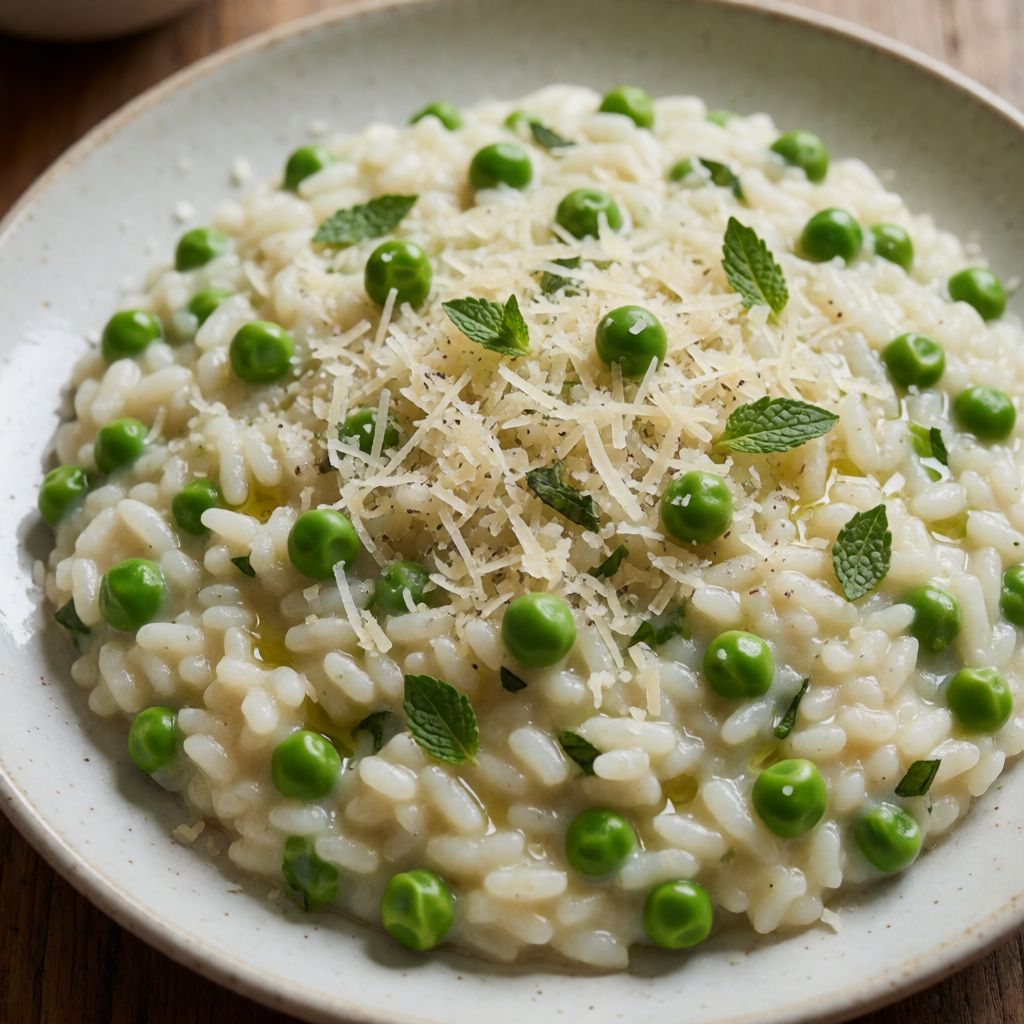
 AI photo
Risotto with Peas and Mint
A creamy pea risotto with a fresh mint and pea purée, finished with Parmesan and a soft cream cheese.
Labels are worked out automatically from the ingredients and can be wrong. Check the packaging if it matters to you.
Ingredients
- 350 g Risotto rice
- 400 g Peas
- 1 l Stock
- 125 ml White wine
- 40 g Parmesan
- 40 g Olive oil
- 1 pcs Onion
- 60 g Cream cheese
- Mint to taste
- Salt to taste
- Black pepper to taste










Steps
Peel and finely chop the onion. Put half in a pan with 20 g olive oil and fry gently until soft.
Add the peas and sauté for a few minutes.
Pour in a few spoonfuls of vegetable stock and cook until the peas are soft.
10 minSeason with black pepper and salt, then remove from the heat.
Transfer half the peas to a blender, keeping the rest in the pan.
Add the mint leaves to the peas in the blender and blitz until smooth.
Pour 20 g olive oil into a saucepan and add the remaining onion. Once golden, add the rice and toast for a few minutes.
Pour in the white wine and let it evaporate completely.
Cook the rice, gradually adding the stock and the pea purée, until all the ingredients are used.
20 minRemove from the heat and stir in the Parmesan and cream cheese.
Add the whole peas and garnish with mint.
What was changed
Risotto rice is used instead of plain rice, and Cream cheese replaces the hard-to-find Italian cheese.
Risotto is not a rice dish, it's a starch-release dish — the whole point is to scrub the surface of each grain so it lets go of its liquid starch, gradually, into the stock around it. That's what gives you the creamy sauce without a drop of actual cream doing the heavy lifting. Peas and mint are the easy part; getting the rice to behave is where this stands or falls.
Here's the mechanism: short, fat, starchy rice (arborio, carnaroli, or vialone nano — you want "risotto rice" on the bag, not basmati, not long grain) has a core that stays al dente and an outer layer that's soft and sheds starch when agitated and kept wet. Toasting it dry in oil for those first few minutes before any liquid goes in isn't tradition for its own sake — it seals that outer layer just enough that the grain holds its shape instead of collapsing into porridge later. Skip that step and you get stodge, not risotto.
Then the wine: you pour it in and you wait for it to vanish completely, not just evaporate the smell out. Alcohol at this stage is a de-glazer and a flavour layer, but if you add stock while wine is still sitting in the pan, you're diluting instead of building — the rice never gets the sharp hit of acidity to balance the fat and cheese coming later. Smell it: when the sharp vinous sting is gone and it just smells like warm rice, you're ready.
On timing: forget the clock as your main instrument. "Add stock gradually until used" means a ladle at a time, waited out — each addition absorbed almost fully (the pan floor just visible through the rice, not dry, not swimming) before the next goes in. That's roughly 20 minutes of standing there, stirring, because the method is a feedback loop: heat, friction from the spoon, and a steady trickle of hot liquid are what coax the starch out. Dump all the stock in at once and you've made a rice soup — plenty of liquid, no sauce, because the starch has nowhere concentrated to build up. Some say you have to use a wooden spoon for luck or tradition — no, you use one because metal can bruise the grains and release starch unevenly, in patches. A wooden or silicone spoon just doesn't do that as sharply.
Stock itself should be hot, kept at a low simmer in a separate pot beside your risotto pan — cold stock shocks the rice, stalls the cooking, and you end up compensating with more heat than you want, which then scorches the bottom. In a British kitchen you've likely got a kettle and two hobs' worth of space; use a small saucepan for the stock, kept barely bubbling, ladled in as needed. If you don't have real stock, a good stock cube dissolved properly beats a weak homemade one — don't be precious about it.
Onion, split in two and used two ways, earns its place: half goes soft and sweet under the peas (that's where it should turn translucent, not browned — browning here means bitterness creeping into a dish that should taste green and fresh), the other half goes into the rice itself and should turn properly golden before the rice goes in, because that's where you want a little more depth and colour. If you don't have fresh onion, a shallot works the same way, just milder — don't substitute onion powder, it has none of the moisture or sugar that softens and sweetens here.
Mint is the one ingredient you can't really swap for "a similar herb" — basil or parsley will give you green and herbal, but not that cool, slightly medicinal lift that cuts against the fat of the cheese. Use it fresh, add some to the blender, keep some back raw for garnish, because cooked mint goes dull and a little bitter fast — that's why it only gets blitzed briefly, not simmered.
Cream cheese and Parmesan go in off the heat, right at the end, stirred through — not simmered in. This is the same logic as finishing pasta off-heat with butter: residual warmth melts the cheese into the starchy liquid without it seizing, splitting, or turning grainy and oily, which is what happens if cheese meets a pan still properly hot. If you've got no cream cheese, mascarpone or even a spoon of crème fraîche does the same binding job — something soft and slightly tangy, not a hard cheese standing in for it.
Olive oil here wants no strong personality of its own at the frying stage — any neutral-ish oil would physically do the job, but olive oil's slight savoury note actually supports onion and peas rather than fighting them, so don't swap it for something with its own loud flavour, like a strongly flavoured nut oil.
Patience is the real ingredient list item nobody writes down: standing by the pan, ladle in hand, resisting the urge to walk off and put the kettle on for tea while the rice finishes. Forty minutes total sounds long for four people's worth of rice and peas, but almost all of that is waiting with intent — watching the rice go from hard pearl to grain that gives slightly when pressed between your fingers, not just checking a timer.