
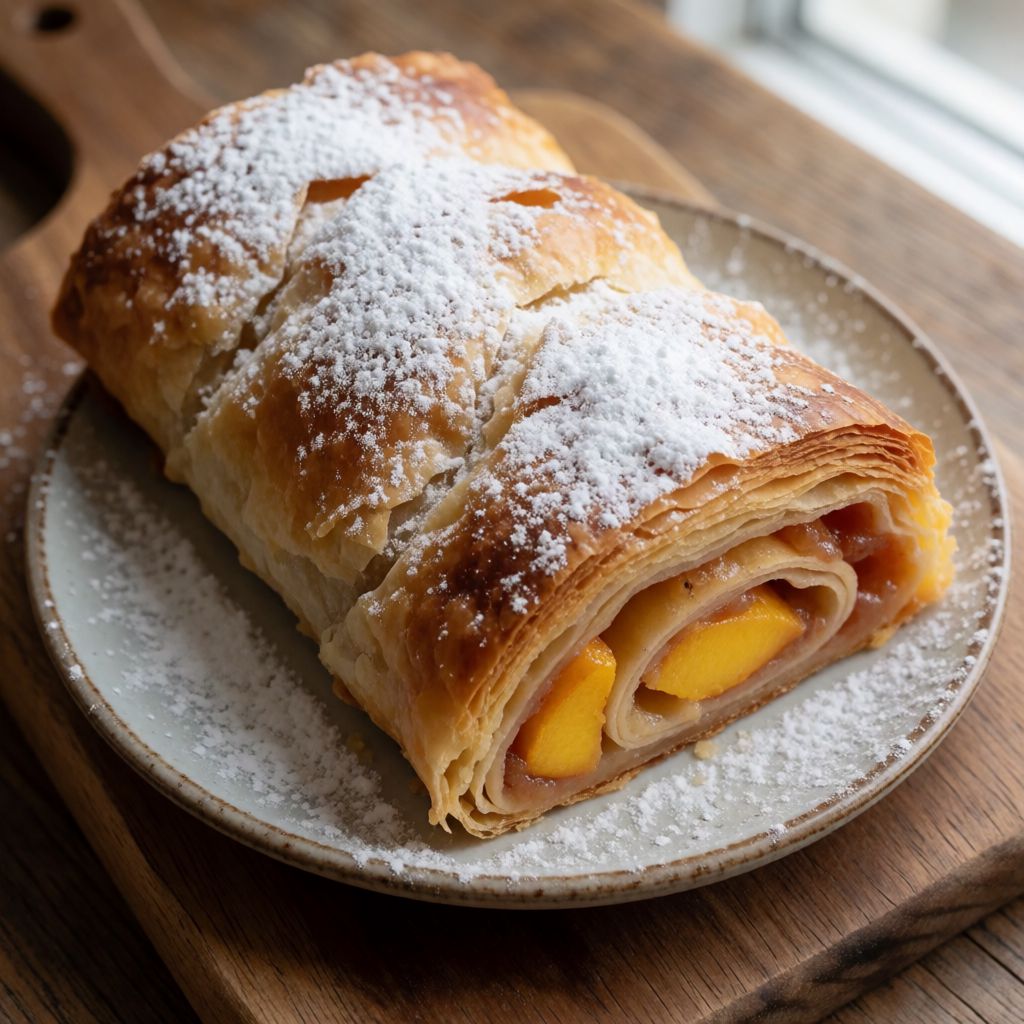
 AI photo
Peach Strudel
A delicate pastry parcel filled with peaches, brown sugar and crumbled amaretti biscuits.
Labels are worked out automatically from the ingredients and can be wrong. Check the packaging if it matters to you.
Ingredients
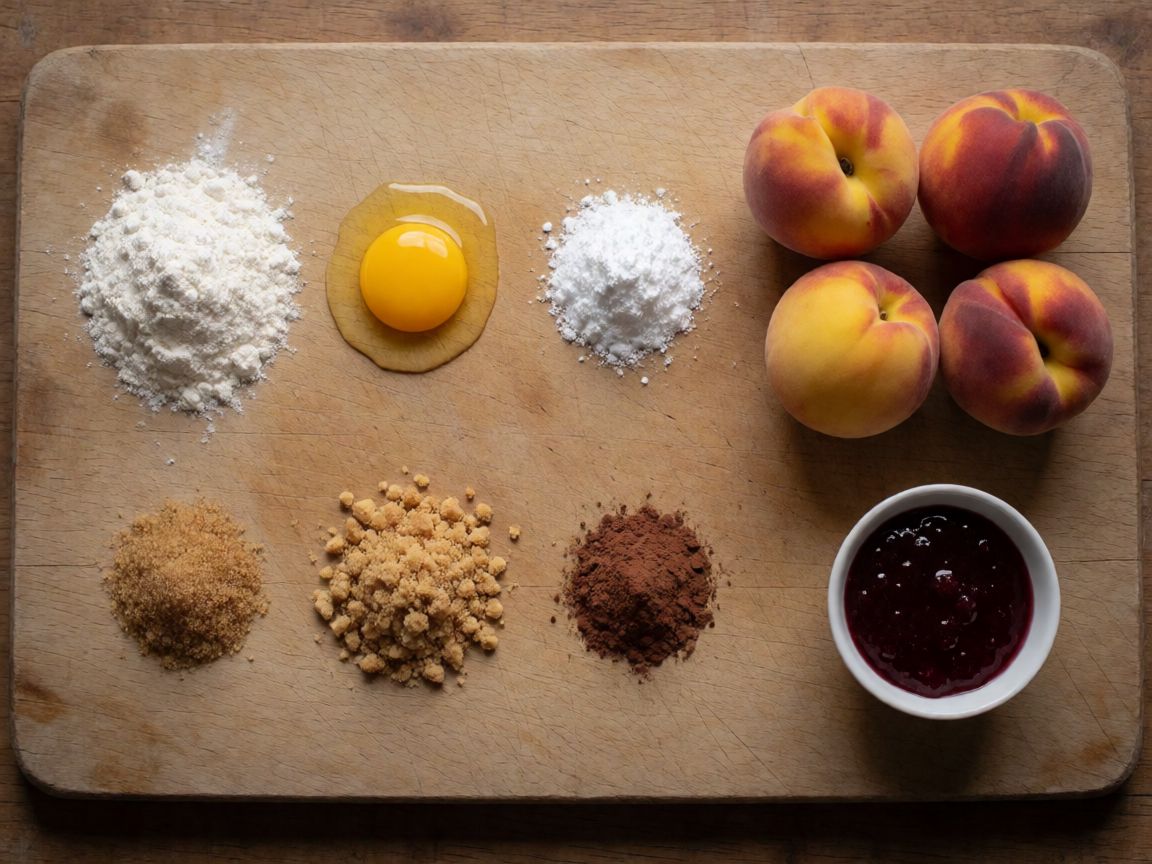
- 300 g Plain flour
- 1 pcs Egg yolk
- 10 g Icing sugar
- 60 ml Olive oil
- 120 ml Water
- Salt to taste
- 1 kg Peach
- 80 g Brown sugar
- 140 g Amaretti biscuits
- 100 g Peach jam
- 10 g Cocoa powder
- Icing sugar to taste
- Egg yolk for brushing











Steps
Pile the flour into a mound, make a well in the centre and add the olive oil, egg yolk, icing sugar, salt and water. Knead until the dough is smooth.
Shape into a ball, wrap in cling film and chill in the fridge.
30 minPeel the peaches, cut into cubes and stew in a pan with the brown sugar, letting the liquid evaporate.
Add the peach jam, cocoa powder and crushed amaretti biscuits to the peaches and mix well.
Roll out the dough into a thin sheet, 3-4 mm thick, and spread the filling along the centre.
Roll the dough into a log, sealing the edges and sides. Transfer to a baking tray and make 4-5 crosswise cuts.
Brush the surface with egg yolk, dust with icing sugar and bake in the oven at 185°C with fan assistance.
33 minLeave the strudel to cool, slice and dust with icing sugar.
Forget the paper-thin, stretched-by-hand Austrian strudel for a minute. What you've got here is a cheat's version — a shortcrust-style oiled dough rolled with a pin, not pulled across a tablecloth until you can read a newspaper through it. That's not a failure, it's an honest trade: you get a pastry that's sturdy enough to hold a wet peach filling without blowing out, and you get there in half an hour instead of an afternoon.
What decides whether this works is moisture management, twice over. First in the pan: the peaches go in with sugar and sit until the liquid they throw off boils away, not just warms through. Skip that and you're wrapping soup in pastry — it'll leak, steam the dough from inside, and you'll get a soggy seam instead of a crisp one. Second in the filling itself: the crushed amaretti and cocoa powder aren't flavour, they're blotting paper. They soak up whatever juice survives the stewing so the dough stays dry on contact.
The jam in the filling looks like it's there for sweetness. It's actually glue — it binds the peach cubes and biscuit crumbs into something that holds its shape when sliced, instead of spilling out the moment you cut through with a knife. Without it you get a log that collapses into its own cross-section on the plate.
On ingredients: the flour is plain, not strong bread flour — you're not after chew, you're after a dough you can roll thin and fold without it fighting back. The egg yolk in the dough does two jobs: richness, and it's what lets the dough hold together with so little liquid. Olive oil stands in for the butter you'd expect in a British pastry — it keeps the dough workable at room temperature and gives a cleaner, less rich crumb than butter would. Any neutral oil would do the mechanical job, but olive oil's faint fruitiness actually suits the peach rather than fighting it, which is the one case here where the specific oil matters, not just "an oil."
Peaches: ripe enough to peel easily and give up juice readily when cut. Underripe peaches won't release liquid properly in the pan — they'll stay firm cubes sitting in a dry pan, scorching rather than stewing. If good peaches aren't to be had — a real possibility outside of a short summer window in the UK — tinned peaches in juice, drained and patted dry, will stew down faster and need less sugar, since some of the work's already been done.
Brown sugar isn't just sweetness — it caramelises as the peach liquid reduces, which is where the slight toffee note in the filling comes from. White sugar would sweeten but wouldn't give you that.
Amaretti biscuits are doing structural work, as above, but they also bring a bitter-almond note that cuts the sweetness of peach and jam — without them the filling tips sickly. If you can't get amaretti, any dry almond or plain biscuit crushed fine will absorb moisture the same way, though you lose that bitter edge and might want to pull back slightly on the sugar to compensate. Cocoa powder here isn't for chocolate flavour — it's unsweetened, and its job is colour and a faint bitterness that does the same balancing job as the amaretti, plus a bit more moisture-absorbing bulk.
On your hob and oven: a domestic fan oven at 185°C with fan is actually a kinder environment for this than a traditional wood-fired one — even heat all round means you don't need to rotate the tray, which matters because a log-shaped bake can brown unevenly in an oven with hot spots. The crosswise cuts aren't decorative — they're vents. Without them, steam builds inside the sealed log and either splits it open somewhere ugly or leaves the inside gluey instead of set.
And the waiting at the end — cooling before you slice — isn't optional thrift of your patience. Cut it hot and the filling, still essentially a hot syrup at that point, runs straight out onto the board. Give it the time to firm up as it cools and it holds a clean slice. That's the ingredient nobody buys at the shop: time, given honestly rather than rushed past.