
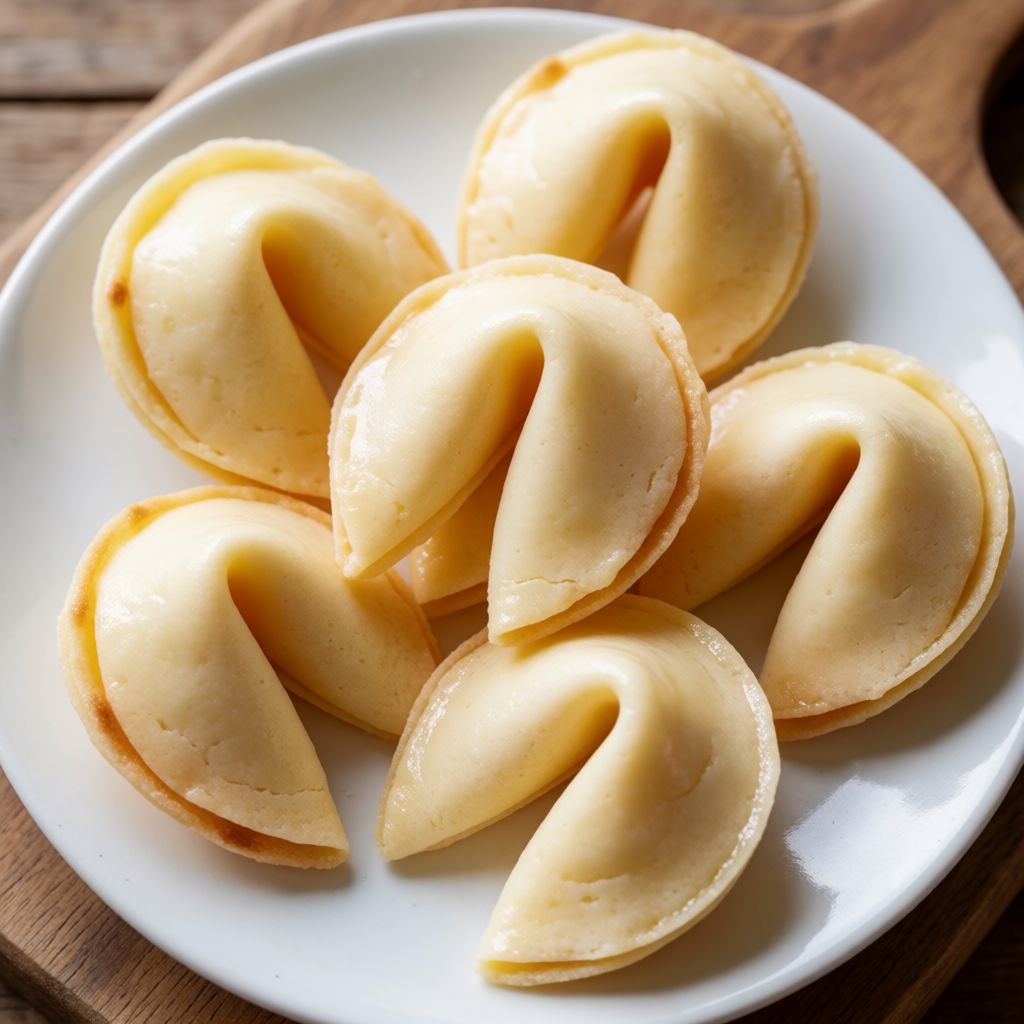
 AI photo
Fortune Cookies
A fun biscuit recipe where you tuck a little fortune inside after baking, before folding it into shape.
Labels are worked out automatically from the ingredients and can be wrong. Check the packaging if it matters to you.
Ingredients
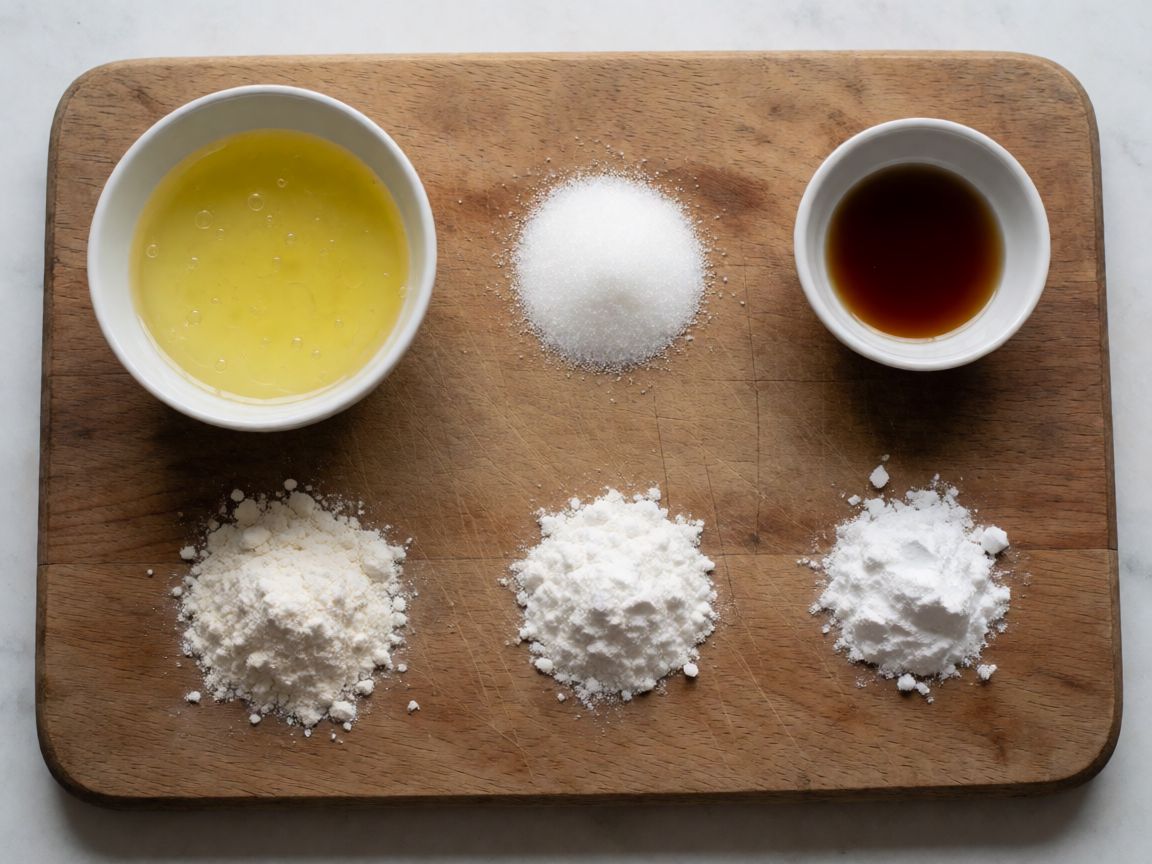
- 75 g egg whites
- 110 g caster sugar
- 15 g olive oil
- 75 g plain flour
- 20 g rice flour
- 13 g cornflour
- 2.5 ml water
- 1 tsp vanilla extract








Steps
Pour the egg whites into a bowl, add the caster sugar and whisk by hand to combine the ingredients.
Add the olive oil and vanilla extract and mix well.
Sift in the plain flour, rice flour and cornflour, add to the mixture and mix until smooth, then pour in the water.
Preheat the oven to 170°C (fan off), letting it come up to temperature.
Pour the batter in small portions onto baking paper, spreading each into a 10 cm circle.
Bake the biscuits for about 10 minutes, until the edges turn golden.
10 minTake the biscuits out of the oven, flip them over, and place a fortune in the centre.
Bring the edges of the biscuit together, folding it in half gently so the ends do not touch completely.
Press the ends downward and gently pinch the edges of the biscuit so it seals well.
Arrange the biscuits in a muffin tin and leave to cool.
Once the biscuits have fully cooled, remove them from the tin, arrange on a plate and serve.
Fortune cookies aren't really a baking exercise - they're a race against the clock, and the batter is almost a side issue compared to what happens in the thirty seconds after the tray comes out. What decides success isn't the oven, it's your hands and how fast they move while the biscuit is still hot enough to bend and not yet cool enough to crack.
The batter itself is a thin, eggy pancake mix, not a dough. You're not making something with structure - you're making a flat disc that behaves like wet fabric for a few seconds. Sugar is doing double duty here: sweetness, yes, but also the thing that caramelises at the edge and tells you, by colour, that the biscuit has gone from raw batter to pliable sheet. That golden edge is your only clock. The middle stays pale because it's thicker and insulated by the tray; the edge thins out and browns first because it has nothing between it and the heat.
Here's where the myth needs breaking: some say you can bake a batch, let them cool a little, then shape them. No - because the sugar sets as it cools, the same way toffee goes from liquid to glass in seconds. Once that happens the biscuit isn't flexible, it's brittle, and trying to fold it just shatters it. You get one window per biscuit, right out of the oven, while it's still soft from residual heat. That's why you bake in small batches, not a full tray at once - you need to fold each one before the next finishes, and you can't fold six at a time with bare fingers on a hot biscuit.
Egg white and sugar are the whole engine of this recipe - everything else is there to stop the egg white from being the only thing you taste. Egg white dries to a thin, glassy film when baked thin and hot; that's the actual texture of a fortune cookie, and it's why you can't swap in whole egg - the yolk's fat softens that glass structure and you'd get something closer to a soft wafer than a cookie that snaps.
The flour blend is doing careful, unglamorous work. Plain flour gives you the only real structure in the mix - without it the batter would just spread into a sugar-egg glaze with no body. Rice flour is there for crispness: it has less gluten than wheat flour, so it interrupts the stretchiness that plain flour alone would give you, and a fortune cookie that's chewy instead of crisp has usually got too much wheat flour and not enough rice flour in the mix. Cornflour is the smallest player but it's thickening without adding any flour taste of its own - think of it as there to help the batter spread evenly into a thin circle rather than pooling thick in the middle.
Olive oil is correct here specifically because of what it's not doing - it's not butter, which would set solid as the biscuit cools and make folding harder by stiffening the structure too early. Oil stays liquid at room temperature, so it keeps the biscuit pliable for those crucial seconds after baking. If your olive oil has a strong, grassy flavour, that's not ideal here - the rule for this recipe is "any neutral liquid oil," and a light, flavourless version serves you better than a robust extra virgin. Sunflower or a mild vegetable oil does the same mechanical job with less perfume competing against the vanilla.
That water measurement - 2.5 ml, essentially half a teaspoon - looks almost pointless on paper, and that's deliberate. It's not there to change the batter's behaviour so much as to loosen it by a fraction, enough to help it spread into a clean 10cm circle rather than sitting stubborn and thick where you poured it. Don't eyeball a generous splash thinking "more can't hurt" - more water thins the batter further and you lose the edge-to-centre thickness difference that gives you that visual doneness cue in the first place.
On the oven: 170°C fan off matters because fan ovens push air that would crisp the thin edges unevenly and fast, before the centre's had its moment - conventional heat here gives you a steadier, more even rise toward that golden edge. This is genuinely a two-person job in spirit even if you're alone: one tray in, hands free and ready, because the moment you pull it out you've got perhaps the time it takes to say "right, fold" before the window closes. If you miss it on your first few, don't panic and don't try to rescue a cracked one - that's not a fixable mistake, it's a timing lesson for the next tray. Patience here isn't about waiting longer, it's about pacing yourself to the batch size so you're never shaping cookie three while cookie four burns.
This makes five servings in the loosest sense - fortune cookies are a one-or-two-bite finish, not a dessert course, so "serves 5" means five people each getting a small handful, not five people being fed by them.