
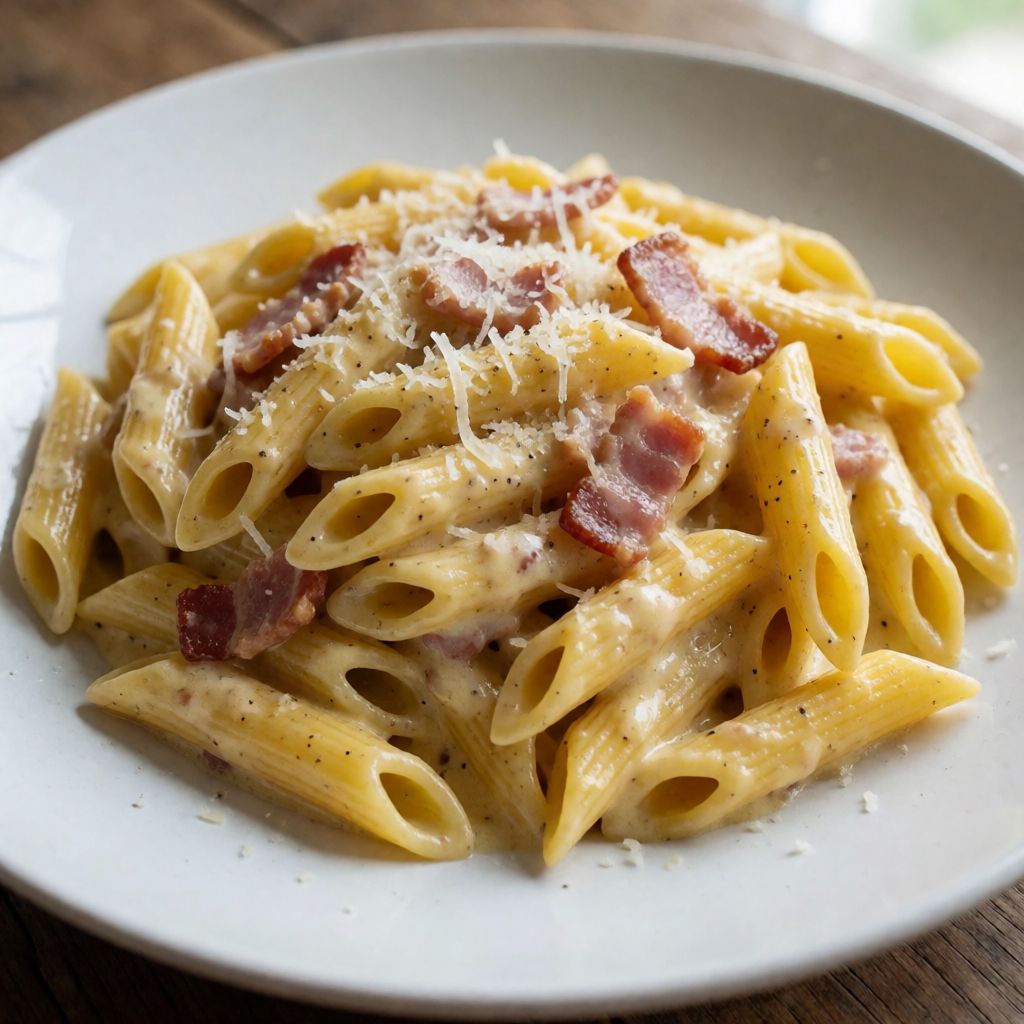
 AI photo
Penne Carbonara with Bacon and Courgette
A creamy penne carbonara made with crispy bacon, eggs and parmesan, finished with tender courgette.
Labels are worked out automatically from the ingredients and can be wrong. Check the packaging if it matters to you.
Ingredients









Steps
In a dry pan, fry the bacon until crispy for a few minutes, then set aside.
In the same pan, with a little olive oil, sauté the sliced courgette for 2 minutes.
2 minCook the penne in salted water, drain, and add to the pan, frying for a few minutes together with the crispy bacon.
In a bowl, whisk the eggs and egg yolk with the grated parmesan and black pepper.
Remove the pan from the heat, pour in the egg mixture and mix well, then serve.
What was changed
Courgette replaces courgette flowers, which are hard to find in the UK, with ordinary courgette.
This is a quick frying-pan trick dressed up as an Italian classic: bacon fat and courgette doing stand-in work for pork jowl and nothing else, bound at the end by egg instead of cream. What decides whether it works has nothing to do with the courgette or the pepper — it's whether the egg sets into a sauce or scrambles into breakfast. That's the whole mechanism, and everything else in the method exists to protect it.
Egg left on heat turns to curd. Egg mixed into something hot enough but off the heat turns to silk. The pasta and the pan are both carrying stored heat — not flame, just warmth held in metal and in starchy water — and that stored heat is exactly enough to cook two eggs and a yolk into a coating sauce, no more. The moment you put the pan back over a burner "to finish it off", you've crossed from sauce into omelette, and no amount of parmesan fixes that.
Some say carbonara needs cream to be safe. No — because cream is a workaround for people who don't trust the egg, and what you lose is the actual texture: a thin, clinging gloss that tastes of the pan, replaced by something heavier that tastes mostly of itself. The egg-and-starch version is riskier only in the sense that it asks you to pay attention for twenty seconds. That's a fair trade.
The courgette here isn't tradition, it's a vegetable someone had in the fridge and a reasonable one at that — it takes on bacon fat fast and doesn't fight the egg sauce the way a watery vegetable with more bite would.
Bacon: in the UK that almost certainly means streaky rather than back bacon, and streaky is the right choice here — it has enough fat running through it to render out into the pan on its own, which is why the first step uses no oil. Dry pan isn't a mistake, it's the point: you're not frying the bacon in fat, you're making the fat. Watch for the shift from pink and limp to a deep amber with crisp edges — that's the cue, not a stopwatch. If it goes dark brown at the edges before the middle firms up, your pan was hotter than the fat could keep up with and you've burned flavour you needed later for the courgette. Any streaky, smoked or not, pancetta, or guanciale if you want the Roman original, all work on the same principle: cured pork fat that melts rather than just sweats.
Courgette: sliced thin so it cooks through in the time it takes to pick up colour rather than release water and go soft and grey. Two minutes is a floor, not a target — the real sign is the edges going translucent and faintly golden, still with a little resistance in the middle. Push past that and the courgette starts weeping water into the pan, and that water is the enemy of the egg sauce later, because it dilutes exactly the starch-and-fat base the egg needs to cling to.
Pasta: penne because the tube holds a bit of sauce inside it as well as out, which matters more here than with a thin sauce — but the mechanism doesn't demand penne specifically, any shape with some surface texture does the job. What matters far more than the shape is the water it leaves the pot with. Don't drain it bone dry; a little cloudy pasta water clinging to it is starch, and starch is what lets the egg thicken into sauce instead of splitting into curds and liquid.
Eggs and parmesan: two whole eggs plus one extra yolk for four people gives you richness from the yolk without too much white, because white sets firmer and grainier than yolk and too much of it pushes you toward scrambled territory faster. The parmesan isn't seasoning so much as structure — its fat and salt help the egg hold together as a coating rather than weeping. Any hard, dry, aged cheese with real salt in it does the same work — Grana Padano, a sharp Pecorino — a soft young cheese won't, it just melts into puddles.
The saffron packet listed among the ingredients never appears in a single step here, so leave it out — it's not doing anything in this dish, whatever the shopping list suggests.
Oil: olive oil is used only to carry the courgette slices without them sticking before the bacon fat is enough to coat the pan — any neutral-tasting oil would do exactly the same job, since at this stage you're not building flavour with it, you're just stopping things catching.
The one ingredient you can't buy is patience at the very end: let the pan sit off the heat a few seconds after the pasta and bacon go in, before the egg mixture goes in, so you're not pouring egg onto something hotter than it can survive. That pause is doing more work than any step on the list.