
 AI photo
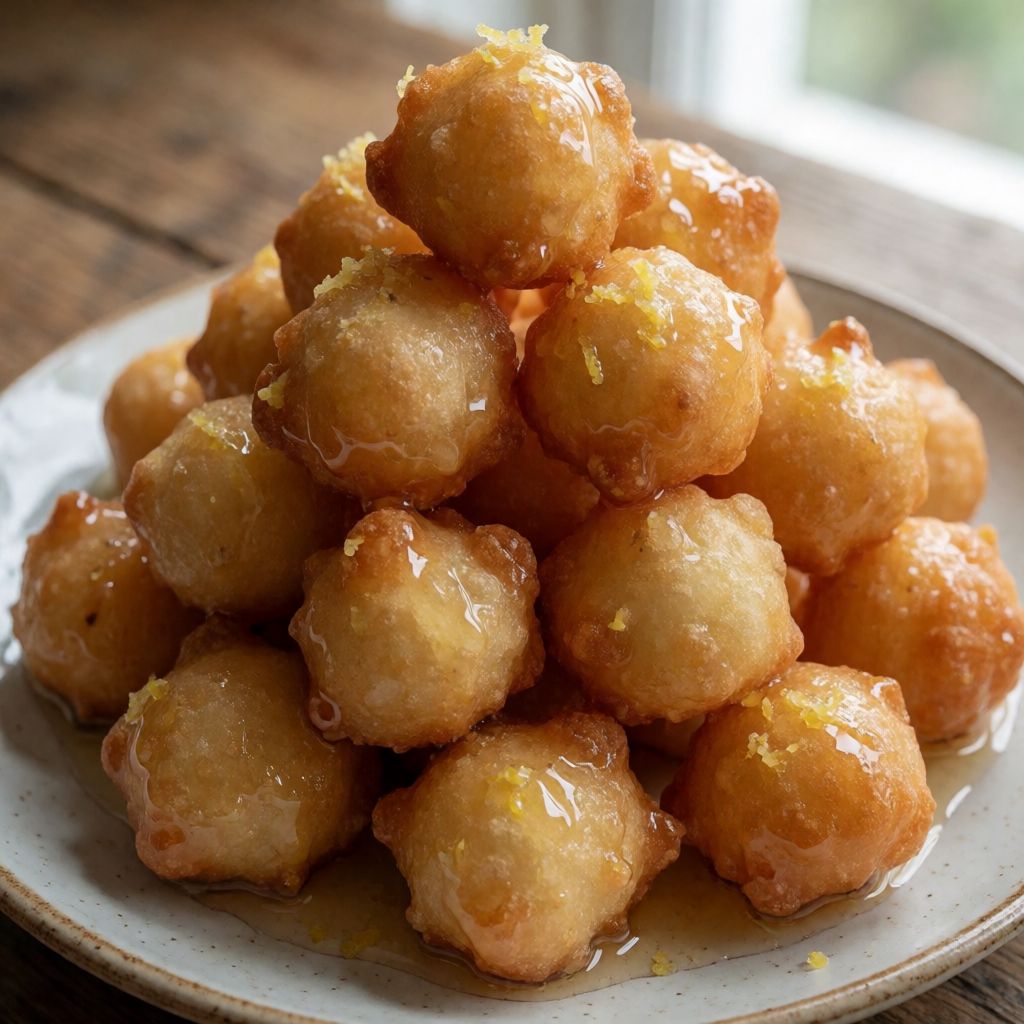
Pignolata with Honey
A honey-glazed fried dough treat, shaped into small pieces and piled high for serving.
Labels are worked out automatically from the ingredients and can be wrong. Check the packaging if it matters to you.
Ingredients
- 300 g Plain flour
- 2 pcs Eggs or 3 small eggs
- 30 g Butter
- 20 g Caster sugar
- 1 pcs Lemon zest or orange zest
- 25 g Grappa or another liqueur
- pinch Salt a pinch
- pinch Baking powder a pinch, optional
- Peanut oil to taste, for frying
- 200 g Wildflower honey
- Pastry sprinkles to taste










Steps
Tip the flour into a large bowl and add the sugar, salt, baking powder and lemon zest.
Add the eggs, grappa and butter, cut into small pieces.
Knead by hand until you have a soft, smooth dough.
Wrap the dough in cling film and place it in the fridge.
60 minTake out the dough and divide it into pieces, rolling each into a cylinder about as thick as a finger.
Cut the cylinders into small pieces.
Heat the peanut oil to 170°C and fry the pieces in small batches until golden.
Place the fried pieces on kitchen paper to drain off excess oil.
Transfer them to a bowl and, while still warm, pour over the honey.
Decorate with pastry sprinkles and pile up on a serving plate.
Pignolata is small fried dough pebbles, glued together with warm honey into a sticky pile — the Sicilian answer to the question "what do we do with eggy dough and no particular shape in mind". It's a Christmas and carnival thing in the south of Italy, where frying in oil was cheaper than running the oven for hours, and honey was the sweetener everyone had before sugar got cheap. Nothing about it is delicate. It's rustic, sticky, built to be pulled apart with fingers, not cut with a fork.
What decides whether it works is the size of the pieces and the heat of the oil, and they decide it together. Cut the dough too thick and the inside stays raw and doughy while the outside burns — because oil only cooks from the surface in, and a "finger-thick" cylinder already asks a lot of patience from the oil before the centre catches up. Cut it finger-thick and then slice it small, the way the recipe wants, and you give the heat a short enough distance to travel.
170°C is not a number to trust blindly without a thermometer, but there's a cue if you haven't got one: drop a scrap of dough in, and it should sizzle and rise to the surface within a couple of seconds, not sit there sulking. Oil that's too cool lets the dough sit and drink fat instead of sealing fast — that's the actual cause of pignolata turning greasy and heavy, not "too much oil" as people blame it. Too hot, and you get colour before the inside has had any chance to cook, which is the other common failure.
The dough itself is plain and deliberately so: flour, egg, a little butter, a little sugar, zest, and the grappa. Grappa isn't there for flavour alone — a splash of spirit in a fried dough firms up gluten less than water would and evaporates fast in the hot oil, which helps the crust set quickly and crisp rather than steam itself soft. Any clear, fairly neutral spirit does the same job — vodka, or a light rum if you don't mind a background sweetness. Skip it altogether and you lose a bit of that quick crisping, but the dough still fries fine; just expect it marginally softer.
Flour is plain, not strong bread flour — you want a dough you can roll into thin cylinders without it fighting back elastically. Too much gluten development and the rolled rope keeps springing back to a stump instead of staying thin. That's also why the recipe tells you to rest the dough in the fridge: an hour of rest lets the gluten you did build relax, so when you come back to roll, the dough behaves and doesn't spring back on you — this is the real reason for the chill, not "to make it cold for frying".
Eggs give structure and some richness; two standard eggs or three small ones amounts to the same quantity of protein and moisture, which is why the recipe offers the swap plainly rather than insisting on a count. Butter, cut into small pieces rather than melted, coats flour in little pockets before the eggs bind everything, which is what keeps the final texture from going tough and bread-like — this is the same logic as a short pastry, just with less fat overall.
Lemon zest (or orange, same job) is there to cut the flatness of fried dough and honey, which is otherwise two heavy, sweet, fatty things with nothing bright between them. Use whichever citrus you have in the fruit bowl; the point is the oil in the zest, not the particular fruit.
Peanut oil is the traditional frying fat because it has a high smoke point and almost no smell of its own, so it doesn't fight the honey or the citrus for your attention — any neutral oil with a similarly high smoke point does the job just as well: sunflower, or a light vegetable oil. Olive oil is the wrong tool here, not out of tradition-snobbery but because its own flavour would sit on top of everything and its lower smoke point makes 170°C riskier to hold steady.
Honey should be something with real body and flavour — wildflower works because it isn't one-note — rather than a thin, bland supermarket honey that just adds sugar and nothing else. Warm it gently before pouring if it's gone thick and cloudy in the jar; cold, stiff honey won't coat the fried pieces evenly, and you'll get patches with none at all.
In a British kitchen, this is a one-pan, one-plate-of-kitchen-roll job — no kazan, no deep-fat fryer required, just a decent-sized saucepan with enough oil depth that the pieces float rather than catch the bottom, and a thermometer if you own one, a sharp eye and a test piece if you don't. Do it in small batches, because crowding the oil drops its temperature fast, and a sudden drop in heat is exactly the scenario that produces the greasy, heavy pignolata people wrongly blame on "too much oil" in the first place. It feeds six as a pudding after a roast, piled on one plate for everyone to pick at — which is rather the point of it.