
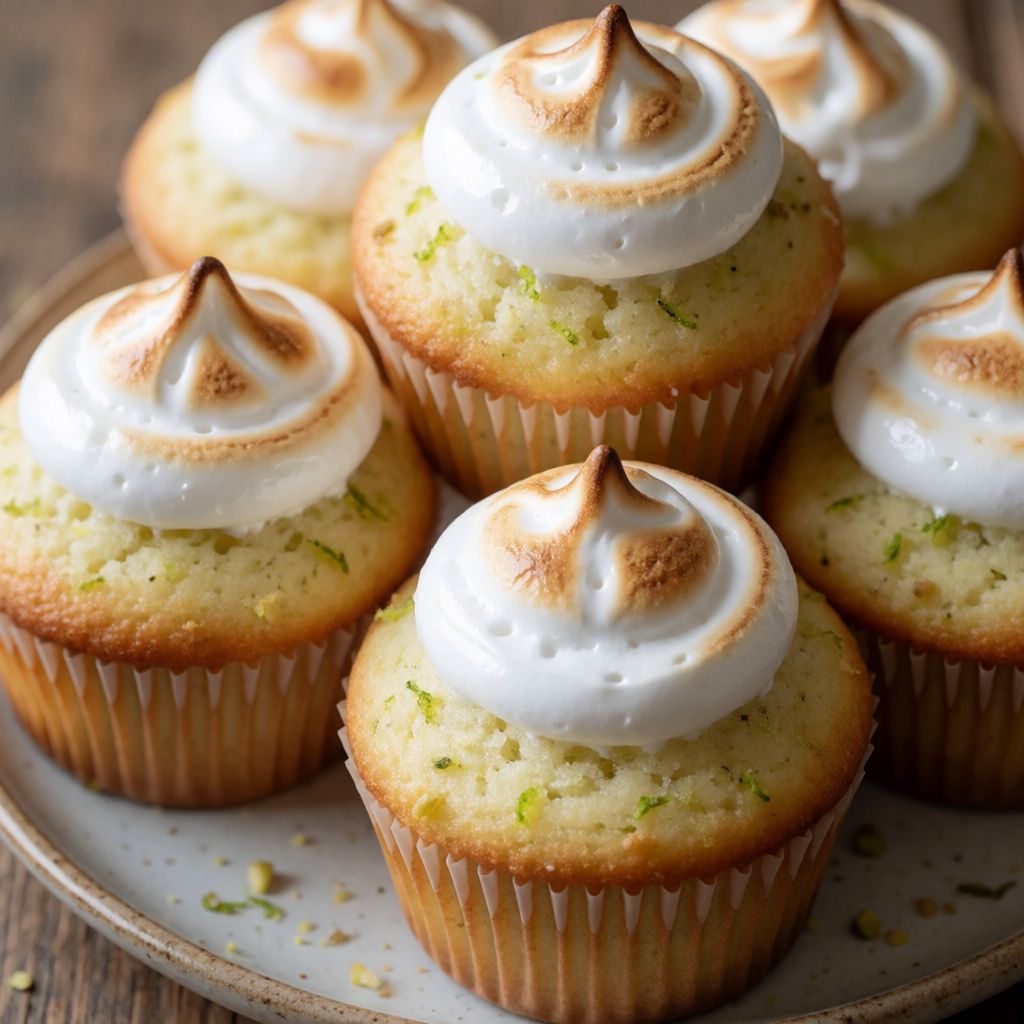
 AI photo
Pistachio and Lime Muffins with Meringue
Pistachio and lime muffins topped with a glossy piped meringue.
Labels are worked out automatically from the ingredients and can be wrong. Check the packaging if it matters to you.
Ingredients
- 175 g Butter room temperature
- 175 g Marzipan grated
- 3 pcs Lime unwaxed, juice and finely grated zest
- 175 g Sugar
- 0.5 tsp Vanilla sugar
- 4 pcs Eggs free-range
- 200 g Plain flour
- 2 tsp Baking powder
- 1 pinch Salt
- 50 g Pistachios roughly chopped






Meringue
- 250 g Sugar
- 110 g Glucose syrup
- 70 g Water
- 150 g Egg whites


Steps
Beat the butter, marzipan, lime juice, zest of one lime, sugar and vanilla sugar until light and fluffy.
Beat in the eggs one at a time until the mixture is smooth.
Mix the flour, baking powder and salt, then sift into the batter.
Fold in the roughly chopped pistachios and mix the batter.
Divide the batter into muffin tins and bake in a preheated fan oven at 175°C for about 20 minutes, until cooked through.
Let the muffins cool on a wire rack.
Put the sugar, glucose syrup and water in a saucepan and bring to the boil.
Cook the syrup to 117°C, checking with a cooking thermometer.
Whisk the egg whites to a stiff, glossy foam with firm peaks.
Slowly pour the hot sugar syrup into the egg whites in a thin stream, whisking constantly so the syrup is fully incorporated.
Whisk the meringue for 8-10 minutes until it is stretchy and glossy.
Fill a piping bag fitted with a large star nozzle with the meringue and pipe a swirl onto each cooled muffin.
A muffin that's really a disguised cake, crowned with what is, mechanically, an Italian meringue buttercream's less rich cousin — just egg whites and cooked sugar, no butter. The marzipan is doing the heavy lifting here, not the flour: it's ground almonds already bound with sugar syrup, so when you beat it with butter you're building an emulsion that holds far more moisture than a plain creamed-butter mix could. That's why these muffins stay damp for days instead of drying out by Tuesday — the almond fat and sugar trap water the way flour alone never could.
What decides whether this works isn't the baking, which is forgiving. It's the syrup. You're making an Italian meringue on top of a muffin, and Italian meringue lives or dies by one number: 117°C. Below that, the sugar hasn't dehydrated enough and your meringue stays wet, collapses under its own weight, weeps on the plate. Above about 121°C you're into hard-crack territory and the meringue turns brittle, sets like glass, cracks when piped. There's no eyeballing this one — a thermometer isn't optional here, it's the whole recipe.
The second thing that decides it: whisking the whites to full stiff peaks *before* the syrup goes in. Pour hot syrup into soft whites and you don't fold air in anymore, you deflate it — the structure collapses as fast as you try to build it. Stiff peaks first means the proteins are already locked into a scaffold; the syrup then just cooks and stabilises what's there, rather than fighting a liquid mess.
Marzipan: buy it ready-made, don't make your own almond paste for this — you want the sugar ratio already calculated, that's what gives the batter its particular density and chew. Grate it cold, straight from the fridge, or it smears instead of incorporating cleanly into the butter. If you can't get marzipan, ground almonds plus icing sugar beaten in won't behave the same way — the bound sugar-fat structure is the point, not just the almond flavour.
Lime: unwaxed is not a nicety, it's a requirement, because you're zesting the skin straight onto the batter — wax doesn't wash off with water, it washes off with hot water and scrubbing, and even then you're eating a thin film of preservative. If you only have waxed limes, scrub hard in hot water first, or skip the zest from one and use lemon zest instead — the acidity matters more than which citrus supplies it, since it's cutting through all that sweet marzipan and sugar.
Eggs, free-range or not — that's a welfare note, not a technical one, so any fresh eggs do the job the same. What matters more: the egg whites for the meringue (150g, roughly 4-5 whites depending on size) need to be genuinely free of yolk, even a trace of fat in there and the whites won't whip to stiff peaks — the fat coats the proteins and stops them unfolding and linking up. Older whites actually whip better than fridge-fresh ones, a little thinner and looser, so don't worry if they've sat a day or two.
Glucose syrup: this isn't decoration, it's an anti-crystallisation agent. Plain sugar syrup, heated and cooled, wants to recrystallise — you'll feel it as grittiness in the set meringue. Glucose molecules get in between the sucrose molecules and physically block them from locking back into crystals, which is why the finished meringue stays smooth and glossy rather than sandy. If you've genuinely got none, golden syrup or liquid honey will do the same interfering job, though honey brings its own flavour along with it — fine here, since pistachio and honey already know each other.
Baking the muffins: a fan oven at 175°C is a reasonable domestic setting, and "about 20 minutes" is the floor, not the answer. What you're watching for is a skewer coming out clean and the tops springing back when pressed, not collapsing into a fingerprint. Ignore the old rule that a cake's done when it "shrinks from the sides of the tin" — by the time it does that reliably, you've usually overbaked the edges while the centre catches up. Trust the springback and the skewer instead.
On the meringue stage in a normal kitchen: you don't need a stand mixer with a thermometer probe built in, a handheld whisk and a jam thermometer clipped to the pan do the job — just pour the syrup down the side of the bowl in a thin stream, not onto the beaters, or it'll fling hot sugar onto the bowl walls and onto your hand before it ever reaches the whites. And pipe while the meringue is still warm and loose; it stiffens as it cools, and a cold piping bag fights you all the way.
Patience here is specific: it's the eight to ten minutes of whisking after the syrup goes in, which feels like a long time to stand there with a bowl of stiff white foam that already looks done. It isn't. That stretch is what cooks the whites through with the syrup's own heat and builds the glossy, elastic texture that holds a piped swirl instead of slumping. Stop early and you'll get a meringue that tastes right but won't hold its shape past the first hour on the plate.