
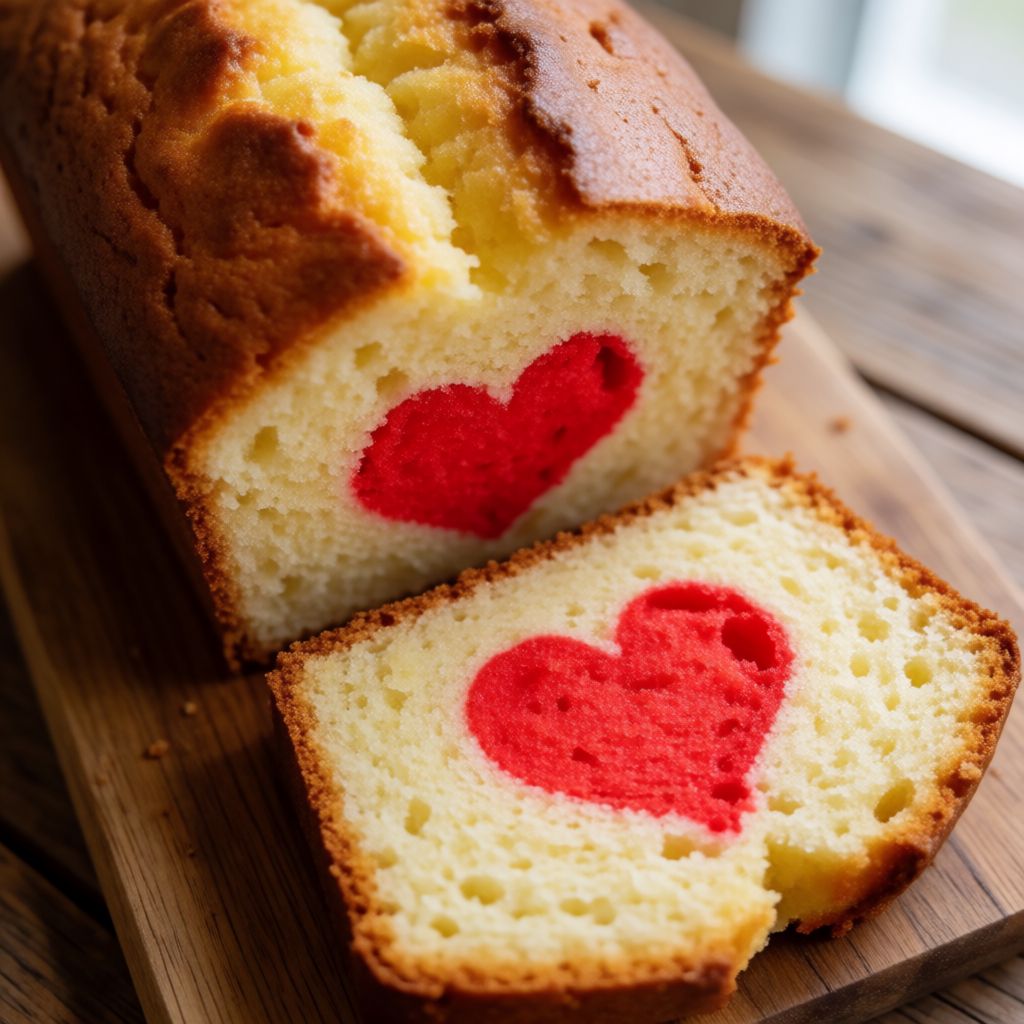
 AI photo
Hidden Heart Loaf Cake
A two-tone loaf cake with a red heart hidden inside a chocolate sponge, revealed in every slice.
Labels are worked out automatically from the ingredients and can be wrong. Check the packaging if it matters to you.
Ingredients
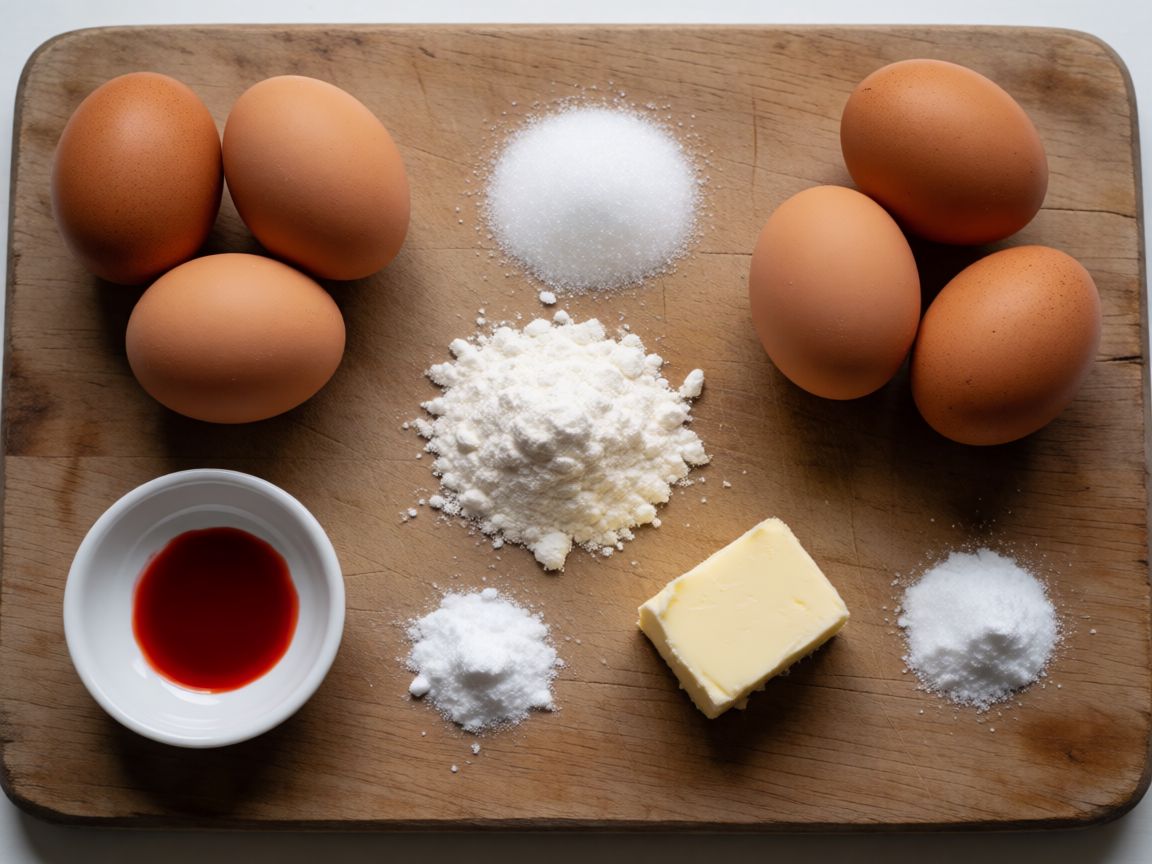
- 3 pcs Eggs
- 110 g Caster sugar
- 120 g Plain flour
- 5 g Baking powder
- 50 g Butter
- Red food colouring to taste, red
- 3 pcs Eggs
- 180 g Caster sugar
- 250 g Plain flour
- 16 g Baking powder
- 20 g Cocoa powder
- 120 g Butter
- 200 ml Milk
- 100 g Dark chocolate







Steps
Whisk the eggs with the caster sugar until pale and fluffy, add the sifted plain flour and baking powder, and mix well.
Stir in the melted butter and mix the batter until smooth.
Add red food colouring to taste and mix through.
Pour the batter into a 26 cm tin or onto a baking tray lined with parchment.
Bake in a preheated fan oven at 180°C.
11 minLet the red sponge cool completely.
Whisk the eggs with the caster sugar, then add the melted butter and room-temperature milk.
Gradually add the sifted plain flour, baking powder and cocoa powder, mixing until smooth.
Stir in the melted dark chocolate and mix through.
Cut heart shapes from the cooled red sponge using a cookie cutter.
Grease a 26x10 cm loaf tin with butter and dust with flour.
Spoon a few tablespoons of the chocolate batter into the base, then arrange the hearts side by side on top.
Cover the top with the remaining chocolate batter.
Bake in a preheated fan oven at 180°C (about 60 minutes in static mode).
53 minLet the loaf cake cool completely before removing it from the tin and slicing.
This is two cakes pretending to be one. You bake a thin red sponge first, let it go stone cold, punch hearts out of it with a cutter, then bury those hearts standing in a chocolate loaf batter so that every slice — cut crosswise — shows a heart staring back at you. The trick isn't flavour, it's geometry: red sponge, chocolate sponge, and a cutter doing the work a steady hand can't.
What decides whether it works is almost entirely about cold and dry. The red sponge has to be fully cooled — not "cool enough", actually room temperature right through — before you cut it, because a warm sponge is soft enough to squash under a cutter instead of being sliced clean, and you'll get a heart with ragged, crumbling edges that bleeds red crumb into the chocolate batter around it. A loaf tin, not a round one, is non-negotiable here: you need a long axis to lay the hearts in a row, pointing the same way, so that when you cut the finished loaf into slices you're cutting across that row and catching a heart in cross-section each time, not a long red smear.
Some say red velvet or beetroot gives a "more natural" red. No — because here the colour isn't flavour, it's a signal. The red sponge is structural, a shape-cutter, not a taste layer; its whole job is contrast, so food colouring that does nothing but colour is the right tool, not a wrong shortcut.
Feeds 8, cut into fairly thick slices — thin ones won't show the heart properly, and that's the whole point of the cake, so don't be mean with the knife.
Two egg-sugar-flour-butter batters, same bones, different jobs. The red sponge is baked thin on a tray or in the 26 cm tin specifically so it ends up a slab a few centimetres deep — enough to cut a heart with a bit of height to it, not a flat cookie-cutter wafer that collapses when you move it. Whisking the eggs and sugar until pale and fluffy before anything else goes in isn't fussiness — that's where the air comes from. Plain flour gives this cake no reason to rise much, so the whisking stage is doing the lifting that the baking powder alone won't manage; skip it and you get a dense disc, hard to cut cleanly and heavier than the chocolate cake around it, which means your hearts sink instead of sitting level in their row.
Butter here, melted rather than creamed, because this isn't a sponge built on trapped air in fat — it's built on trapped air in egg. Melted butter just adds richness and keeps the crumb from drying out; any neutral fat with no smell of its own does the same job, so a flavourless vegetable oil works at a pinch, though you'll lose a little of the structure butter gives once it re-solidifies on cooling. Food colouring: gel, if you have it, because gel concentrates colour without adding the water that liquid colouring does — and water in a sponge that's trying to hold its shape as a cut-out is the last thing you want.
The chocolate batter is the same method with more weight behind it — more flour, more sugar, more butter, and milk added for moisture because cocoa powder drinks liquid and dries a crumb out if you don't account for it. Dark chocolate melted in on top of the cocoa powder isn't belt-and-braces: cocoa gives colour and a slightly bitter, dry chocolate note; melted chocolate gives the fat and the gloss, a rounder, less dusty flavour. Leave the chocolate out and the cake will still taste of chocolate, just flatter — it'll taste like cocoa and nothing else, if that makes sense.
Baking powder jumps from 5 g in the small red batch to 16 g in the larger chocolate one — not because chocolate batter needs more lift gram for gram, but because cocoa powder is slightly acidic and heavier than flour, and it drags on rising; the extra powder is there to fight the cocoa, not to make the cake tower up.
On your hob: a fan oven at 180°C is what the recipe assumes, and fan ovens run a touch hotter and more evenly than static ones because the moving air strips the insulating layer of still air off the cake's surface, which is why the note about "60 minutes in static mode" matters — a static oven with no fan will need longer at the same dial setting to do the same job, because it's relying on radiant heat alone working its way in from the outside.
Patience is the actual ingredient that makes this cake rather than a mess. Both coolings — red sponge before cutting, finished loaf before unmoulding and slicing — aren't optional pauses between steps, they're the two moments where the cake either holds its shape or doesn't. Cut into a warm loaf and the heart you worked for comes out smeared at the edges, chocolate crumb dragging into red. Let it sit, properly cold, and the knife goes through clean.