
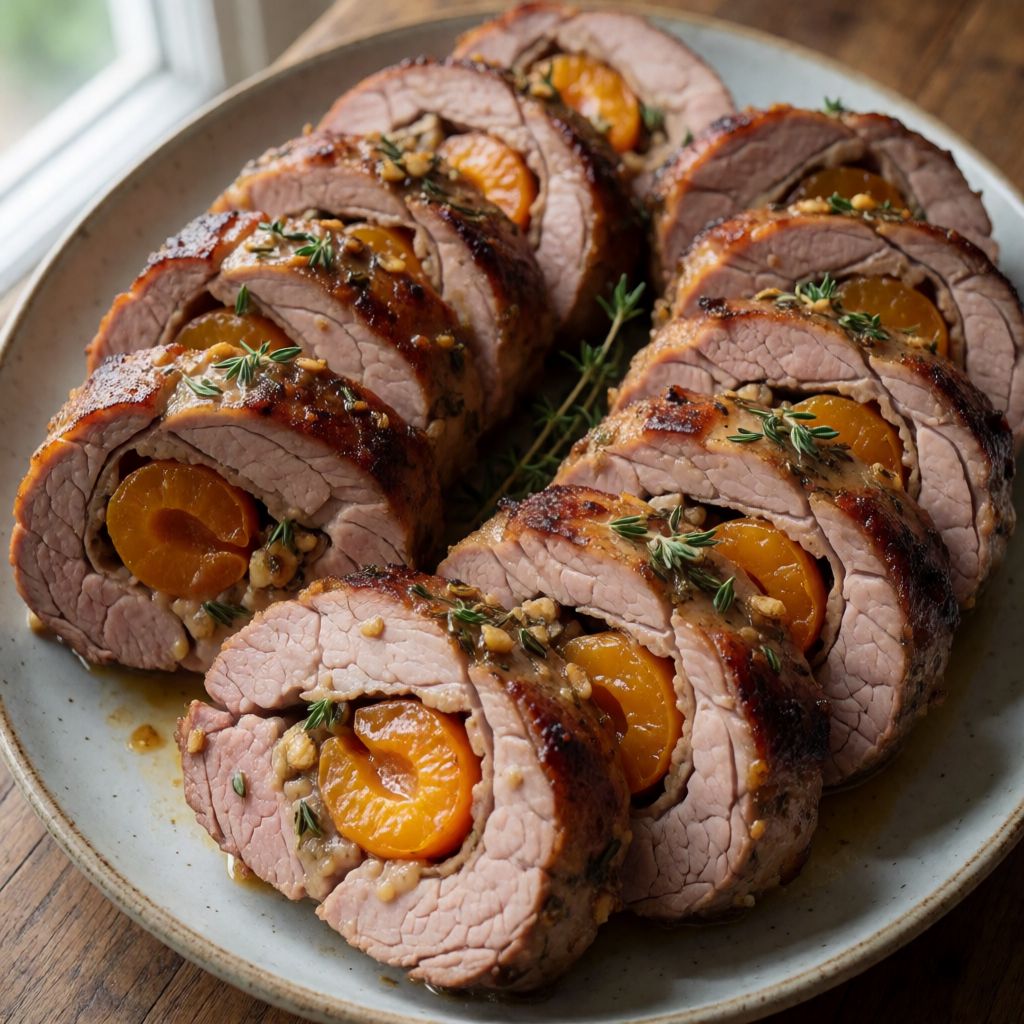
 AI photo
Pork Loin Stuffed with Apricots and Thyme
A succulent pork loin filled with sweet dried apricots, apricot jam and fresh thyme, roasted until the skin turns crisp.
Ingredients
- 1 pcs Pork loin skin on
- 6 pcs Dried apricots
- 2 tbsp Apricot jam
- 1 bunch Thyme fresh, or 1 tbsp dried thyme
- 2 clove Garlic
- to taste Salt
- to taste Black pepper freshly ground





Steps
Score the skin of the pork loin, cutting right through the fat but stopping just before the meat – take care not to cut into the meat itself.
Season the skin, rubbing coarse salt and freshly ground black pepper into every score. This step is key to getting crisp crackling.
Cut a deep pocket into the meat.
Dice the dried apricots finely, chop the garlic and thyme, mix with the apricot jam and use the mixture to fill the pocket.
Secure the loin with cooking skewers so the filling stays enclosed.
Place the loin in a roasting dish that fits it well, ideally on a rack over a little water in the base of the dish.
Sprinkle the skin with a little extra salt and put the loin into a cold oven, then set it to 100°C and roast for about 3 hours.
180 minAfter that, raise the oven to 230°C and roast for a further 30 minutes.
30 minThe internal temperature of the loin should reach about 65°C, so check with a thermometer if needed.
If the crackling isn't quite perfect yet, put it back under high heat briefly to finish it off.
What was changed
The final oven heat was rounded to suit UK oven dials.
This is a Sunday joint where the skin is the whole argument and everything else is support. The apricot, thyme and garlic packed into the loin aren't a garnish — they're doing indoors what apple sauce usually does on the side: cutting the richness of the fat. Take that stuffing out and you still have a roast; take the crackling away and you've lost the reason anyone chose this cut over a shoulder or a chop.
The recipe is really two separate cooking problems, solved one after the other, and the whole mechanism hangs on not confusing them. First you have to melt the fat under the skin — slow, low, patient. Then, and only then, you crisp the surface — fast, hot, dry. Try to do both in one go and you get neither: a scorched top sitting over rubbery white fat.
Some say crackling needs a hot oven from the first minute. No — because a hot oven hits skin whose fat hasn't melted yet, seals the surface before the fat beneath it has anywhere to go, and you end up with the thing everyone blames on "bad skin", which is really just the wrong order of heat.
You'll know it's going right by looking, not by the clock: the skin should move from damp, pink, freshly scored rind to pale, dry, almost leathery before it ever meets the high heat at the end. By the time the final blast is done, it should sound hollow and faintly brittle when you knock it with a spoon. Inside, 65°C at the centre reads as pale pink, not grey — and that's correct, not underdone. Loin has almost no fat running through the muscle itself, so pushing it further just squeezes the moisture out of it for no reason.
Start with the scoring. It goes through the fat, not into the meat, and that line matters: the fat needs channels so salt and heat can reach all the way down to it, but the muscle underneath doesn't need opening at all — cut into it and you're just giving juice a way out where none was wanted.
The salt rubbed into those scores is doing more work than the oven does. Salt pulls water out of the skin by osmosis, and that water needs to leave as vapour before the skin ever sees serious heat — a damp skin steams itself soft no matter how hot your oven gets. This is the real secret behind crisp crackling, more than any temperature number: dry skin crackles, wet skin just goes leathery and sits there looking disappointed.
Inside the pocket, each ingredient has one job. Dried apricot is chosen over fresh for the obvious economic reason — it's shelf-stable, already concentrated in sugar and acid, and doesn't need a season. The jam keeps that filling from drying out over three hours with no direct heat reaching it, and doubles as glue holding the mix together. Thyme is woody enough to survive a long slow roast without collapsing into nothing — a soft herb like basil would be wasted in there. Garlic, enclosed and cooked gently for hours, loses its sharpness and turns sweet rather than staying raw and aggressive. If you're out of apricots, any dried stone fruit with real acid to it — peach, even sour cherry — does the same job; a bland dried fruit won't cut the fat the way this one does.
Skewers are just a cheap, honest trussing method — their only purpose is to stop the seam opening as the jam melts and the loin shrinks slightly with heat. Cocktail sticks or kitchen string do exactly the same thing; the criterion is anything that holds a seam shut and won't melt or burn in the oven.
The rack over a little water isn't about steaming the meat — it's about protecting it. At 230°C, rendered fat dripping into an empty tin will scorch and smoke before your thirty minutes are up; the water underneath catches and cools those drips. The rack lifts the skin clear of that liquid so it crisps in dry air rather than sitting half-submerged in its own fat. No rack at home — three or four tight balls of foil under the joint do the same lifting.
The staged heat is the whole mechanism in one line: cold oven up to 100°C lets the fat under the skin liquefy gently and the collagen soften without the surface tightening too fast, so the meat stays moist through hours that would otherwise dry it out. Only once that fat is mostly gone does 230°C make sense — now there's little left to render, just a dry surface to flash-crisp, and thirty minutes of high heat barely has time to push the core past the few degrees it needs to reach 65°C. And on the old worry that pork has to be cooked grey through — no, not any more; that fear came from a parasite risk that commercial UK pig farming eliminated decades ago. Holding onto that myth here costs you nothing but a dry loin. Give it a rest before you carve — no need for a clock, just wait until it stops leaking onto the board when you press it.