
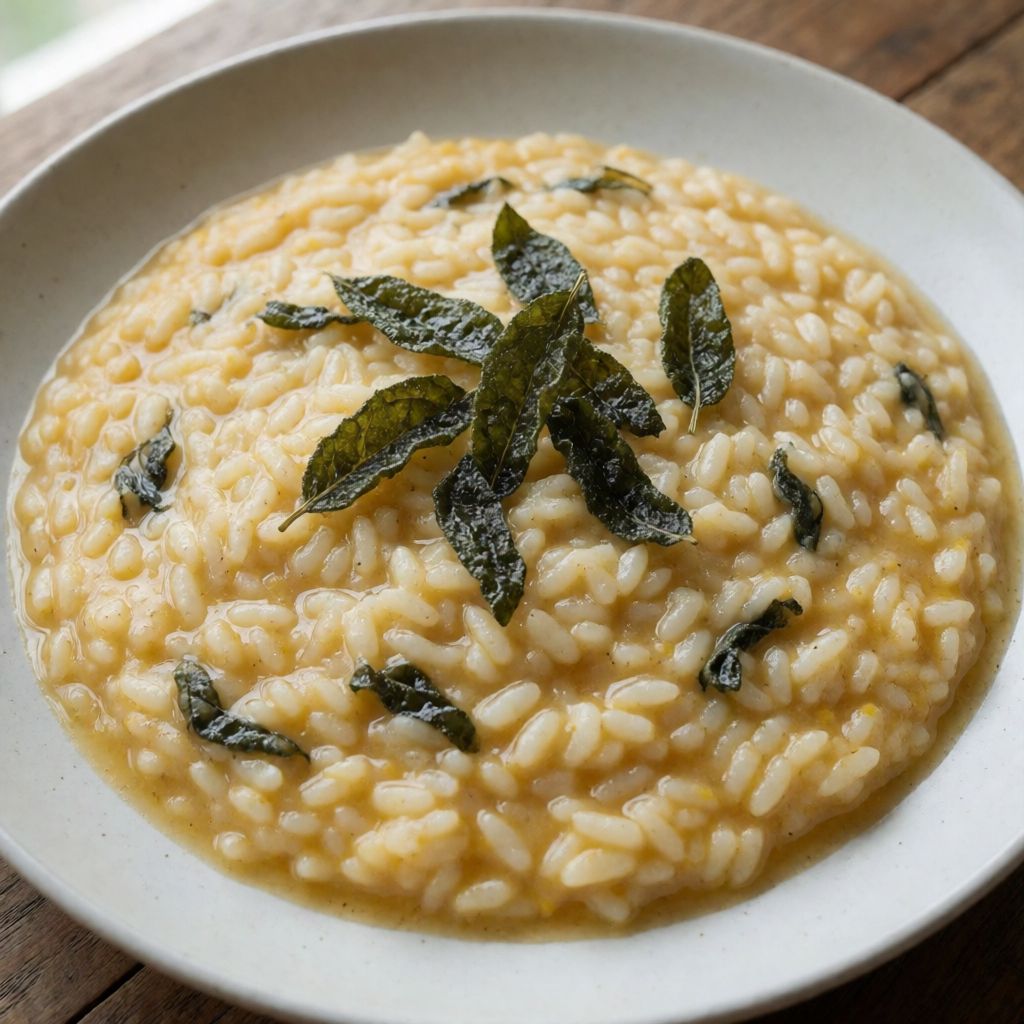
 AI photo
Pumpkin Risotto with Sage and Browned Butter
A creamy pumpkin risotto finished with crisp sage and golden browned butter.
Labels are worked out automatically from the ingredients and can be wrong. Check the packaging if it matters to you.
Ingredients
- 60 g Butter
- 2 pcs Sage fresh sprigs
- 400 g Pumpkin diced small
- 2 tbsp Butter
- 1 pcs Onion finely chopped
- 2 clove Garlic finely chopped
- 350 g Risotto rice
- 100 ml White wine
- 1.2 l Stock
- 75 g Parmesan finely grated
- 1 tbsp Butter for frying
- pinch Salt
- pinch Black pepper freshly ground
- 30 g Pine nuts toasted
- 50 g Parmesan freshly grated












Steps
Melt the butter in a pan and let it foam, then reduce the heat to low and add the sage leaves.
Stir the butter with the sage leaves until the butter turns golden-brown and the sage becomes crisp — this takes about 10–15 minutes.
Turn off the heat once the butter is golden-brown with a nutty aroma and the scent of sage.
Put the pumpkin cubes into a pan of salted water and cook for about 15–20 minutes, until completely tender.
Drain and blend the pumpkin into a smooth purée.
Fry the onion and garlic in oil until the onion turns translucent and soft. Add the rice and stir well.
Pour in the white wine and stir until the rice has absorbed all the liquid.
Gradually add the vegetable stock, stirring, until the rice is just tender and the risotto is pleasantly creamy.
Stir the pumpkin purée and Parmesan into the risotto. Season well with salt and pepper.
Serve the pumpkin risotto on plates with pine nuts, crisp sage, browned butter and a little extra Parmesan.
Risotto is not a sauce you pour over rice — it's starch you drag out of the rice by force. That's the whole mechanism. Arborio or carnaroli grains have a soft outer layer of starch wrapped around a firmer core. Stock added a little at a time, with constant stirring, scrubs that outer starch off into the liquid, where it thickens into something creamy without a drop of cream going in. Dump all the stock in at once and you've just made rice soup — the starch never gets agitated enough to let go.
This version swaps half the usual stock-and-stir grind for pumpkin purée stirred in near the end, which is a reasonable bit of cheating: you still need the rice to give up its starch, but the pumpkin does the "creamy" heavy lifting so you don't have to chase perfection with the ladle quite so anxiously. Boil the pumpkin to collapse, not to colour — you want it falling apart at a knife-touch, soft enough to blend without a whisper of resistance, because any firm bits will show up as grit in the finished purée.
Some say risotto needs constant, religious stirring from the second the rice hits the pan or it's ruined. No — because what stirring actually does is bring starchy grains into contact with liquid and with each other, releasing that outer starch. You can step away for a few seconds to deal with a boiling-over pumpkin pot and nothing collapses. What you can't do is walk off for ten minutes, because then the rice at the bottom sits still in hot liquid, overcooks on one side, and you get a layer of mush under a layer of bite — texture inconsistency, not a stirring-police violation.
On rice: use a short-grain variety bred for this — arborio is the easy supermarket find, carnaroli holds its structure a touch better if you can get it, because it has a higher proportion of that firm core starch (amylose) to the soft, sticky kind. Long-grain rice, basmati, anything bred to stay separate and fluffy, won't do this job — it doesn't have enough of the starch you're trying to extract. There's no real substitute here; this is one of the few places where the ingredient and the technique are the same thing.
The onion and garlic go in before the rice and get cooked gently until the onion turns from opaque white to translucent — that's the cell walls softening and the raw, sulphurous bite cooking off. This isn't a step for colour; browning here would mean bitterness sitting under your finished dish for the next half hour, since nothing after this point cooks hot enough to burn it off. Any neutral oil with no smell of its own works for this stage — a flavourless vegetable or sunflower oil, or a knob of butter if you want the richness; just don't reach for strongly flavoured olive oil and wonder why your risotto tastes faintly of pressed olives.
The wine, added once the rice has had a minute in the hot pan, does two things: it deglazes any stuck bits off the bottom, and the alcohol cooks off while the acid stays, cutting through what will otherwise be a very rich, buttery, cheesy dish. Stir until it's fully absorbed before reaching for stock — this is really the first rep of the extraction technique, a smaller-scale rehearsal for what the stock is about to do at length.
Stock quality matters more than people admit, because at 1.2 litres you're essentially flavouring the whole dish with it. Keep it warm in a separate pan while you work — ladling cold stock into hot rice drops the temperature every time, slows the starch release, and stretches your cooking time out for no gain. Add it gradually, a ladle or two at a time, letting the rice drink it down before the next addition. You're looking for the rice to be tender with the faintest resistance in the centre — bite one grain, don't trust the clock, because stove heat, pan width and pumpkin timing all shift the number of minutes anyway.
Parmesan goes in at the end, off any serious heat, because cheese stirred into something too hot can split into oil and grit instead of melting smooth — look for freshly grated over pre-grated bagged cheese, which is often coated in anti-caking starch that stops it melting cleanly. If you can't get Parmesan, a hard, aged, well-salted cheese like a mature Pecorino does a similar job, though you'll want to go lighter with your added salt since Pecorino runs saltier.
A wide domestic frying pan stands in fine for a proper risotto pot, but be honest about the shape: more surface area means faster evaporation, so your stock may run out before the rice is done — have a little extra warm, or a kettle of hot water as backup, rather than forcing underdone rice to finish in liquid that's already gone. And don't rush any of this. Risotto rewards someone standing at the stove paying attention far more than it rewards a clever trick — that's not romance, that's just how starch behaves when you give it time instead of heat.