
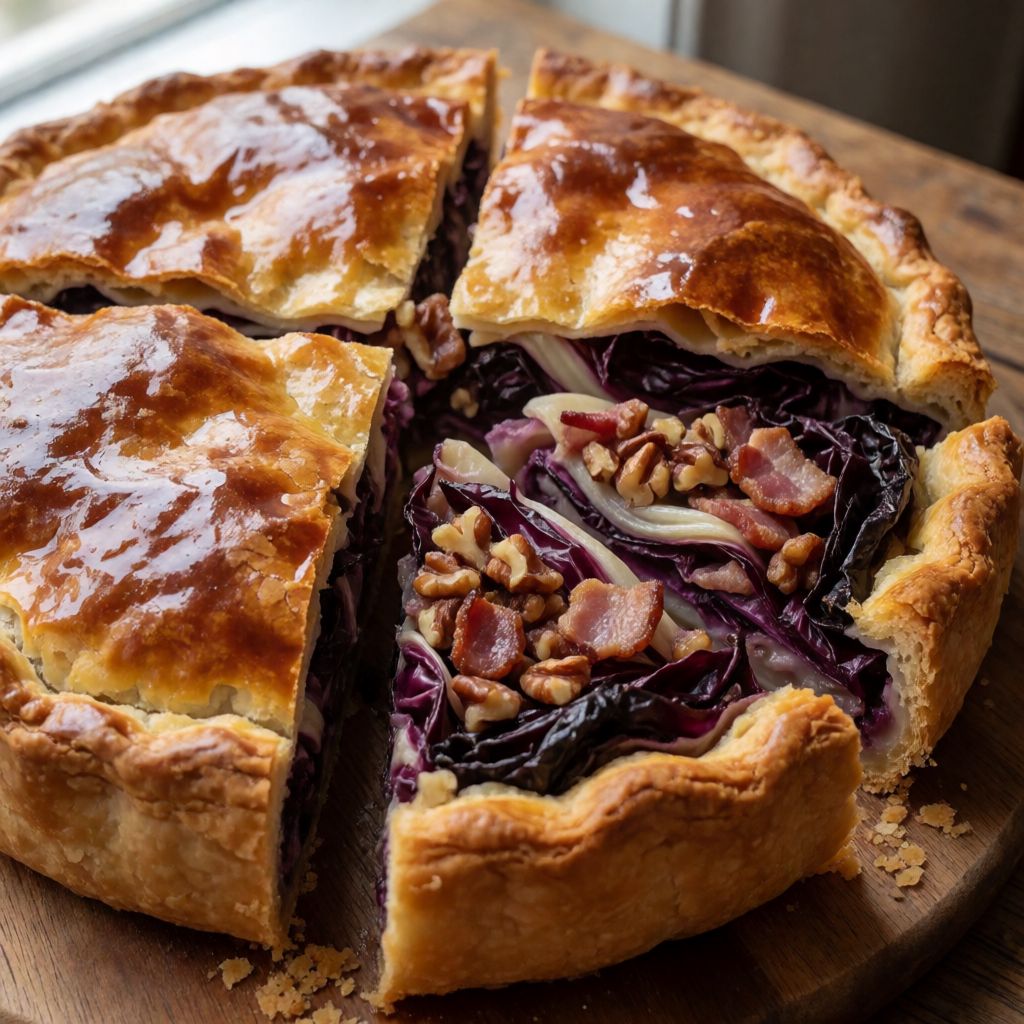
 AI photo
Radicchio, Bacon and Walnut Pie
A savoury pie with braised radicchio, crispy bacon, ricotta and walnuts in a buttery shortcrust pastry.
Labels are worked out automatically from the ingredients and can be wrong. Check the packaging if it matters to you.
Ingredients










Steps
On a work surface, heap the flour into a mound, make a well in the centre and add the cold butter and cold water. Mix and knead by hand until a smooth ball of dough forms.
Wrap the dough in cling film and chill in the fridge.
30 minFry the shallot in a pan with a little olive oil.
Add the radicchio, cut into strips, season with salt and cook, stirring occasionally and adding a little water if needed.
10 minIn a separate bowl, mix the ricotta with the eggs, add a pinch of salt and the Parmesan, and stir well until smooth.
Add the cooked radicchio to the bowl with the filling, along with the bacon cut into strips and the roughly chopped walnuts. Mix everything together.
Take the dough out of the fridge and roll it out with a rolling pin to about 5 mm thick, then line a 26 cm tin greased with butter and dusted with flour.
Trim off the excess dough with the rolling pin or a palette knife and prick the base with a fork.
Spread the filling over the pastry, sprinkle with a little extra Parmesan if you like, and drizzle with olive oil.
Bake in a preheated fan oven at 180°C.
40 min
This is a savoury tart built on a contradiction: radicchio is bitter on purpose, and everything else on the list exists to argue with that bitterness without winning the argument outright. Ricotta softens it, Parmesan salts it, bacon smokes it, walnuts give it something to crunch against. If you strip the bitterness out entirely by over-cooking the radicchio to sweetness, you've made a different, blander pie — the whole point is gone.
What decides whether this works is the pastry, and specifically whether you treat it like puff pastry's lazy cousin or like what it actually is: pâte brisée, a short crust held together by cold fat, not by gluten. Butter stays solid, cuts the flour into small sheltered pockets, and those pockets steam open in the oven — that's your short, flaky base. The moment the butter softens in your hands, you're not making pastry anymore, you're making bread dough with delusions. Some say warm hands are fine if you work fast — no, because by the time you've noticed the dough gone silky and elastic, the butter's already melted into the flour and the structure's lost; you won't get it back by chilling it afterwards, only by starting again.
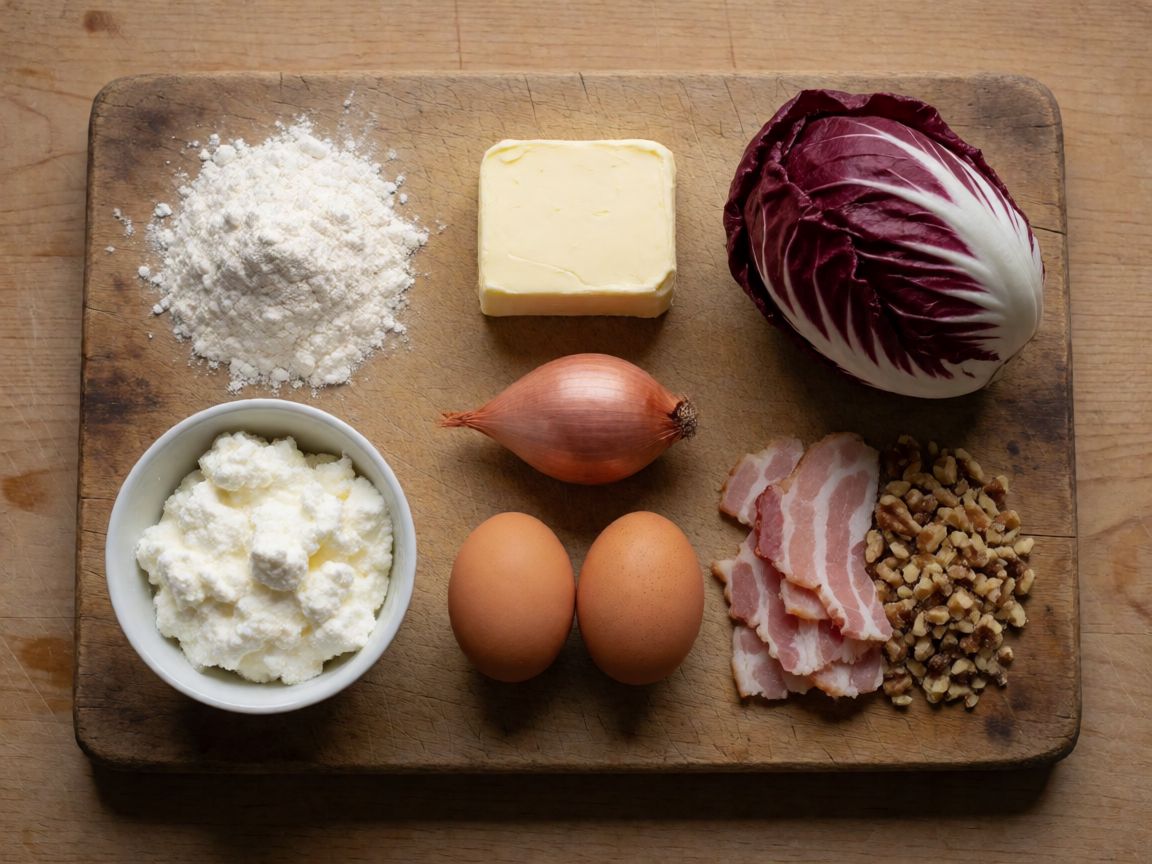
On the flour: 300g plain flour here, not bread flour — you don't want the extra gluten strength, you want a dough that's easy to tear, because tearing means short. If what you have is "plain" by a different name (all-purpose, whichever bag's in the cupboard), it's fine; the issue is protein content, not the label.
Butter: 150g, and it must stay cold right up until it's in the oven. The classic method here — mounding flour on the worktop with a well — is mostly theatre for hand-kneaded dough; it does let you work the butter into small pieces gradually rather than in one go, which matters, but a bowl does the same job if your kitchen worktop isn't marble-cool. What doesn't work is substituting margarine or a spread — too much water content, not enough structural fat, and you'll get a dough that's greasy rather than flaky.
Radicchio, 380g, is the whole premise. It's a chicory, related to endive, bred for bitterness rather than away from it — that bitterness is intercybin and other compounds that also made chicory root a coffee substitute in hard times, which tells you something about how Italians decided bitter vegetables were worth cultivating rather than breeding out. If you can't get radicchio, use a red chicory with some backbone to it (Treviso-type if your shop stocks Italian veg), not lettuce dressed up — you need a leaf sturdy enough to survive frying, not one that collapses to nothing.
Ricotta and eggs are your binder — ricotta alone is too wet and loose to hold a filling together once sliced, the eggs set it like a custard in the oven's heat. If ricotta's not to hand, cottage cheese blitzed smooth works, though you lose a little of ricotta's cleanness; don't reach for cream cheese, it's too dense and tangy and will fight the Parmesan rather than support it.
Bacon, cut into strips rather than left in slices, means it renders its fat into the filling as it bakes rather than sitting as one slab of chew in the middle — it's seasoning as much as it's protein. Streaky bacon with decent fat does the job; back bacon's too lean and you'll notice the dryness. Walnuts are there entirely for texture — an occasional hard interruption in something otherwise soft — so don't chop them to dust; roughly broken is the instruction because fine pieces vanish into the filling and stop doing their job.
Parmesan: real aged Parmesan carries glutamates that read as savoury depth, not just salt — a pre-grated "Italian hard cheese" substitute will taste thinner and flatter in exactly the way you won't notice until you've had the real thing beside it. Pecorino is the honest substitute if you want more bite, not less.
On the tin and the oven: 180°C fan means the air's actually moving, carrying heat to the pastry edges as well as the top of the filling — in a non-fan oven you'd want it a touch hotter to compensate, since still air is a worse conductor. A domestic oven doesn't hold heat the way a professional one does, so resist opening the door early to check; let the window do the looking.