
 AI photo
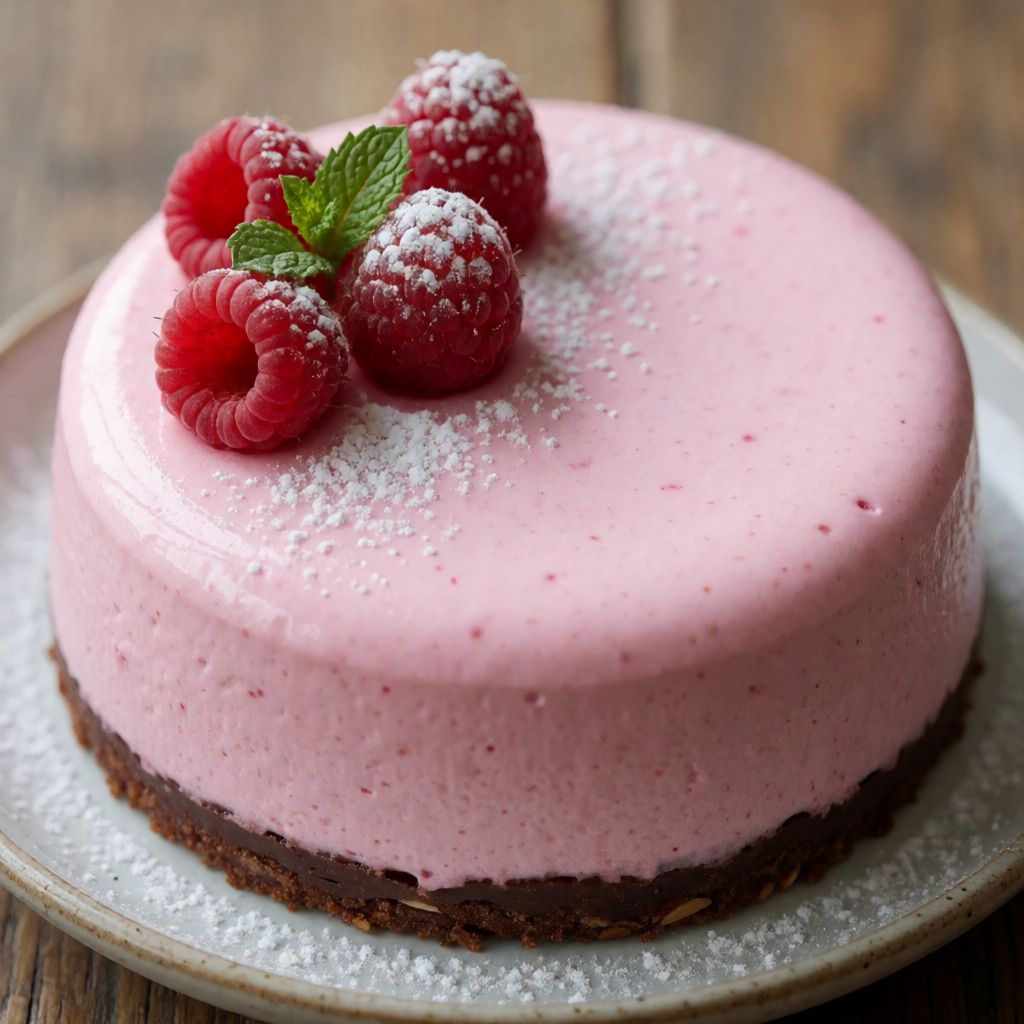
Raspberry Mousse Cake on a Chocolate Base
A raspberry mousse cake set on a soft chocolate-almond base.
Labels are worked out automatically from the ingredients and can be wrong. Check the packaging if it matters to you.
Ingredients
Chocolate base
- 100 g Butter
- 3 pcs Eggs
- 125 g Caster sugar
- ½ pcs Vanilla pod
- 70 g Ground almonds
- 1 pinch Salt
- 100 g Dark chocolate finely chopped





Raspberry mousse
- 4 pcs Gelatine leaves
- 450 g Frozen raspberries
- 1 pcs Lemon juice and finely grated zest
- 60 g Caster sugar
- 1 pcs Vanilla pod
- 500 ml Double cream




Decoration
- 200 ml Double cream
- 60 g Raspberries
- 2 pcs Mint sprigs

Steps
Melt the butter in a saucepan over low heat, without overheating, until clear.
2 minWhisk the eggs, sugar and vanilla seeds until pale and smooth, then fold in the ground almonds and salt.
3 minRemove the pan from the heat, melt the chocolate in the warm butter and slowly add it to the egg-sugar mixture, stirring constantly.
2 minPour the batter into a greased 18 cm springform tin.
Bake the base in a preheated fan oven at 175°C for 27-30 minutes. It should remain slightly underbaked and wobbly.
29 minPut the base in the fridge until the next day.
480 minSoak the gelatine leaves in cold water for 10 minutes.
10 minBring the raspberries, lemon juice and zest, vanilla seeds and sugar to the boil in a saucepan and simmer for about 2-3 minutes.
3 minPass the raspberries through a sieve, separating the seeds from the purée. Bring the juice and purée to a quick boil again.
3 minSqueeze the water from the gelatine, stir it into the hot raspberry purée and mix well.
1 minCool the mousse to room temperature.
15 minWhip the cream to soft peaks, then gently fold it into the cooled raspberry purée.
5 minPour the mousse into a 20 cm silicone mould and place the chocolate base into the raspberry mousse.
Press the chocolate base so that it and the mousse are level with the edges of the mould, and place in the freezer overnight.
420 minTake the cake out of the freezer at least 7 hours before serving.
420 minRemove the cake from the springform tin, place it on a cold plate and let it thaw in the fridge.
150 minDecorate the top of the cake with dollops of whipped cream, sprigs of mint and fresh raspberries.
5 min
What was changed
Lemon balm was replaced with mint (Mint), as there is no separate option for it in the catalogue.
This is two desserts stacked on top of each other and tricked into behaving like one. A flourless chocolate-almond disc — dense, barely set, almost brownie — sits inside a dome of raspberry mousse, and the whole thing lives in the freezer until an hour before your guests arrive. Nothing here is complicated. What decides whether it works is restraint at two exact moments: how far you bake the base, and how gently you fold the cream.
The base is meant to come out of the oven looking like a mistake — a wobble in the middle, like a just-set custard rather than a cake. Some say a sponge base needs to be fully baked through, firm to the touch, or it'll collapse. No — this isn't a sponge, it has almost no flour to hold air, and if you bake it until it's firm, you've driven out all the moisture and you're left with a thin chocolate biscuit, dry as sand, instead of the fudgy slab that's meant to be there when the mousse meets it. The residual heat and the overnight rest in the fridge finish the setting job that the oven was told to stop short of.
Think about why this shape of recipe exists at all. A mousse this soft can't hold its own weight on a plate — it needs either a container or a cold surface to set against. The freezer and the silicone mould are doing the job that a proper French pâtisserie would do with a metal ring and careful chilling in a blast freezer; at home, a springform tin for the base and a loose silicone mould for the mousse are the honest stand-ins. A silicone mould matters here for one reason only — it releases the frozen mousse cleanly without you having to run a tin around the edge and risk tearing the dome, which a rigid cake tin would do.
Butter: melt it gently, don't let it brown or spit, because this isn't a recipe that wants nutty butter flavour fighting the chocolate — it wants fat that carries the chocolate smoothly into the eggs without seizing it. If the butter's too hot when the chocolate goes in, the chocolate can split and go grainy rather than glossy; that's the real reason for taking the pan off the heat first.
Eggs and sugar whisked until pale: this is what gives the base its only lift, since there's barely any flour here to hold structure. Whisk them properly — pale and thick, ribbon stage — because this trapped air is the entire difference between "dense cake" and "chocolate brick." The ground almonds replace flour almost entirely; they add structure without the gluten that would make the base chewy rather than fudgy, and they're also the reason this base stays moist rather than drying out the way a flour sponge would.
Dark chocolate: use something you'd actually eat off a bar, not a baking chocolate with waxy filler — around 60-70% cocoa solids gives bitterness that balances the sweet raspberry mousse above it. Go too mild and the base reads as just "more sweetness," which the cake doesn't need.
Gelatine leaves: these exist to give the mousse just enough backbone to stand as a cake rather than slump as a trifle. Four leaves for this volume of cream and purée is a light set deliberately — a mousse that's too firm turns rubbery, loses the point of being a mousse at all. If leaf gelatine isn't to hand, powdered gelatine works as a substitute by weight (roughly 2g powder per leaf), bloomed in a few spoonfuls of cold water instead of a bowlful.
Raspberries, frozen rather than fresh, for the purée: frozen fruit is picked and frozen at peak ripeness, so you get more consistent flavour and colour out of season than from fresh berries that travelled a long way to your shop — one of the few places where frozen genuinely beats fresh, not a compromise. The lemon juice and zest aren't there to make it taste of lemon; raspberries lose acidity when cooked, and the lemon pulls the brightness back so the mousse doesn't taste flat and purely sweet. Sieving out the seeds isn't fussiness — leave them in and every mouthful of mousse has a faint grit that fights the smoothness it's meant to have.
Double cream, whipped to soft peaks and no further: any fresh cream with enough fat to hold air works — in the UK that's double cream, full stop, nothing lighter will whip stiff enough to carry its own weight once folded with purée. Whip it past soft peaks and you're folding little grains of butter into your mousse instead of air; that shows up as a slightly curdled texture once frozen and thawed. Fold, don't stir — stirring knocks the air straight back out, and that air is the only thing standing between "mousse" and "raspberry jelly."