
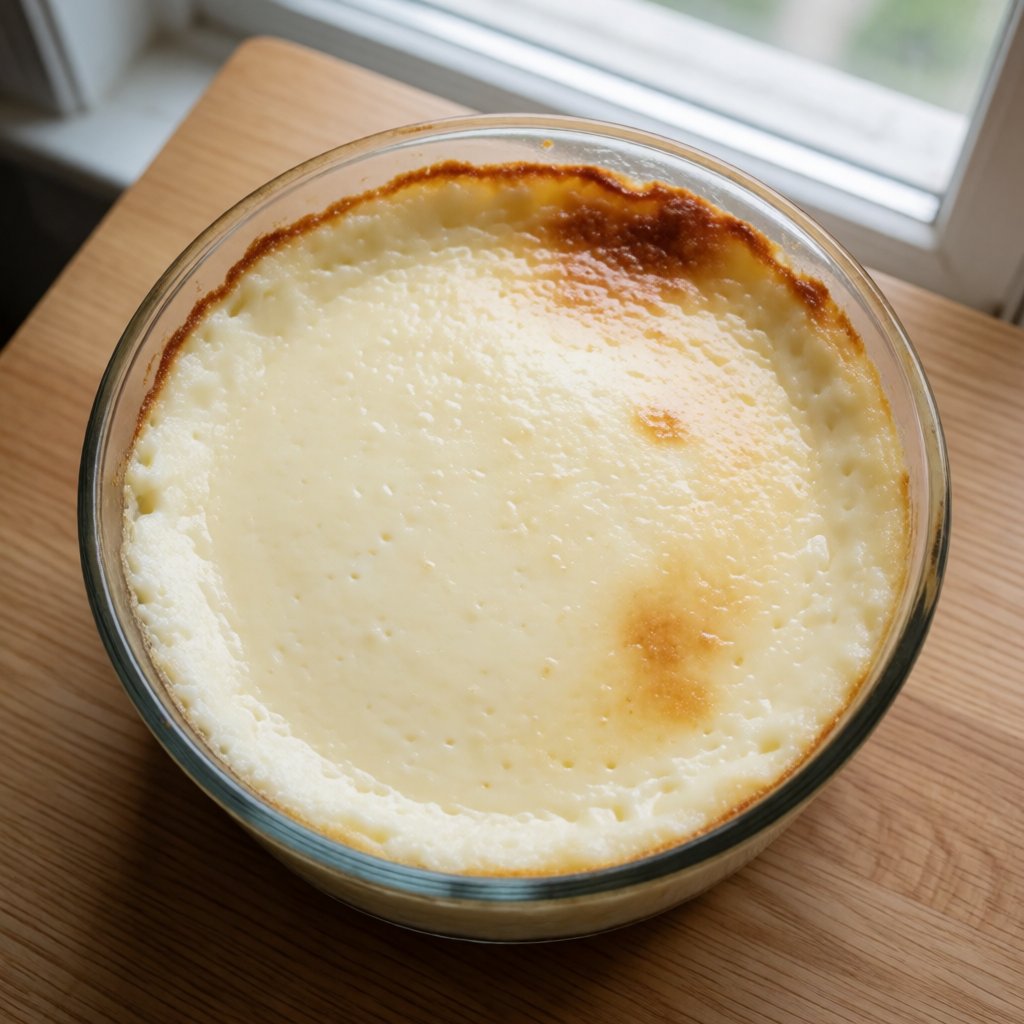
 AI photo
Baked Rice Pudding
A simple baked rice pudding made with milk, sugar and a hint of vanilla.
Labels are worked out automatically from the ingredients and can be wrong. Check the packaging if it matters to you.
Ingredients
- 100 g pudding rice rinsed
- 400 ml milk hot
- 1 tbsp sugar
- 10 g butter
- 1 pinch salt
- 0.25 tsp vanilla extract to taste






Steps
Put the rinsed rice into a baking dish with the sugar, salt and vanilla extract.
Pour over the hot milk, dot with butter, and cover with foil.
Place the dish on a baking tray.
Place the tray in the oven and bake at 200°C for 45 minutes.
45 minTake the dish out of the oven.
Stir well before serving.
This is a lazy custard dressed as rice pudding — rice sits in hot milk, goes into the oven covered, and comes out only when the milk has turned from liquid to a loose, clinging sauce and the rice has swollen into something soft enough to mash with a spoon, not crunch between your teeth. The oven is doing the job a hob and constant stirring would do for risotto, but slower and without your attention. That's the whole point of it.
What decides whether it works is the foil, not the heat. Milk left open in an oven loses water from the top faster than the rice underneath can absorb it — you'd get a dry, cracked skin over a thin, under-cooked middle. Foil over the dish traps the steam, the steam condenses and drips back in, and the milk stays near a simmer for the whole 45 minutes instead of reducing on you. That's what lets the rice take up liquid evenly, grain by grain, instead of just the top layer.
Doneness is a feel, not a clock: lift a corner of the foil, press a grain against the side of the dish — it should give, almost burst, not crunch. Forty-five minutes is where that usually happens, but it's a floor, not a guarantee; ovens lie about their own number on the dial.
Some say you have to stir rice pudding the way you stir risotto, or it'll clump. No — risotto needs stirring because you're rubbing starch out through contact with a spoon and a hot pan; this dish gets its starch release from steady, enclosed heat doing nothing dramatic for three quarters of an hour. Stir it under the foil and you let the steam out, cool the milk, and undo what the covering was protecting.
Pudding rice — the short, round grain, not the long thin kind you'd put under a curry — is chosen because it's almost all amylopectin, the starch that swells and half-bursts rather than staying firm. That's not a flaw you rinse away; rinsing is only to wash off the loose starch dust from milling and bagging, which otherwise clouds the milk and can catch and scorch on the base of the dish. The swelling itself is the engine of the whole pudding — don't rinse it away by accident with a long soak, a quick pass under the tap is enough.
Arborio or other risotto rice will survive this recipe if it's what's in the cupboard, but it's bred for the opposite job — holding a bite against liquid, not surrendering to it — and it costs more for a result that's slightly firmer than you want here. Long grain rice (basmati, jasmine) is the wrong tool entirely: low in that swelling starch, it stays separate and never gives you the thick, clingy sauce that's half the dish.
Starting with hot milk rather than cold matters more than it looks: it means the rice begins absorbing and swelling the moment it hits the oven, rather than sitting in cold milk slowly coming up to temperature while the top of the dish is already heating. That uneven start is how you get a rubbery skin with soup underneath. Whole milk gives you fat and casein protein, both of which thicken and round out the sauce as it bakes; a plant milk will work in a pinch but, lacking that protein, won't set the same clinging texture — expect something closer to sweet rice soup.
Sugar, salt and vanilla are doing small jobs, not big ones. The pinch of salt isn't there to be tasted as salt — it sharpens the milk's own sweetness the same way a splash of milk changes how sweet your tea tastes without adding sugar. Vanilla is a flavour with no real competition in this dish, which is exactly why it works; any aromatic that doesn't fight milk will do the same — a strip of lemon zest, a cracked cardamom pod, even a bay leaf if you're curious and brave.
The butter on top isn't decoration. Under foil, condensation keeps dripping back onto the same spot, and a little fat there stops that surface drying into a tough patch while the rest sets — it melts, spreads thin, and coats. Any solid fat will do the same work; you don't need unsalted specifically, there's so little of it here that it won't tip the salt balance.
On foil and the tray under the dish: this isn't tradition, it's a domestic kitchen being honest about what it has. A proper ovenproof lid would do the same job as the foil — trap steam, stop it reducing too fast — but most flats don't have one that fits a pudding dish, so foil stands in. The tray underneath is just insurance: milk simmering inside a covered dish for 45 minutes sometimes finds the one gap in the foil and bubbles over, and cleaning burnt milk off an oven floor is a worse job than rinsing a tray. Patience is the real ingredient here — the 45 minutes is a floor you don't get to skip by turning the oven up, because the milk is already working at its own ceiling, gently; more heat just dries the top before the centre has had its turn.
·