
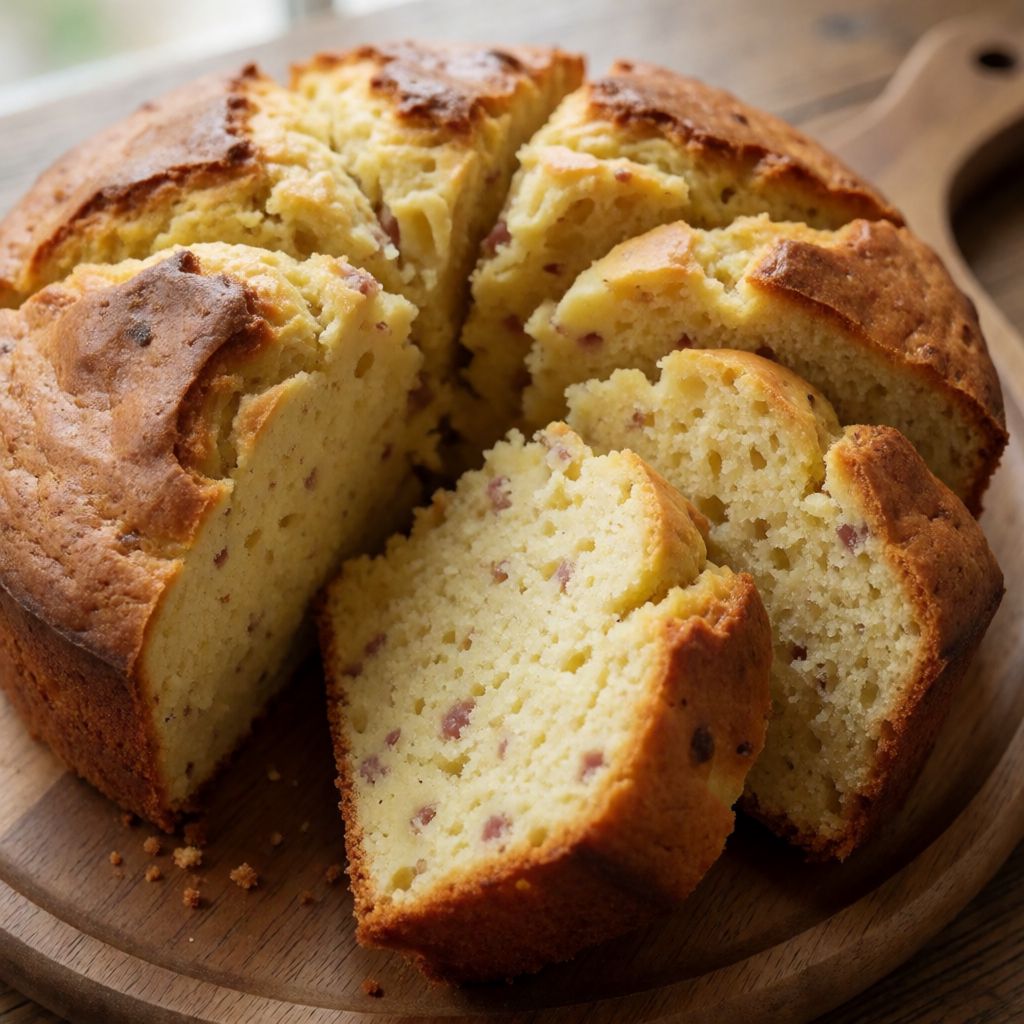
 AI photo
Savoury Ricotta and Bacon Cake
A savoury cake packed with ricotta, Parmesan, bacon and melted cheddar, baked until golden.
Labels are worked out automatically from the ingredients and can be wrong. Check the packaging if it matters to you.
Ingredients
- 180 g Ricotta
- 100 g Olive oil
- 250 g Plain flour
- 120 g Milk
- 3 pcs Eggs
- 15 g Baking powder
- 80 g Parmesan
- 100 g Smoked bacon
- 60 g Cheddar diced
- Salt to taste
- Black pepper to taste









Steps
By hand, whisk the fresh ricotta with the olive oil, then after a few minutes add the milk and mix.
Gradually add the sifted flour, stir in the baking powder and mix.
Separate the egg yolks from the whites. Beat the yolks with an electric mixer and fold them into the batter.
Add the Parmesan, diced bacon and diced cheddar. Season with salt and pepper to taste, then mix.
Separately beat the egg whites to stiff peaks and gently fold them into the batter.
Pour the batter into a 22 cm tin lined with baking paper, and bake in an oven preheated to 180°C for about 40 minutes.
40 min
What was changed
Smoked scamorza was swapped for Cheddar, which is easier to find in UK shops.
This is not a sweet cake wearing a savoury disguise — it is an Italian torta salata, built the way bread-adjacent things get built when there's cheese to use up and a lunchbox to fill. No butter, no sugar, no creaming. Instead you build an emulsion of ricotta and olive oil, loosen it with milk, then bulk it with flour and bacon and two cheeses that behave differently under heat. What rises it isn't magic, it's engineering: baking powder does some of the lifting, but the real structure comes from egg whites whipped stiff and folded in at the end, trapping air the way a soufflé does. Lose that air and you get a dense, greasy brick with good flavour and no lightness — which is still edible, just not what you meant to make.
What decides whether it works: how little you fight the gluten, and how gently you fold the whites in last. Flour meeting a wet, oily base wants to form gluten strands as soon as you stir — stir hard and long, chasing a smooth batter, and you get a batter that bakes up chewy and close, like a dense scone rather than a cake. Add it gradually, stop once it's just combined, and leave the smoothing to the whisking you already did at the start with the ricotta and oil. Then, right before the tin, fold the egg whites in with a light hand — cut and turn, don't stir — because every knock you give that foam is air you paid for with a mixer and won't get back.
Ricotta is doing two jobs: moisture, and a mild protein backbone instead of butter. Buy it fresh, and if it looks wet and loose in the tub, tip it into a sieve for ten minutes first — a runny ricotta thins your batter and you'll end up adding more flour to compensate, which only tightens the crumb you were trying to keep soft. No ricotta in the fridge — well-drained cottage cheese, blitzed smooth, or a British curd cheese, does the same structural work.
Olive oil here is not the usual "any flavourless oil will do" situation — this time the oil is one of only three fats in the whole cake (the others being the fat in the cheese and the fat in the bacon), and it's meant to taste of something. Use a fruity, assertive olive oil, not your most delicate bottle saved for dressing salad leaves. A neutral oil would make this taste like a very cheesy loaf of plain bread, which is not the point.
Flour's only job is to hold the crumb together around genuinely heavy things — diced bacon, diced cheddar, grated Parmesan. Sift it so it goes in without lumps, and fold it in rather than beat it, for the gluten reason above. Milk just adjusts the pour — ordinary milk from the same fridge that does your tea works fine, nothing special required.
Eggs are split for a reason, not tradition for its own sake: yolks go in early, into the oily ricotta base, where their fat helps hold the emulsion together and adds colour. Whites are whipped separately to stiff peaks and folded in last, because that's your real leavening alongside the baking powder — and you need both. Fifteen grams of baking powder sounds like a lot on its own, but it's fighting the sheer weight of cheese and bacon suspended in this batter; without the whipped whites alongside it, the middle of the cake would stay gummy no matter how long you baked it, because gas alone can't carry that much dead weight upward — it needs the foam to climb through.
Parmesan brings salt and a dry, aged sharpness that doesn't fully melt — it's there for backbone, not gooeyness. Any hard aged cheese with that same dry bite does the job: Grana Padano, a very mature Cheddar, pecorino if you want it sharper. Cheddar, diced rather than grated, is the opposite job — pockets of actual melted cheese scattered through the crumb, which is also why Britain is a good place to make this, since cheddar is already sitting in most fridges. Dice it properly; grated cheddar disappears into the batter instead of staying as a pocket you bite into.
Line the tin with baking paper, don't skip it — melting cheese against bare metal catches and welds itself to the sides, and you'll lose half the crust prising it out. A 22 cm springform, if you have one, makes the whole business easier; if not, paper up the sides of whatever round tin you've got. Go easy with the salt at the seasoning stage — bacon and Parmesan are both already salty, and you're not trying to cure the thing, just finish it. Judge the bake by a skewer coming out clean and a top gone a deep, settled gold, not by the clock alone — forty minutes is where to start checking, not where to stop checking. And once it's out, give it time before you cut it: the cheese fat and bacon fat are still liquid straight from the oven, and a warm slice will ooze and crumble where a rested one holds its shape. Patience here isn't politeness, it's the difference between a slice and a mess on the plate.