
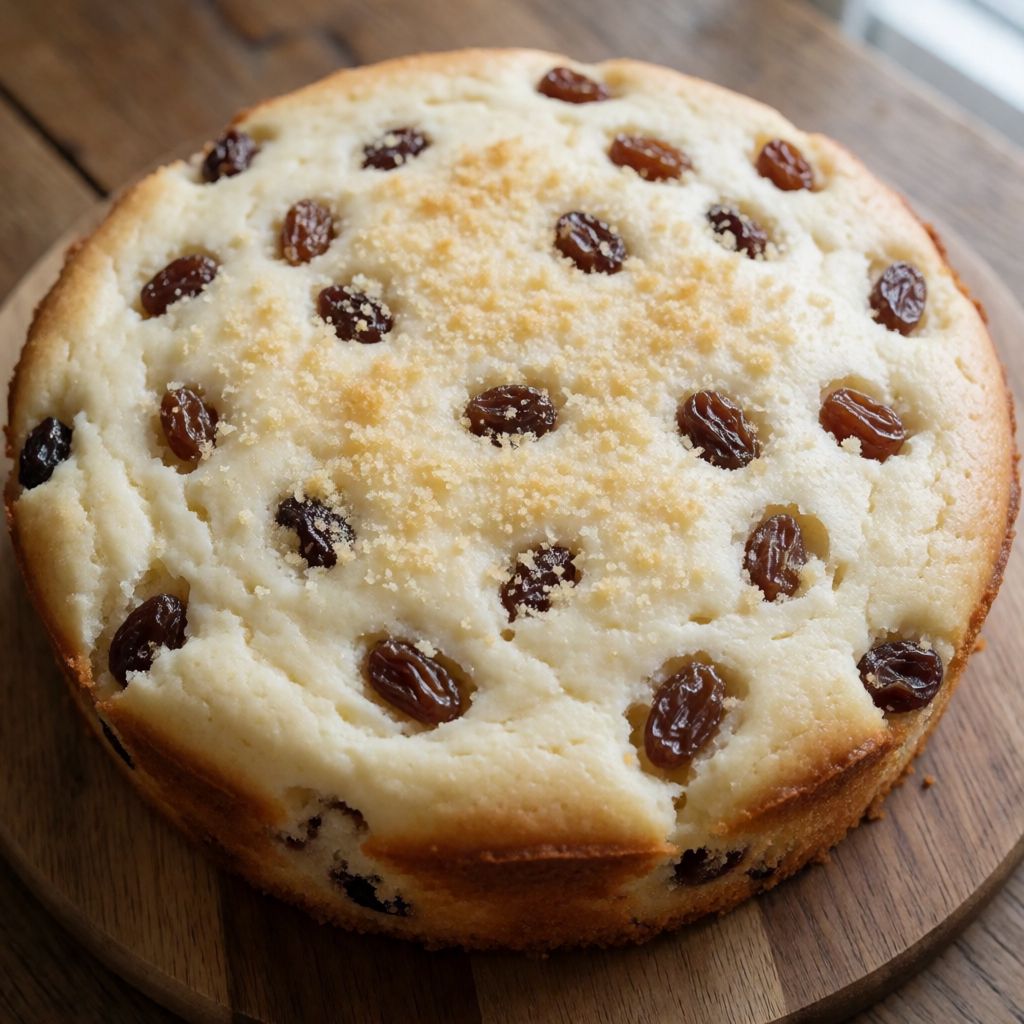
 AI photo
Ricotta and Raisin Cake
A soft ricotta cake studded with raisins, lightly scented with lemon zest.
Labels are worked out automatically from the ingredients and can be wrong. Check the packaging if it matters to you.
Ingredients
- 400 g Ricotta
- 230 g Caster sugar
- 100 g Raisins
- 200 g Plain flour
- 3 pcs Eggs
- 16 g Baking powder
- pinch Salt a pinch
- 1 pcs Lemon zest
- pcs Icing sugar to taste
- pcs Butter for greasing










Steps
Soak the raisins in water for about 10 minutes.
10 minIn a large bowl, beat the eggs with the sugar using a whisk or mixer until light and fluffy.
Add the lemon zest and ricotta, and beat with the mixer until smooth.
Sift in the flour to remove any lumps.
Add the baking powder and a pinch of salt.
Squeeze out the raisins and gently fold them into the batter with a spatula.
Grease and flour a 22-24 cm ring tin, then pour in the batter.
Bake in an oven preheated to 180°C for about 45 minutes.
45 minRemove the cake, let it cool, and dust with icing sugar if desired.
This is a ricotta cake pretending to be humble, but the ricotta is doing serious work: it's not a flavour, it's a structure. Ordinary sponge gets its lift from whipped air and gluten. Here you've got a heavy, moist curd cheese sitting in the batter, and the only thing stopping it collapsing into a dense, eggy brick is the baking powder and the way you handle the eggs. So the real decision point isn't the oven — it's how long you beat those eggs and sugar at the start.
Some say ricotta cakes are naturally "wet" and that's just their nature, no fixing it. No — a cake is wet because the ricotta's own moisture wasn't given anywhere to go. Beating eggs and sugar until "light and fluffy" isn't decoration, it's building a scaffold of trapped air that will carry the weight of 400g of soft cheese through baking. Skip that and the structure sinks under its own water content, and you get a pudding, not a cake.
The raisins get soaked and squeezed for the same reason you'd blot a wet cloth before ironing: dry raisins steal moisture from the batter as they bake, leaving dry pockets around each one; raisins straight from a packet, un-soaked, do exactly that. Soaking plumps them so they stop pulling water from the crumb, and squeezing afterwards stops them adding it back and turning the base gummy.
Ricotta itself: buy it fresh, drained, not the ultra-wet supermarket tub sitting in liquid whey — if that's all you've got, tip it into a sieve lined with a paper towel for twenty minutes first, or your batter inherits water you never accounted for. No ricotta in the house? Cottage cheese blitzed smooth, or well-drained quark, will do the same structural job — soft curd, low fat, no strong flavour of its own to fight the lemon.
The eggs and sugar are the engine, not seasoning. 230g caster sugar isn't there purely for sweetness; the fine crystals dissolve into the egg as you whisk, and that dissolving-and-trapping-air process is what gives you the "light and fluffy" stage the method asks for. Granulated sugar works but takes longer to dissolve, so beat a bit longer if that's what's in your cupboard — don't rush it just because the clock on this recipe says 45 minutes for baking, not for beating.
Flour here (200g) is sifted "to remove lumps" — that's not fussiness, it's because flour clumps trap pockets of raw starch that never properly hydrate in a batter this wet and heavy, and you'd bite into a small chalky patch later. Any plain flour with decent gluten works; self-raising would let you drop some of the baking powder, but then you're guessing at ratios someone else already decided for you, so stick to plain and measure your own 16g baking powder — that amount is calibrated to lift a cheese-heavy batter, not a classic sponge.
Lemon zest: use the zest only, not juice — the acid in juice would slacken the ricotta's structure right when you need it firm. Zest just perfumes. No lemon? Orange zest does the same job with a different mood, or a few drops of vanilla if citrus isn't your thing, though you lose that slight lift lemon gives against the richness of the cheese.
On the tin and oven: a 22-24cm ring tin is specified because a solid round tin that size, with a batter this dense, would cook unevenly — the ring's open centre lets heat reach the middle faster, which matters because this is a batter already slow to set. A domestic oven running a touch hot or cold is normal; an oven thermometer is worth more than trusting the dial, and that's true whether you're baking this or your Sunday roast potatoes. Grease and flour the tin properly, because a wet, heavy batter like this is exactly the kind that tears on release if the tin's surface isn't properly broken up first — butter alone can leave patches where ricotta batter sticks stubbornly.
Patience matters twice here: once while the eggs whip to the right volume, and once while the cake cools before you touch it. A ricotta cake cut warm will look sunken and gluey in the middle even when it's perfectly cooked, because the curd needs the cooling time to finish firming up — that's not a baking failure, that's physics catching up with your knife.