
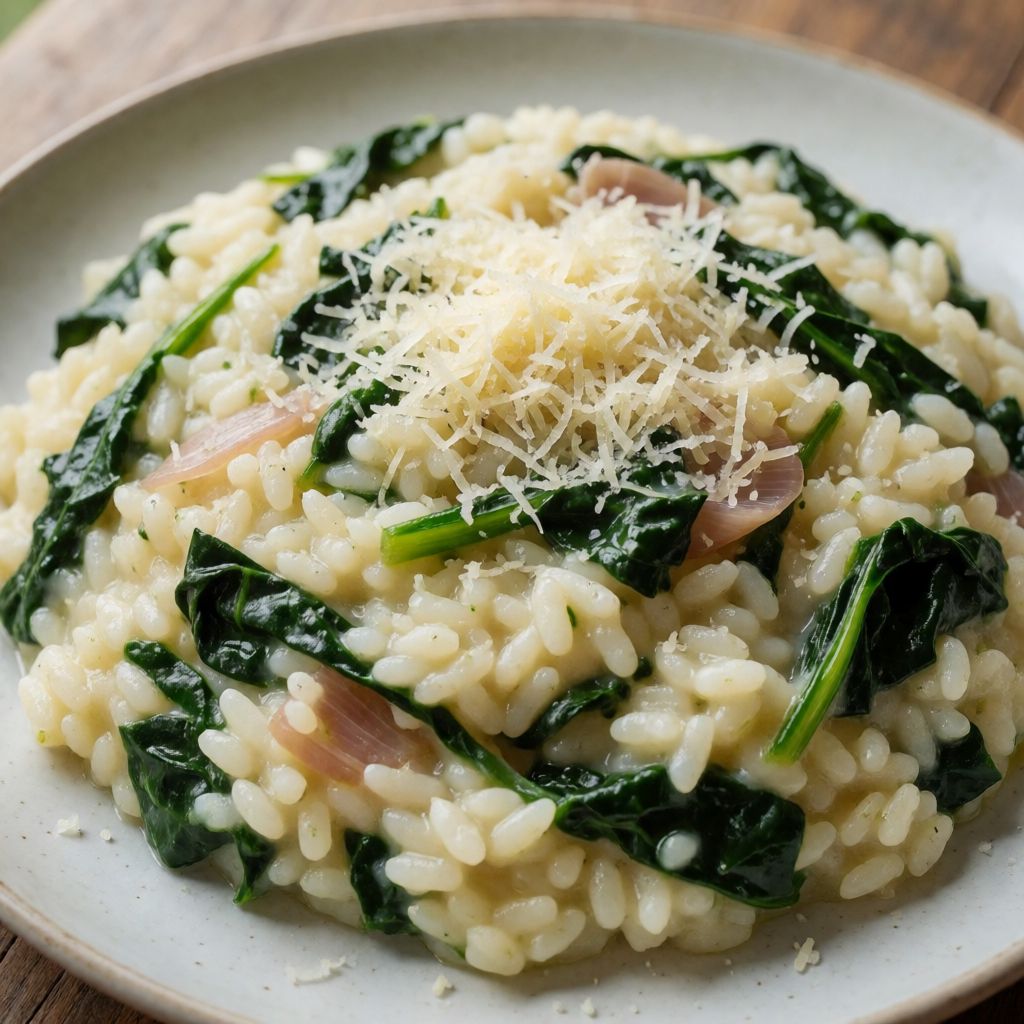
 AI photo
Risotto with Swiss Chard
A creamy risotto made with Swiss chard, Carnaroli rice and a generous finish of Parmesan and butter.
Labels are worked out automatically from the ingredients and can be wrong. Check the packaging if it matters to you.
Ingredients
- 320 g Carnaroli rice
- 400 g Swiss chard
- 150 g Parmesan
- 40 g Butter
- 1 pcs Shallot
- 3 tbsp Olive oil
- Salt to taste
- Black pepper to taste
- 2 l Water
- 1 pcs Onion
- 1 pcs Leek
- 1 pcs Carrot
- 1 pcs Celery stick
- 1 pcs Courgette
- 1 bunch Parsley
- 1 pinch Nutmeg













Steps
Wash the Swiss chard thoroughly, trimming the tougher ends and any soil. Cut it into pieces and boil in salted water with a pinch of salt.
Drain the water and set the chard aside.
Finely chop the shallot and sauté it in a pan with the olive oil, stirring often.
Add the Carnaroli rice and toast it over high heat for a few minutes until lightly browned.
Add a ladle of hot vegetable stock, stir, and add the previously boiled chard.
Continue cooking the risotto: add one ladle of hot stock at a time, stirring occasionally and waiting for the rice to absorb the liquid.
20 minIf needed, continue cooking for another 5 minutes, tasting the risotto before taking it off the heat.
Before serving, stir the Parmesan and butter into the risotto.
Serve hot.
Risotto is not "rice cooked in stock" — it's a starch-extraction process. Carnaroli has a hard core and a loose surface layer of amylose and amylopectin. The toasting, the ladle-by-ladle liquid, the stirring: all of it exists to pull that starch into the water around the grain and build a sauce, not to cook rice through boiling. This one adds Swiss chard, which cooks tender in salted water first, then rides along in the pot soaking up stock-flavour without turning to mush.
What decides whether it works is the ladle discipline. Add stock one ladle at a time, let the rice drink it dry-ish before the next — not because of ritual, but because flooding the pan drops the temperature and the grain just simmers in a puddle instead of releasing starch at the rate that thickens the liquid into cream. Dump two litres in at once and you get wet rice soup, edible, nothing like risotto.
Some say you must stir constantly, like a sentence from a cookbook you're not allowed to question. No — constant stirring bruises the grain and can turn the whole pot gluey. Stir occasionally, enough to stop sticking and to keep starch moving into the liquid, not so much you beat the rice apart.
Carnaroli is chosen because it's high in amylose and holds its shape while still bleeding starch — Arborio works too but turns softer faster and forgives less; any round, short-grain Italian risotto rice will do, but don't reach for basmati or long-grain, they were bred for separate dry grains, the opposite of what you want here.
The chard needs its own pre-boil because raw, it would need far longer in the pot than the rice does, and by the time the rice is al dente the chard would be stringy rag. Boiling it first in salted water, draining, then folding it into the rice partway through lets both finish at the point you actually want: rice with bite, chard soft but not collapsed. This is also your "bend not snap" test for the chard stems before you drain them — no clock needed, feel the stalk give.
The shallot goes in gently, in oil, before the rice — sweated, not coloured, because a browned shallot turns bitter and that bitterness has nowhere to hide once it's folded through 320g of rice. Watch it turn translucent and slightly golden at the edge, that's the cue, not a stopwatch. Any mild allium works if you have no shallot — a quarter of a regular onion, finely chopped, does the job; it'll be a touch sharper, not wrong.
The stock — onion, leek, carrot, celery, courgette, parsley simmered in the two litres — is there because water alone gives you starchy, flavourless glue. Vegetable stock doesn't need to be reduced or fussed over; it needs to be hot when it hits the rice, because cold stock shocks the pan back down in temperature and stalls the starch release you spent the toasting stage setting up. Keep it at a bare simmer on the next ring over while you work the risotto.
Parmesan gives salt, fat, and its own glutamate-driven savouriness; buy a wedge, not the ready-grated tub, because pre-grated cheese is often cut with anti-caking starch that won't melt the same way and leaves a grainy finish. If Parmesan isn't to hand, a hard, aged, well-salted cheese — Grana Padano, or a mature Cheddar in a pinch, since you're in the UK and it's in every fridge — will carry the fat-and-salt job, if not quite the same nutty note.
Butter at the end is for gloss and roundness, not for cooking anything — it melts into an already-made starch sauce rather than frying. Use unsalted if you can, since you've already salted the stock and the chard water, and double salting is the easiest way to ruin the dish at the finish line when there's no fixing it.
On a domestic hob, forget the kazan-style wide pan you'd use for a pilaf — you want a wide, heavy-based pan here too, but for the opposite reason: more surface area means more contact with heat, faster, more even evaporation, and a shorter window where the rice sits in a shallow layer of stock instead of drowning. A narrow deep pot just builds a tall column of liquid that takes forever to concentrate, and by the time it does, your rice is overcooked. The 20 minutes the recipe gives is the floor, not the target — taste a grain, it should have the faintest resistance in the centre, then stop.